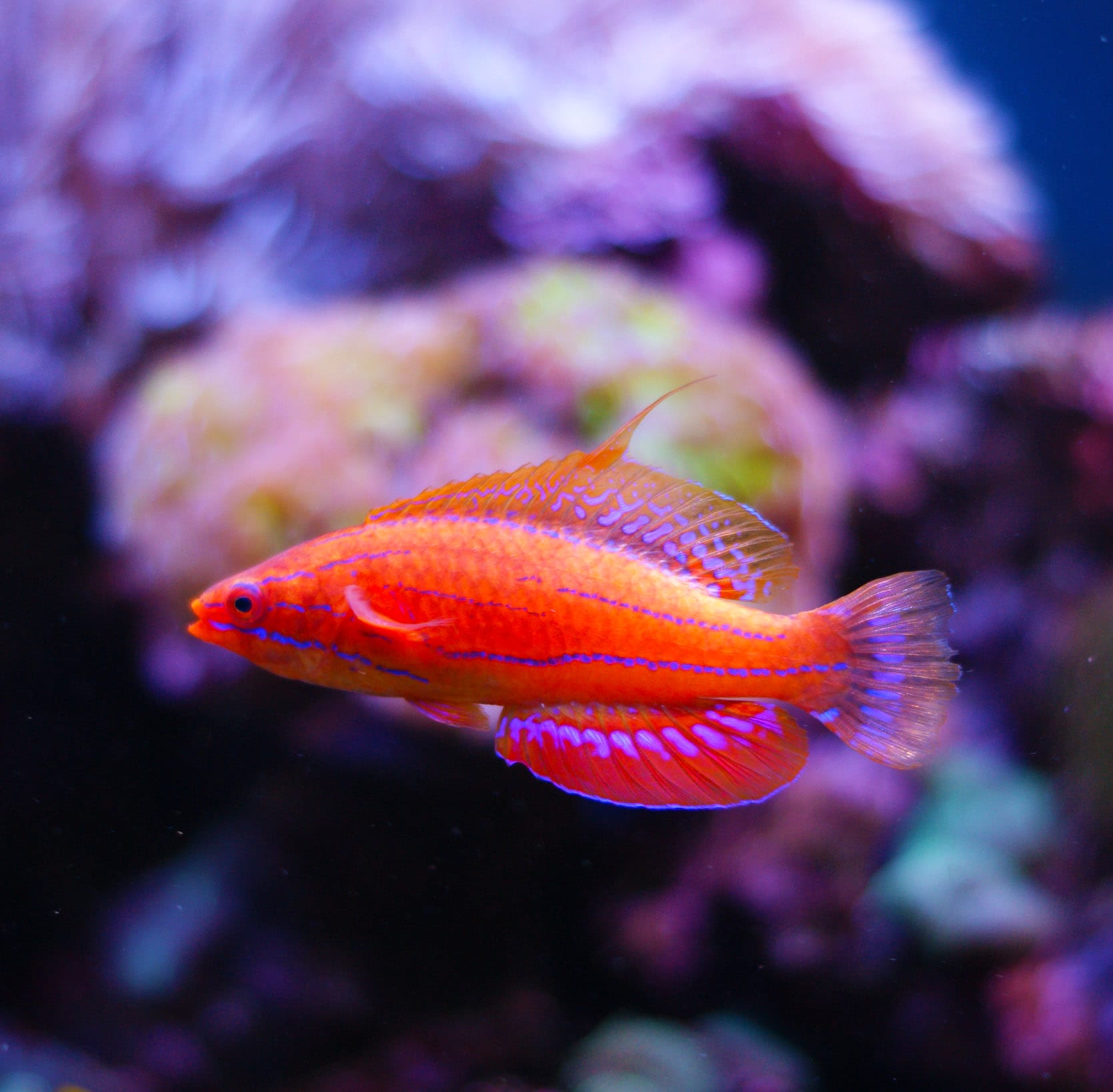
Source: Wikimedia Commons
Redfin flasher wrasse
BeginnerParacheilinus carpenteri
A small wrasse of outer reef slopes in the western Pacific. Red males with blue lines court females by 'flashing' — darting while spreading their large fins. A reef-safe choice for coral tanks.
Difficulty
Beginner
Temperature
23〜26℃
Lifespan
Few reliable data
Size
Up to 8 cm TL (FishBase)
Diet
Carnivore (zooplankton, frozen mysis and brine shrimp)
About
Paracheilinus carpenteri, Carpenter's or the redfin flasher wrasse, occurs in the western Pacific from the Philippines north to Taiwan and Iriomote Island and south to northern Bali and Flores, and has recently been recorded from Tonga (FishBase). In the Indian Ocean it is replaced by P. mccoskeri. It reaches 8 cm TL and forms schools over coral or rubble at the base of steep outer reef slopes, pairing during breeding. Males court females by 'flashing' — quick dashes through the water with fins flared and colours intensified — which makes it popular with aquarists. It is named after marine biologist Kent Carpenter, who collected the type specimens. It is regarded as one of the easier wrasses, adapting quickly to a carnivorous diet, and is considered reef-safe as it does not harass invertebrates or nip coral polyps. It is sold in Japanese marine shops and also occurs in the Ryukyu Islands.
Source: Wikipedia (CC BY-SA 4.0)
Size of the Redfin flasher wrasse
The Redfin flasher wrasse grows to Up to 8 cm TL (FishBase).
Basic Info
Origin
Western Pacific (Philippines to Taiwan and Iriomote; northern Bali and Flores)
Lifespan
Few reliable data
Size
Up to 8 cm TL (FishBase)
Temperature
23〜26℃
Diet
Carnivore (zooplankton, frozen mysis and brine shrimp)
Care Guide
Water Temperature & Quality
Few species-specific temperature data. Keep stable reef-aquarium conditions.
Aquarium
It swims in open water, so leave space and provide rockwork to retreat into; use a lid, as it can jump.
Tank Mates & Compatibility
Peaceful with similarly sized peaceful fish. One male with several females encourages flashing displays.
Reef Compatibility
Does not harass invertebrates or nip coral polyps, so it is considered reef-safe.
Diet & Feeding
Adapts well to meaty foods; give frozen mysis, brine shrimp and fine prepared foods several times a day.
Health & Cautions
It also occurs in the Ryukyu Islands; collecting in Japanese waters must follow prefectural fisheries regulations.
Marine FishWrasseFlasher WrasseReef SafeJapanese Waters
Redfin flasher wrasse FAQ
QHow difficult is it to keep Redfin flasher wrasse?
A
Beginner. This is a beginner-friendly species. No special equipment or experience is required, and it can be kept successfully with basic care setup.
QHow large does Redfin flasher wrasse get?
A
Redfin flasher wrasse typically reaches Up to 8 cm TL (FishBase) as an adult. Size may vary depending on care conditions and individual genetics.
QWhat should I feed Redfin flasher wrasse?
A
Redfin flasher wrasse feeds on: Carnivore (zooplankton, frozen mysis and brine shrimp). Aim for a balanced diet with appropriate feeding frequency.
QWhat is the typical price for Redfin flasher wrasse?
A
The price of Redfin flasher wrasse varies significantly depending on morph, size, and lineage. Check our market price page for the latest pricing information.
Last updated: September 23, 2026
References & Sources
Edited & verified by: BreederDirect editorial team
The taxonomic, regulatory, and husbandry data on this page are compiled and verified against the authoritative primary sources below.
Primary sources
Taxonomy & Authority
Regulations & Conservation Status
Not CITES-listedIUCN DD · Data Deficient
Not listed in the CITES Appendices (checked on Species+). Not a designated invasive alien species in Japan. Listed as Data Deficient (DD) on the IUCN Red List. It also occurs in southern Japan and the Ryukyu Islands; collecting in Japan must follow each prefecture's fisheries adjustment regulations. Never release aquarium fish into the sea.
Sources: Species+ (CITES) / FishBase
Regulations may change. Always verify the latest information with the relevant authorities.
Related Species
Redfin flasher wrasse Listings
Loading latest listingsFind listings for this species
Related Articles
Sex Change and Harem Society in Wrasse | Practical Guide to Behavior Management and Male-Female Breeding in Aquariums
Wrasse fish are famous for "protogyny (female-first maturity)," a type of sex change from female to male. This practical guide covers the mechanics of harem society in aquariums, triggers for sex change, managing dominance relationships among multiple individuals, and the characteristics of representative species such as Thick-lipped Wrasse and Coris, enabling you to deeply understand and keep wrasse.
Wrasse Care Guide | How to Choose Popular Species and Deal with Burrowing Behavior
Learn how to care for wrasses (Labridae), popular in saltwater aquariums. This guide compares popular species like Fairy Wrasses and Flasher Wrasses, and introduces strategies for managing burrowing behavior.
Fairy Wrasse (Cirrhilabrus spp.) Care Guide | Colorful Saltwater Fish Husbandry and Tankmate Compatibility
A guide to Fairy Wrasse (Cirrhilabrus spp.) species, characteristics, and care methods. Detailed coverage of male display behavior, feeding, tankmate compatibility, breeding, and harem management.
A Guide to Keeping Marine Wrasses | Characteristics and Care Tips for Popular Species
Learn about the characteristics and care methods for popular wrasses such as Ornate Wrasse, Six-Line Wrasse, and Harlequin Tuskfish. Detailed introduction to sand-dwelling habits, feeding methods, and tank compatibility precautions.
🩺 Common diseases
Coral BleachingRapid Tissue NecrosisBrown Jelly DiseaseFlatworm InfestationRed Slime (Cyanobacteria)Tissue Recession (Polyp Recession)Nudibranch PredationAlkalinity Burn (KH Burn)Marine Ich / CryptocaryoniasisMarine Velvet / AmyloodiniosisBrooklynelliasis / Clownfish DiseaseHead and Lateral Line Erosion (HLLE)