Source: Wikimedia Commons
Queen angelfish
IntermediateHolacanthus ciliaris
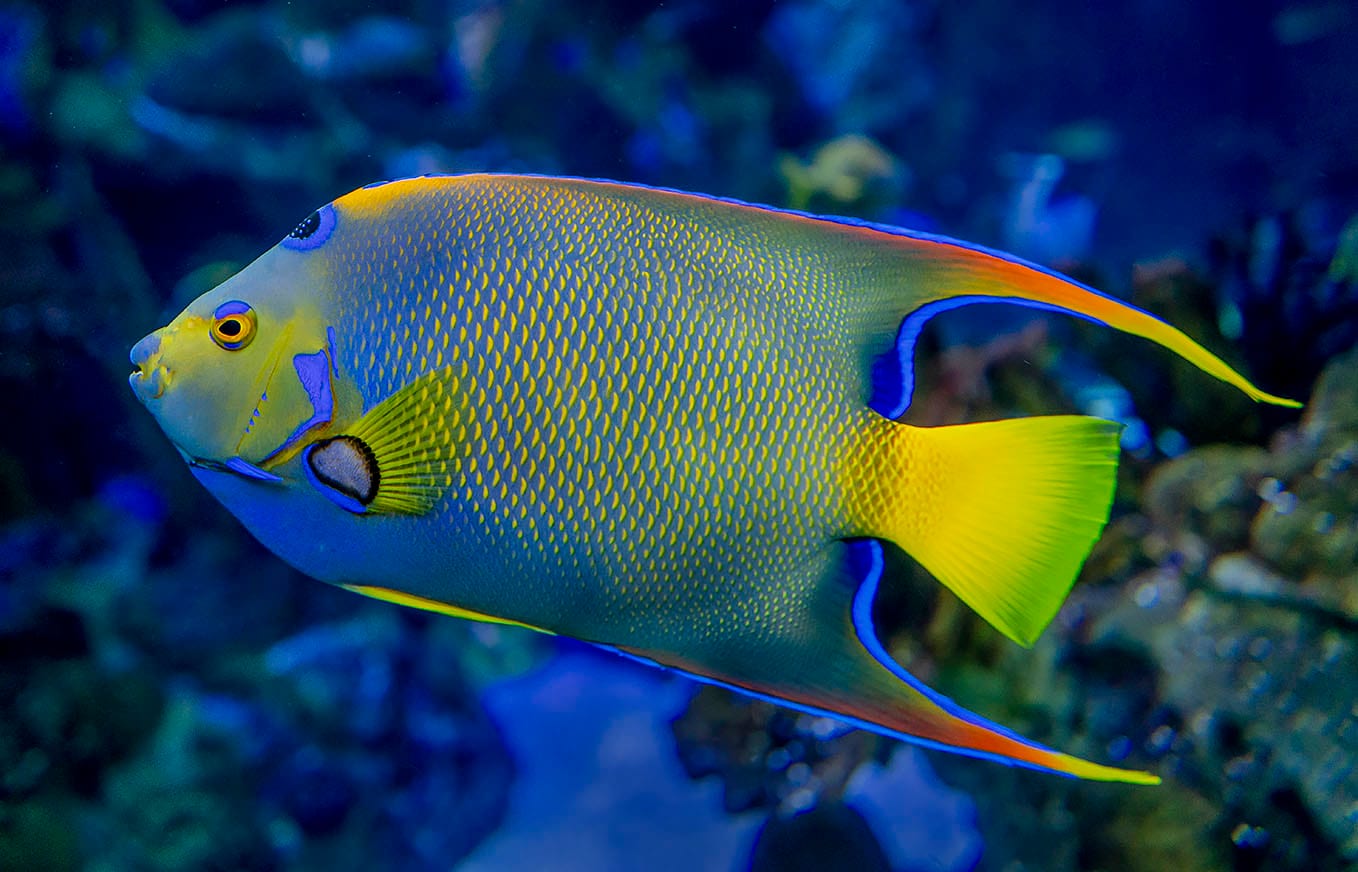
A large Caribbean angelfish in blue and yellow with a black, blue-ringed "crown" on the forehead. Its entirely yellow tail and pectoral fins distinguish it from the similar blue angelfish.
Difficulty
Intermediate
Temperature
21〜27℃
Lifespan
Little data available
Size
Up to 45 cm TL (FishBase)
Diet
Omnivore (mainly sponges)
About
The queen angelfish (Holacanthus ciliaris) is a large angelfish of the western Atlantic, from Florida and the Gulf of Mexico to Brazil (FishBase), reaching 45 cm TL and 1.6 kg. Adults are purplish blue to yellow with yellow-orange scale edges, and carry a black forehead spot ringed in electric blue - the "crown". The tail and pectoral fins are entirely yellow. It closely resembles, and hybridises with, the blue angelfish (H. bermudensis), whose tail is only edged in yellow and which lacks the crown. It lives alone or in pairs on coral reefs and, judging from stomach contents, eats almost only sponges; juveniles pick parasites off other fish. Plan for about 680 L (180 gallons) or more for an adult and feed sponge-containing angelfish foods and frozen foods several times a day. Adults nip corals and clams, so it is not reef-safe. In Japan it is a representative Caribbean large angelfish handled by specialist shops.
Source: Wikipedia (CC BY-SA 4.0)
Size of the Queen angelfish
The Queen angelfish grows to Up to 45 cm TL (FishBase).
Temperature & humidity for the Queen angelfish
The ideal temperature for the Queen angelfish is 21〜27℃.
Basic Info
Origin
Western Atlantic (Florida and the Gulf of Mexico to Brazil)
Lifespan
Little data available
Size
Up to 45 cm TL (FishBase)
Care Specifications
- Water Temp.
- 21–27℃
- Specific Gravity
- 1.02
- Min. Tank
- 680 L
Semi-aggressiveNot reef safe
Sources: FishBase (Holacanthus ciliaris) / Saltcorner Fish Library (Bob Goemans)
References & Sources
Edited & verified by: BreederDirect editorial team
The taxonomic, regulatory, and husbandry data on this page are compiled and verified against the authoritative primary sources below.
Taxonomy & Authority
Accepted name: Holacanthus ciliaris (Linnaeus, 1758)
Synonyms: Angelichthys ciliaris (Linnaeus, 1758), Angelichthys iodocus (Jordan & Rutter, 1897), Chaetodon ciliaris Linnaeus, 1758, Chaetodon parrae Bloch & Schneider, 1801, Chaetodon squamulosus Shaw, 1796, Holacanthus cornutus Desmarest, 1823, Holacanthus coronatus Desmarest, 1823, Holacanthus formosus Castelnau, 1855
Authority databases: WoRMS · GBIF · GBIF · WoRMS · FishBase
Nomenclature follows global taxonomic authority databases.
Regulations & Conservation Status
Not CITES-listedIUCN LC · Least Concern
Not listed in the CITES Appendices (checked on Species+). Not designated as an Invasive Alien Species under Japanese law. Never release aquarium animals into the sea.
Sources: Species+ (CITES) / Ministry of the Environment: List of Designated Invasive Alien Species / FishBase
Regulations may change. Always verify the latest information with the relevant authorities.
Queen angelfish Listings
Loading latest listingsFind listings for this species