Source: Wikimedia Commons
Bluering angelfish
IntermediatePomacanthus annularis
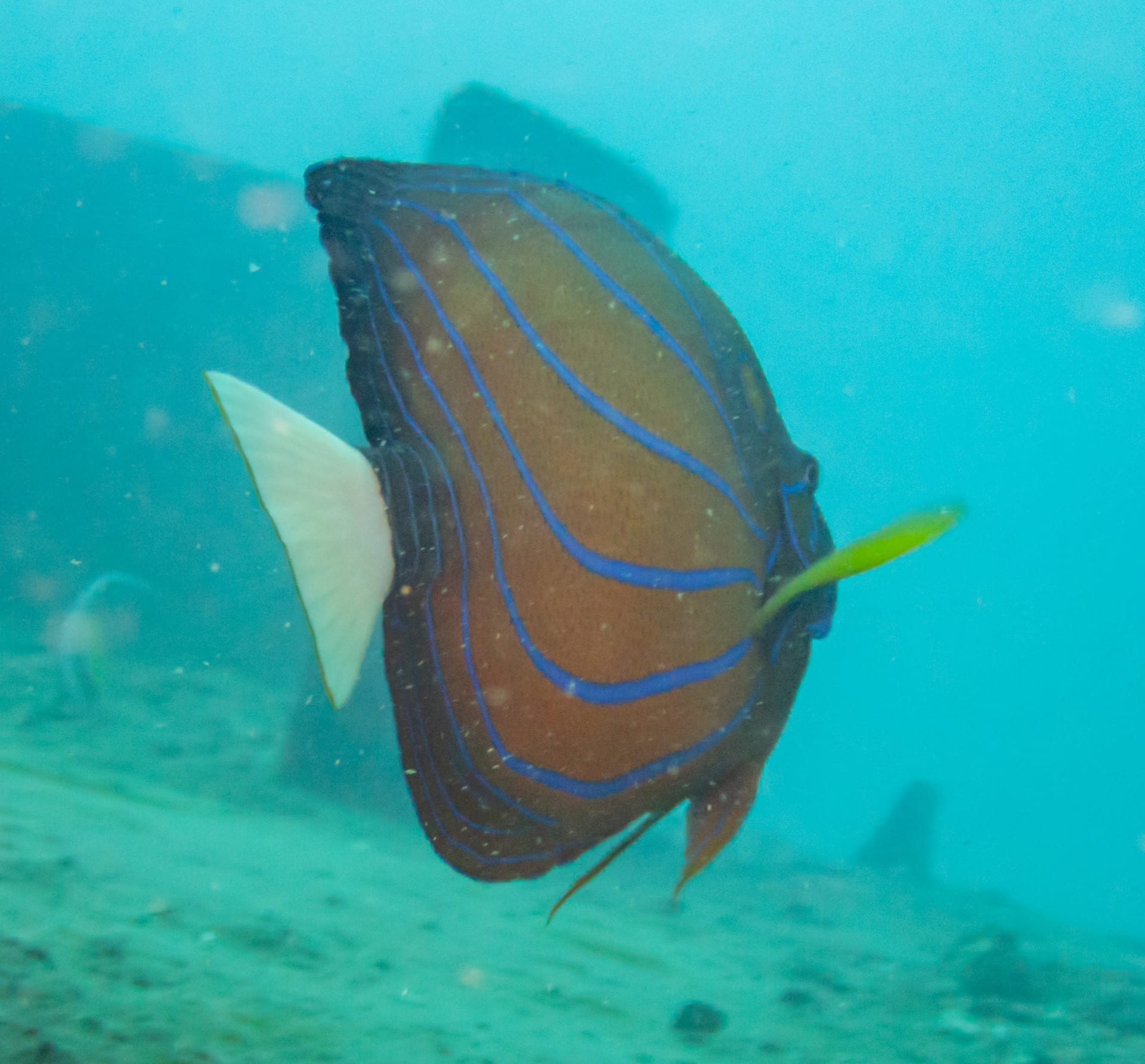
A large angelfish with curved blue lines over a brown body, a blue ring on the shoulder and a white tail. Juveniles are blue-black with white and pale-blue bars and completely change colour as they grow.
Difficulty
Intermediate
Temperature
22〜27℃
Lifespan
Little data available
Size
Up to 45 cm TL (FishBase)
Diet
Omnivore (sponges, tunicates, algae)
About
The bluering angelfish (Pomacanthus annularis) is a large marine angelfish of the Indo-West Pacific, from East Africa through Indonesia and New Guinea to New Caledonia and north to southern Japan (FishBase). It reaches 45 cm TL. Adults are brown with curved blue lines and the blue shoulder ring that gives the species its name; juveniles have a completely different pattern of white and pale-blue bars on blue-black and change colour entirely as they grow. It lives on coastal rocky and coral reefs, adults often in pairs inside caves, feeding on sponges and tunicates. Plan for its adult size: about 680 L (180 gallons) or more is the guideline. Feed angelfish foods containing sponge, frozen foods and algae-based foods several times a day. Adults nip stony and soft corals and clams, so it is not suited to reef tanks. It is a staple large angelfish in Japan, sold at sizes from juvenile to adult.
Source: Wikipedia (CC BY-SA 4.0)
Size of the Bluering angelfish
The Bluering angelfish grows to Up to 45 cm TL (FishBase).
Temperature & humidity for the Bluering angelfish
The ideal temperature for the Bluering angelfish is 22〜27℃.
Basic Info
Origin
Indo-West Pacific (East Africa to New Caledonia, north to southern Japan)
Lifespan
Little data available
Size
Up to 45 cm TL (FishBase)
Temperature
22〜27℃
Diet
Omnivore (sponges, tunicates, algae)
Care Guide
Water Temperature & Quality
22-27°C, specific gravity from 1.020 (Saltcorner).
Container & Tank
Adults reach 45 cm, so about 680 L (180 gallons) or more is the guideline. Provide cave-like rockwork and live rock.
Tank Mates & Compatibility
Do not keep it with other Pomacanthus.
Reef Compatibility
Adults nip stony corals (LPS and SPS), soft corals, clams and tubeworms, so it is not reef-safe.
Diet & Feeding
Feeds on sponges and tunicates in the wild. Give sponge-containing angelfish foods, frozen brine shrimp and mysis, and algae-based foods such as spirulina and nori, several times a day.
Health & Cautions
Newly added fish hide, so feed several times a day to settle them. Juvenile and adult patterns differ completely, so choose with the colour change in mind.
AngelfishLarge angelfishPomacanthusColour change
Bluering angelfish FAQ
QHow difficult is it to keep Bluering angelfish?
A
Intermediate. This is an intermediate-level species. Some prior experience and knowledge of environmental management are recommended.
QWhat is the ideal temperature for Bluering angelfish?
A
The ideal temperature for Bluering angelfish is 22〜27℃. Avoid sudden temperature changes and maintain a stable environment.
QHow large does Bluering angelfish get?
A
Bluering angelfish typically reaches Up to 45 cm TL (FishBase) as an adult. Size may vary depending on care conditions and individual genetics.
QWhat should I feed Bluering angelfish?
A
Bluering angelfish feeds on: Omnivore (sponges, tunicates, algae). Aim for a balanced diet with appropriate feeding frequency.
QWhat is the typical price for Bluering angelfish?
A
The price of Bluering angelfish varies significantly depending on morph, size, and lineage. Check our market price page for the latest pricing information.
Last updated: September 23, 2026
Care Specifications
- Water Temp.
- 22–27℃
- Specific Gravity
- 1.02
- Min. Tank
- 680 L
Semi-aggressiveNot reef safe
Sources: FishBase (Pomacanthus annularis) / Saltcorner Fish Library (Bob Goemans)
References & Sources
Edited & verified by: BreederDirect editorial team
The taxonomic, regulatory, and husbandry data on this page are compiled and verified against the authoritative primary sources below.
Taxonomy & Authority
Regulations & Conservation Status
Not CITES-listedIUCN LC · Least Concern
Not listed in the CITES Appendices (checked on Species+). Not designated as an Invasive Alien Species under Japanese law. Never release aquarium animals into the sea.
Sources: Species+ (CITES) / Ministry of the Environment: List of Designated Invasive Alien Species / FishBase
Regulations may change. Always verify the latest information with the relevant authorities.
Related Species
Bluering angelfish Listings
Loading latest listingsFind listings for this species
Related Articles
Complete Guide to Enhancing Marine Fish Colors | Maximizing Color Expression Through Food, Lighting, and Water Quality
A comprehensive guide to maintaining and enhancing the beautiful colors of marine fish. Explains how to select carotenoid-based foods, set up blue-wavelength lighting, reduce nitrate levels, and species-specific color enhancement techniques for angelfish, anthias, wrasse, and mandarin fish.
Getting Started with Marine Fish Pair Breeding | Pre-breeding Preparation for Clownfish, Gobies, and Basslets
This article explains the fundamental knowledge for attempting marine fish breeding. It introduces methods for forming pairs in species that are relatively easy to breed, such as clownfish, gobies, and basslets, as well as how to set up spawning environments and prepare for fry rearing, all geared toward beginners.
Complete Guide to Marine Fish Larval Rearing | Larval Stage Management, Feeding, and Metamorphosis
Complete rearing manual for the "larval stage," the most challenging aspect of marine fish breeding. From hatchling to metamorphosis and settlement, this expert guide thoroughly explains water quality management, green water technique, feeding transitions, density management, and photoperiod settings.
Genicanthus (Swallowtail Angelfish) Care Guide | Reef-Safe Angelfish Characteristics, Tank Mates & Sex Reversal
Genicanthus (Swallowtail Angelfish) is a flagship reef-safe angelfish for reef tanks. This guide covers their planktivorous diet that prevents coral-picking, beautiful sexual dimorphism, observing female-to-male sex reversal, compatible tank mates, and quarantine protocols—all explained with practical insights.
🩺 Common diseases
Coral BleachingRapid Tissue NecrosisBrown Jelly DiseaseFlatworm InfestationRed Slime (Cyanobacteria)Tissue Recession (Polyp Recession)Nudibranch PredationAlkalinity Burn (KH Burn)Marine Ich / CryptocaryoniasisMarine Velvet / AmyloodiniosisBrooklynelliasis / Clownfish DiseaseHead and Lateral Line Erosion (HLLE)