Source: Wikimedia Commons
French angelfish
IntermediatePomacanthus paru
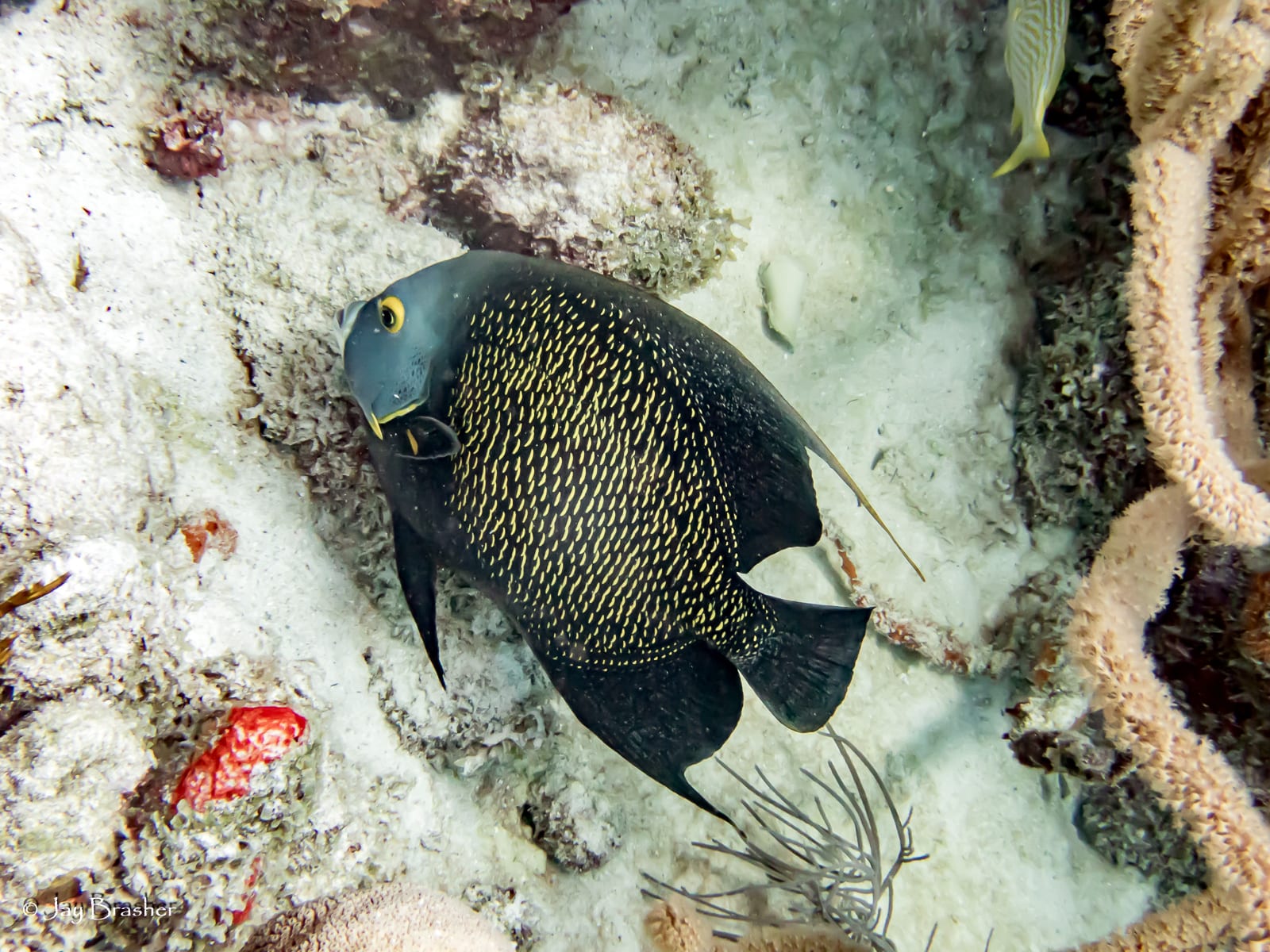
A large Caribbean angelfish whose black scales are each rimmed in gold. Juveniles are black with five yellow bars and act as cleaners; wild fish have been aged at 27 years.
Difficulty
Intermediate
Temperature
21〜27℃
Lifespan
Wild fish aged at 27 years
Size
Up to 41 cm TL
Diet
Omnivore (sponges, algae, gorgonians, etc.)
About
The French angelfish (Pomacanthus paru) ranges through the western Atlantic from Florida and the Bahamas through the Gulf of Mexico and Caribbean to Brazil, and around Ascension Island (FishBase), reaching 41 cm TL. Adults are black with gold-rimmed scales (except on the head), yellow around the eye and a trailing yellow dorsal filament. Juveniles are black with five yellow bars and are known as cleaners, picking parasites off jacks, snappers and other large fish. It lives in pairs on shallow reefs, often near sea fans, eating sponges, algae, bryozoans, zoanthids, gorgonians and tunicates. It is slow-growing and long-lived, with wild fish aged at 27 years. Allow about 680 L (180 gallons) or more and feed sponge-containing angelfish foods, frozen foods and algae several times a day. Adults nip corals and clams, so it is not reef-safe. It has been bred in captivity, and in Japan it is a staple large angelfish often sold as individual specimens.
Source: Wikipedia (CC BY-SA 4.0)
Lifespan of the French angelfish
The French angelfish lives Wild fish aged at 27 years.
Size of the French angelfish
The French angelfish grows to Up to 41 cm TL.
Temperature & humidity for the French angelfish
The ideal temperature for the French angelfish is 21〜27℃.
Basic Info
Origin
Western Atlantic (Florida and the Bahamas through the Caribbean to Brazil) and Ascension Island
Lifespan
Wild fish aged at 27 years
Size
Up to 41 cm TL
Temperature
21〜27℃
Diet
Omnivore (sponges, algae, gorgonians, etc.)
Care Guide
Water Temperature & Quality
21-27°C, specific gravity from 1.020 (Saltcorner).
Container & Tank
Slow-growing but over 40 cm as an adult. Plan for about 680 L (180 gallons) or more, as a fish-only tank with caves and live rock.
Tank Mates & Compatibility
It is considered one of the calmer Pomacanthus, but do not mix it with others of the genus.
Reef Compatibility
Adults nip stony and soft corals, clams and tubeworms, so it is not reef-safe.
Diet & Feeding
Feed sponge-containing angelfish foods, frozen brine shrimp and mysis, and algae-based foods such as nori and spirulina several times a day.
Health & Cautions
It is long-lived, so plan the tank for the long term. The pattern changes markedly from juvenile to adult.
AngelfishLarge angelfishCaribbeanLong-lived
French angelfish FAQ
QHow difficult is it to keep French angelfish?
A
Intermediate. This is an intermediate-level species. Some prior experience and knowledge of environmental management are recommended.
QWhat is the ideal temperature for French angelfish?
A
The ideal temperature for French angelfish is 21〜27℃. Avoid sudden temperature changes and maintain a stable environment.
QWhat is the lifespan of French angelfish?
A
The average lifespan of French angelfish is Wild fish aged at 27 years. With proper care and nutrition, they can live a long and healthy life.
QHow large does French angelfish get?
A
French angelfish typically reaches Up to 41 cm TL as an adult. Size may vary depending on care conditions and individual genetics.
QWhat should I feed French angelfish?
A
French angelfish feeds on: Omnivore (sponges, algae, gorgonians, etc.). Aim for a balanced diet with appropriate feeding frequency.
QWhat is the typical price for French angelfish?
A
The price of French angelfish varies significantly depending on morph, size, and lineage. Check our market price page for the latest pricing information.
Last updated: September 23, 2026
Care Specifications
- Water Temp.
- 21–27℃
- Specific Gravity
- 1.02
- Min. Tank
- 680 L
Semi-aggressiveNot reef safe
Sources: FishBase (Pomacanthus paru) / Saltcorner Fish Library (Bob Goemans)
References & Sources
Edited & verified by: BreederDirect editorial team
The taxonomic, regulatory, and husbandry data on this page are compiled and verified against the authoritative primary sources below.
Taxonomy & Authority
Regulations & Conservation Status
Not CITES-listedIUCN LC · Least Concern
Not listed in the CITES Appendices (checked on Species+). Not designated as an Invasive Alien Species under Japanese law. Never release aquarium animals into the sea.
Sources: Species+ (CITES) / Ministry of the Environment: List of Designated Invasive Alien Species / FishBase
Regulations may change. Always verify the latest information with the relevant authorities.
Related Species
French angelfish Listings
Loading latest listingsFind listings for this species
Related Articles
Genicanthus (Swallowtail Angelfish) Care Guide | Reef-Safe Angelfish Characteristics, Tank Mates & Sex Reversal
Genicanthus (Swallowtail Angelfish) is a flagship reef-safe angelfish for reef tanks. This guide covers their planktivorous diet that prevents coral-picking, beautiful sexual dimorphism, observing female-to-male sex reversal, compatible tank mates, and quarantine protocols—all explained with practical insights.
Care Guide for Koran Angelfish | Color Change from Juvenile to Adult, Tank Size, Feeding, and Tank Mates
Complete care guide for the Koran Angelfish (Pomacanthus semicirculatus). Covers the dramatic color transformation from juvenile striped patterns to the dignified coloration of adults, explains why tanks of 150 cm or larger are necessary, fish-only (FO) tank mate management, and prevention of white spot disease and lymphocystis.
Dwarf Angelfish (Centropyge) Compatibility Guide | Species Compatibility and Successful Combinations
Mixing guide for Centropyge (Dwarf Angelfish). Compare the temperament and reef-safety of popular species like Coral Beauty, Flame Angelfish, and Lemonpeel, and learn how to successfully set up mixed tanks.
Half-black Angelfish Care Guide | Complete Guide to Dwarf Angel Temperament, Water Parameters, and Reef Safety
A detailed guide to caring for Half-black Angelfish (Centropyge vrolikii). Covers water quality management, feeding, white spot disease prevention, and coral nipping risks in reef tanks for this striking dwarf angelfish with beautiful black and white contrast. Learn key points for long-term success.
🩺 Common diseases
Coral BleachingRapid Tissue NecrosisBrown Jelly DiseaseFlatworm InfestationRed Slime (Cyanobacteria)Tissue Recession (Polyp Recession)Nudibranch PredationAlkalinity Burn (KH Burn)Marine Ich / CryptocaryoniasisMarine Velvet / AmyloodiniosisBrooklynelliasis / Clownfish DiseaseHead and Lateral Line Erosion (HLLE)