Source: Wikimedia Commons
Asian Grass Lizard
IntermediateTakydromus sexlineatus
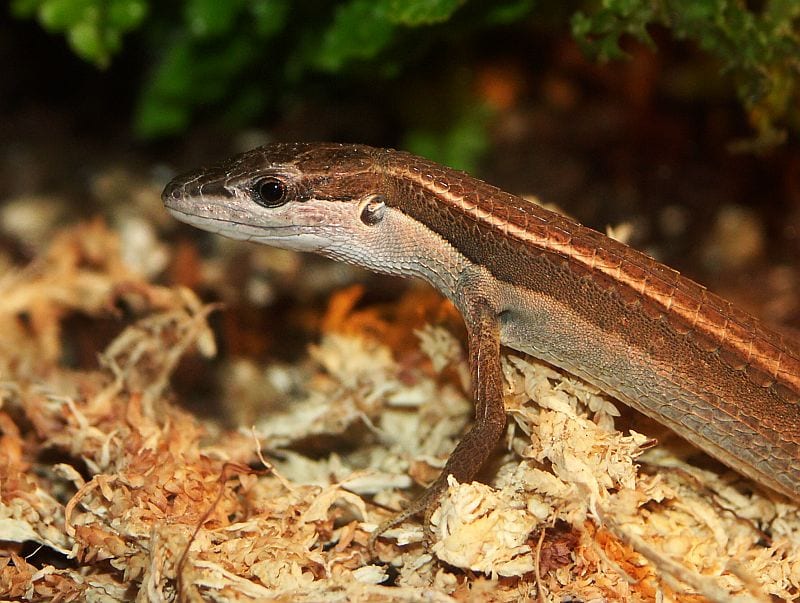
A slender lacertid with a tail more than three times its snout-vent length, said to have the longest tail relative to body length of any lizard. Longitudinal stripes in white, brown and black run along the body, with stronger contrast in males.
Difficulty
Intermediate
Temperature
25〜32℃
Lifespan
3-5 years
Size
Over 30cm total length (SVL about 8cm, tail more than three times the SVL)
Humidity
40〜70%
Diet
Carnivorous, mainly small insects
About
The Asian grass lizard (Takydromus sexlineatus) is a lacertid widely distributed from South to South-East Asia. The body is very slender and the head small with a sharply pointed snout. The colour pattern is of contrasting white, brown and black longitudinal stripes, brighter and more contrasting in males, and the epithet refers to the six lines along the back. The large feet and long tail distribute weight and provide stability, letting the lizard climb even thin grass stems without bending them, and it can prop itself on its tail, rear onto its hind legs and leap from that position. It is a fast, diurnal hunter, taking mainly small insects with a rapid forward lunge of the whole body and swallowing them whole. Intraspecific territoriality is weak in both sexes. In captivity females produce four to six clutches a year of two to three eggs, or two to five in the subspecies ocellatus.
Source: Wikipedia (CC BY-SA 4.0)
Lifespan of the Asian Grass Lizard
The Asian Grass Lizard lives 3-5 years.
Size of the Asian Grass Lizard
The Asian Grass Lizard grows to Over 30cm total length (SVL about 8cm, tail more than three times the SVL).
Its snout-vent length is about 8 cm, but the tail is more than three times that, giving a total length of over 30 cm; it is said to have the longest tail relative to body length of any lizard.
Basic Info
Origin
India (Sikkim, Assam, Mizoram), southern China (Yunnan east to Fujian, Guangdong, Guangxi, Hainan and Hong Kong), Myanmar, Thailand, Laos, Cambodia, Vietnam, the Malay Peninsula and Indonesia (Sumatra, Java, Borneo), in tall grassland and the herb layer of open forest
Care Specifications
PeacefulGroupBreeding: Moderate
Sources: Reptile Database: Takydromus sexlineatus / Wikipedia (German): Sechsstreifen-Langschwanzeidechse / Reptiles Magazine: Long-tailed And Emerald Grass Lizard Care Tips
References & Sources
Edited & verified by: BreederDirect editorial team
The taxonomic, regulatory, and husbandry data on this page are compiled and verified against the authoritative primary sources below.
Taxonomy & Authority
Accepted name: Takydromus sexlineatus Daudin, 1802
Synonyms: Takydromus quadrilineatus Daudin, 1802, Tachydromus ocellatus Guérin-Méneville, 1829, Tachydromus meridionalis Günther, 1864
Authority databases: GBIF · Reptile Database
Nomenclature follows global taxonomic authority databases.
Regulations & Conservation Status
Not CITES-listedIUCN LC · Least Concern
Not listed in any CITES appendix (not recorded in Species+). IUCN Red List assessment: Least Concern (LC). This species is not included in either the specified animals listed in the appended table of the Ordinance for Enforcement of the Animal Welfare and Management Law, nor the specified invasive alien species under the Ordinance for Enforcement of the Invasive Alien Species Act.
Sources: CITES Species+ (species not listed) / IUCN Red List
Regulations may change. Always verify the latest information with the relevant authorities.
Asian Grass Lizard Listings
Loading latest listingsFind listings for this species