Basilisk Lizard Care Guide | Water Running, Vertical Enclosures, and Differences Between Common and Green Species
Explaining the care methods for the water-running Basilisk Lizard (genus Basiliscus), also called the "Jesus Lizard." This guide covers the differences between Common Basilisk (tan-brown) and Green Basilisk, vertical enclosure setup, water area requirements, humidity management, cricket feeding, and handling precautions.
Key Takeaways
Explaining the care methods for the water-running Basilisk Lizard (genus Basiliscus), also called the "Jesus Lizard." This guide covers the differences between Common Basilisk (tan-brown) and Green Basilisk, vertical enclosure setup, water area requirements, humidity management, cricket feeding, and handling precautions.
Basilisk Lizards
The Basilisk Lizard (scientific name: genus Basiliscus) is a lizard of the Iguanidae family that inhabits the tropical rainforests of Central America and northern South America. It is world-famous by the nickname "Jesus Christ Lizard," and its greatest characteristic is its ability to run short distances across water by rapidly moving the webbed scales on its hind limbs.
Main Captive Species
| Species | Scientific Name | Characteristics |
|---|---|---|
| Common Basilisk | B. basiliscus | Overall tan-brown coloration. Males have large crest and dorsal fin |
| Green Basilisk | B. plumifrons | Vibrant emerald green. Males have three crests |
| Brown Basilisk | B. vittatus | Slightly smaller with fine patterns. Few captive examples |
Green Basilisk and Common Basilisk are the mainstream species in pet care.
Basic Data (Common and Green)
| Item | Details |
|---|---|
| Total Length (Adult) | Common: 60-80 cm, Green: 70-90 cm (tail is approximately 2/3 of total length) |
| Lifespan | 7-10 years (in captivity) |
| Activity Type | Semi-arboreal, waterside dwelling. Can run across water at speeds up to approximately 1 m/second |
Setting Up the Enclosure Environment
Enclosure Size
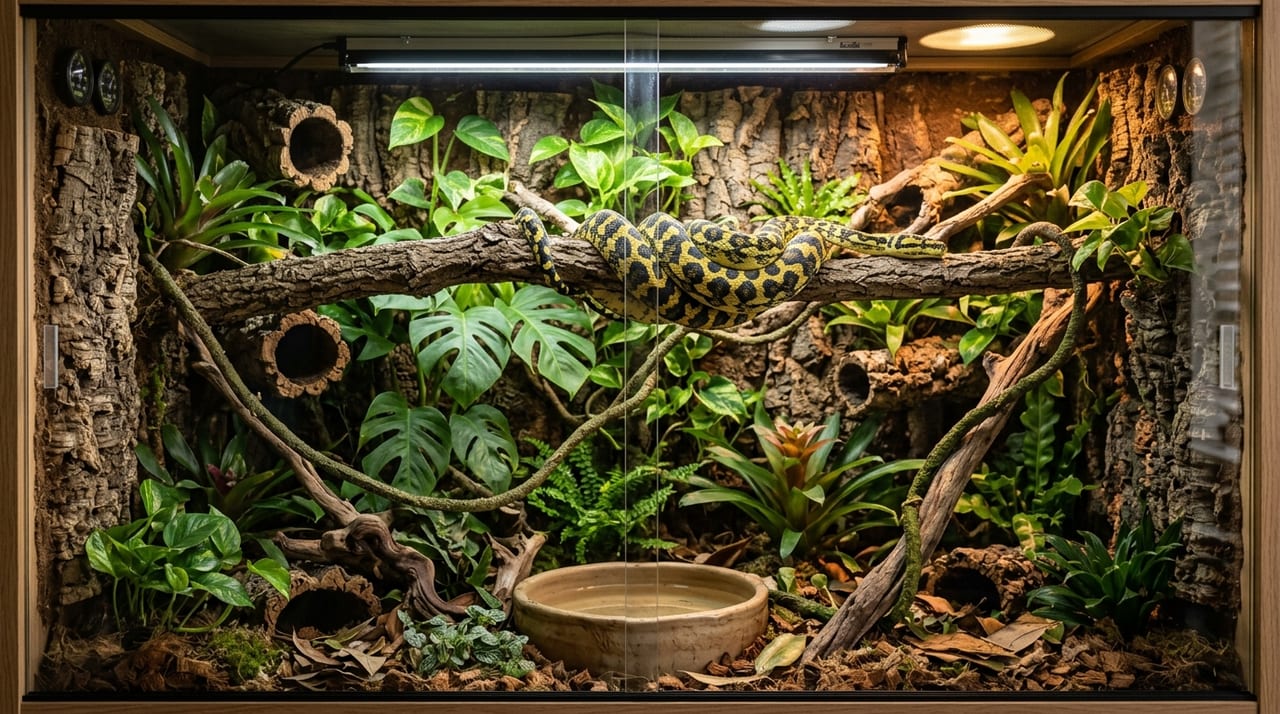
Basilisks are active, semi-arboreal lizards that prefer heights. A tall, spacious enclosure is essential.
| Specimen Size | Recommended Enclosure Size (W × D × H) |
|---|---|
| Juveniles to Subadults | 60×45×90 cm or larger |
| Adults | 90×60×120 cm or larger (ideally 150 cm tall) |
Adult males are extremely active and require spacious enclosures. When housing multiple individuals, males engage in fierce territorial disputes, so solitary housing is essential.
Water Setup
Water areas in the enclosure are crucial for Basilisks, as they naturally inhabit waterside environments.
- Dedicate approximately 1/4 of the enclosure floor to a water area (pool)
- Depth should be 5-15 cm (ideally deep enough for the lizard to fully submerge)
- Maintain water quality with filtration (small external filter or submersible pump)
- Maintain water temperature at 27-30°C with a heater
- Perform water changes 2-3 times per week as the basis of hygiene management
Temperature and Humidity
| Location | Temperature |
|---|---|
| Basking Spot | 38-42°C |
| Warm Side | 28-32°C |
| Cool Side | 24-27°C |
| Nighttime (Overall) | 22-25°C |
| Humidity | 70-80% |
An automatic misting system is effective for maintaining high humidity. Misting 2-3 times daily is recommended.
UVB Lighting
Basilisks have high UVB requirements as relatives of the Agamidae family, and strong UVB is necessary to prevent metabolic bone disease (MBD).
- UVI 2.0-4.0 (T5HO 6-10% UVB bulbs recommended)
- Exposure time: 12-14 hours/day
- Replace every 6 months
Feeding
Basilisks are omnivorous with a primary diet of insects. As they mature, they also consume plant matter.
Food Types and Feeding Frequency
| Specimen Size | Primary Food | Secondary Food | Frequency |
|---|---|---|---|
| Juveniles (~25 cm) | Crickets (Small to Medium) | — | Daily |
| Subadults (25-50 cm) | Crickets, Dubia roaches | Pink mice (1-2 times monthly) | Every other day |
| Adults (50 cm+) | Crickets, Dubia roaches, superworms | Vegetables (bok choy, Chinese cabbage, bell peppers), small amounts of fruit | 3-4 times per week |
Calcium dusting should be performed at every feeding. Calcium with vitamin D3 should be used 1-2 times per week.
Handling and Temperament
Basilisk Lizards tend to be difficult to acclimate to handling compared to many other lizard species.
Important Precautions
- Basilisks are extremely quick and will flee in panic when startled
- Accidents such as jumping from heights or colliding with walls occur easily
- Handling should be done in spacious areas (entire room or dedicated large space)
- Preventing escapes is essential
Steps to Acclimate
- For 3-4 weeks after introduction, only observe the lizard in its enclosure
- During feeding, use tongs to familiarize the lizard with your presence
- Begin with short handling sessions (5 minutes or less)
- If panicked, don't chase—gently place the lizard back down
While experienced keepers have successfully raised tame individuals, it is appropriate to treat them overall as nervous lizards.
Common vs. Green Basilisk: Care Differences
| Item | Common Basilisk | Green Basilisk |
|---|---|---|
| Body Color | Tan-brown | Emerald green |
| Crest | One (males only) | Three (head, back, tail; males only) |
| Care Difficulty | Somewhat difficult (nervous) | Difficult (especially during juvenile stage) |
| Availability | Relatively limited | Abundant |
| Price | Mid-range | Slightly higher price |
Green Basilisks are particularly fragile during the juvenile stage and are known as a "high-difficulty species" that can die suddenly due to improper conditions. They are primarily suited for experienced keepers.
Conclusion
The Basilisk Lizard is a fascinating reptile whose wild behavior of running across water has made it internationally famous through videos. While keeping them requires establishing a tall, spacious enclosure with adequate water areas, high humidity, and strong UVB lighting—not for beginners—they are an exceptionally rewarding species for intermediate and advanced keepers. The sight of a male Green Basilisk with its crests raised is particularly striking.