Keeping African Rock Pythons: Legal Regulations, Large Enclosure Setup, Feeding, and Safety Considerations
Husbandry information for African rock pythons (Python sebae). Detailed guidance on legal procedures following designation as a special animal, large enclosure design, feeding methods, and managing bite risk.
Key Takeaways
Husbandry information for African rock pythons (Python sebae). Detailed guidance on legal procedures following designation as a special animal, large enclosure design, feeding methods, and managing bite risk.
The African rock python (Python sebae), often called the African rock python, is one of the world's largest snake species native to the African continent. With a maximum length exceeding 6 meters, it is designated as a "special animal" in Japan, and following the June 2020 revision of the Animal Welfare and Management Act, new private ownership for pet purposes has been prohibited nationwide. Husbandry difficulty is extremely high and not recommended for beginners; however, for large python specialists, this species holds incomparable appeal.
Legal Regulations and Permit Applications
In Japan, African rock pythons are designated as "special animals" under the Animal Welfare and Management Act. Effective June 1, 2020, following the revised law, new private ownership for pet purposes is prohibited nationwide. Permission to keep and maintain such animals is restricted to purposes such as exhibition and research at zoos and similar facilities.
Individuals who obtained permission to keep specimens before the revision (by May 31, 2020) may continue breeding under specified procedures. In such cases, the following obligations apply:
- Facility Standards Compliance: The facility must meet standards for preventing escape and harm (double doors, locks, sturdy enclosures, etc.)
- Signage Requirements: A sign indicating the presence of a special animal husbandry facility must be posted in a visible location at the facility
Keeping such animals without permission is subject to imprisonment of up to six months or a fine of up to 1 million yen. For an overview of the system, see also Reptile Husbandry Laws and Regulations Guide.
Basic Information
- Adult Size: 3–6 m (3–4 m is typical in captivity)
- Weight: 30–50 kg at maturity; large individuals can exceed 90 kg
- Lifespan: 20–30 years in captivity
- Distribution: Sub-Saharan Africa (savannas, riverine areas, forest edges)
- Temperature: Hot spot 32–35℃, cool area 24–27℃
Enclosure Design
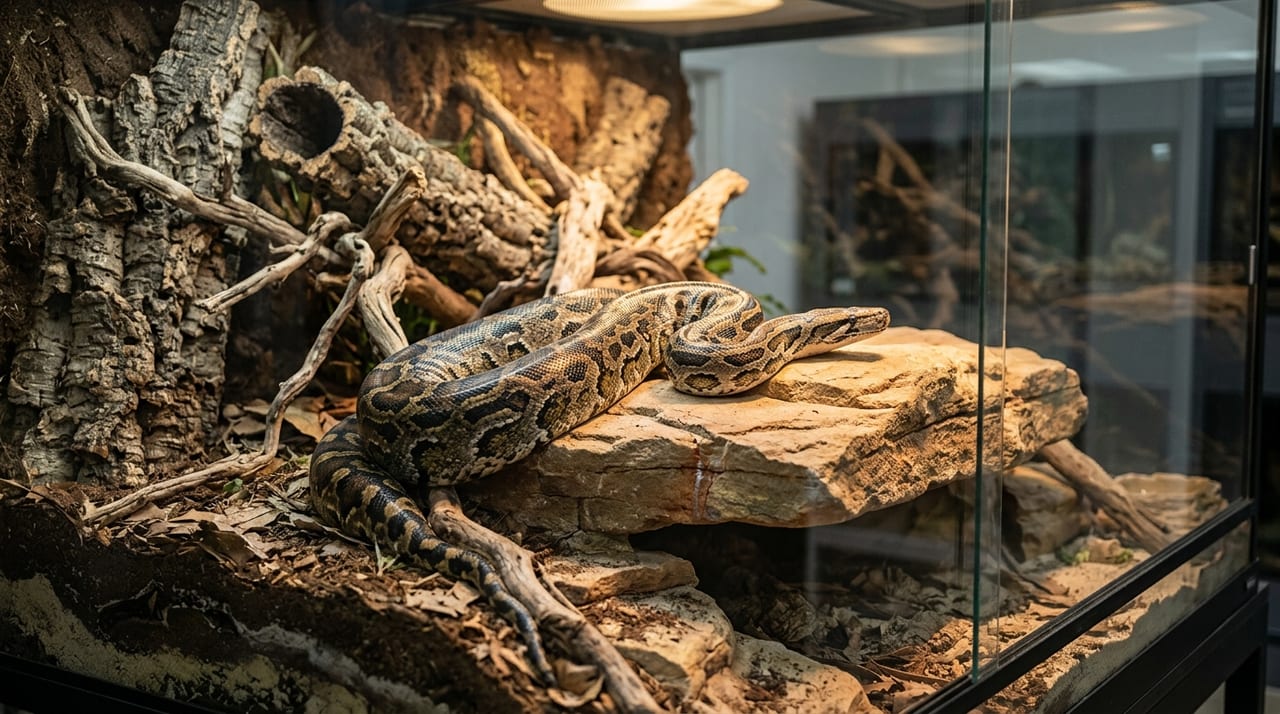
Safe husbandry of African rock pythons requires a specially designed large enclosure.
Size Guidelines An enclosure providing at least two-thirds the snake's total length is recommended. For a 3-meter snake, a minimum floor area of 200 cm × 100 cm is necessary. If a young snake is placed in a large enclosure from the start, exploratory behavior may cause restlessness; gradual size increases as the animal grows is the standard approach.
Structure and Safety Measures This species is extremely powerful and may push against or lift enclosure lids to escape. The following safety measures are essential:
- Secure locking with padlocks or latches
- Sturdy construction using metal frames or reinforced wood
- Double-door system (for keeper safety)
- Escape sensors (optional but recommended)
Temperature and Humidity Management
Temperature Gradient Setup Create a temperature gradient in one direction using heating mats or far-infrared panels. Maintain the hot spot (basking zone) at 32–35℃ and the opposite end at 24–27℃. If the entire enclosure is uniformly warm, the snake cannot regulate its body temperature; a temperature differential is essential.
Humidity Maintain 60–80% humidity. Increasing humidity to 70% or higher before shedding helps prevent ecdysis problems. Installing a large water bowl naturally raises humidity. The water bowl must be large enough for the snake to fully submerge (snakes may regulate body temperature and shed in water).
Feeding Management
Prey Types and Size
African rock pythons feed primarily on mammals. Rabbits, mice, and rats are common prey animals. The appropriate feeding amount is equal to or slightly larger than the thickest part of the snake's body diameter.
Feeding Frequency:
- Juveniles (up to 1 m): Once every 7–10 days
- Sub-adults (1–2 m): Once every 10–14 days
- Adults (over 2 m): Once every 2–4 weeks
Safe Feeding Methods
African rock pythons are temperamental, and feeding time poses one of the highest risks for bite incidents and constriction accidents.
- Never feed alone: Always conduct feeding with multiple people present
- Use hooks and tools: Do not hand-feed directly while handling
- No handling for 48–72 hours after feeding: Handling during digestion increases regurgitation and aggression risk
Important Notes on Handling
This species should not be handled by anyone other than highly experienced keepers. If handling must occur, strictly observe the following:
- Always support the head and body simultaneously with at least two people
- Do not allow the snake to coil around the neck
- If tightening occurs, calmly place alcohol near the nose area to encourage release (emergency use only)
- Even juveniles under one meter can inflict serious bite wounds with their sharp fangs
Summary
Among large python species, the African rock python demands particularly careful husbandry protocols. Compliance with legal regulations, facility standard implementation, and safe feeding management are the three fundamental prerequisites for keeping this species. Over time, as trust is built and the animal is kept in appropriate conditions, you can share your life with this unique reptile for over 20 years. When considering keeping this species, begin with careful attention to legal procedures and facility preparation.