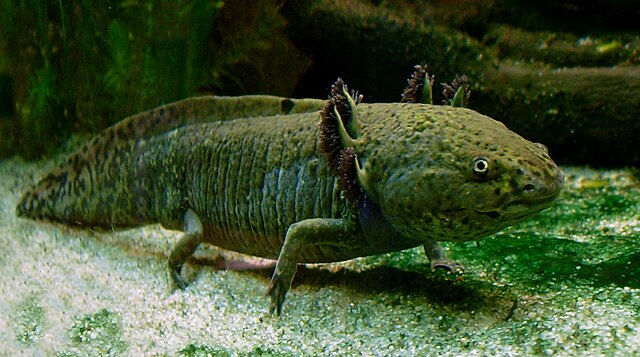
Source: Wikimedia Commons
Axolotl
BeginnerAmbystoma mexicanum
Fascinating amphibian that reaches maturity in larval form. Charming face and external gills are popular. Amazing regeneration ability.
Difficulty
Beginner
Temperature
15〜20℃
Lifespan
10-15 years
Size
20-30cm
Humidity
40〜70%
Diet
Frozen bloodworms, pellets, feeder fish
About
The axolotl is a species of paedomorphic mole salamander. They mature into the terrestrial adult form without undergoing metamorphosis; the adults remain fully aquatic with obvious external gills. This trait, although somewhat unusual among the majority of amphibians, is not unique. Axolotls may be difficult to distinguish from the larval stage of other neotenic adult mole salamanders, such as mudpuppies or the occasionally paedomorphic tiger salamander.
Source: Wikipedia (CC BY-SA 4.0)
Lifespan of the Axolotl
The Axolotl lives 10-15 years.
Size of the Axolotl
The Axolotl grows to 20-30cm.
Temperature & humidity for the Axolotl
The ideal temperature for the Axolotl is 15〜20℃.
Basic Info
Origin
Lake Xochimilco and Lake Chalco in Mexico City, Mexico
Lifespan
10-15 years
Size
20-30cm
Temperature
15〜20℃
Humidity
Morphs (Varieties)
The axolotl's color morphs are determined by 4 pairs of pigmentation genes (D dark / M non-melanoid / A non-albino / AX non-xanthic), with most color variations being recessive. GFP derives from gene introduction but shows dominant inheritance. Striking combos such as "enchi" (e.g., "fire") result from combinations of these.
RecessiveVisual only with two copies; one copy = het (carrier).
LeucisticAlbino (White Albino)Golden AlbinoMelanoidAxanthicCopper
DominantVisual with a single copy; no distinct super form.
GFP (Green Fluorescent Protein)
Sources: MorphMarket Morphpedia - Axolotls / Axolotl Planet - Introduction to Axolotl Genetics
A curated selection of notable morphs. Inheritance modes are a breeding-planning guide; actual appearance varies with combos.
References & Sources
Edited & verified by: BreederDirect editorial team
The taxonomic, regulatory, and husbandry data on this page are compiled and verified against the authoritative primary sources below.
Taxonomy & Authority
Accepted name: Ambystoma mexicanum (Shaw & Nodder, 1798)
Synonyms: Amblystoma weismanni Wiedersheim, 1879, Axolotes guttata Owen, 1844, Axolotus pisciformis (Shaw, 1802), Gyrinus mexicanus Shaw & Nodder, 1798, Hemitriton mexicanum (Shaw & Nodder, 1798), Hypochton pisciformis (Shaw, 1802)
Authority databases: GBIF
Nomenclature follows global taxonomic authority databases.
Regulations & Conservation Status
CITES Appendix IIIUCN CR · Critically Endangered
Wild populations are critically endangered (IUCN CR). Captive-bred individuals comprise the bulk of those in commerce.
Sources: CITES Checklist (Ambystoma mexicanum Appendix II) / IUCN Red List
Regulations may change. Always verify the latest information with the relevant authorities.
Axolotl Listings
Loading latest listingsFind listings for this species