Source: Wikimedia Commons
Amazon leaffish
AdvancedMonocirrhus polyacanthus
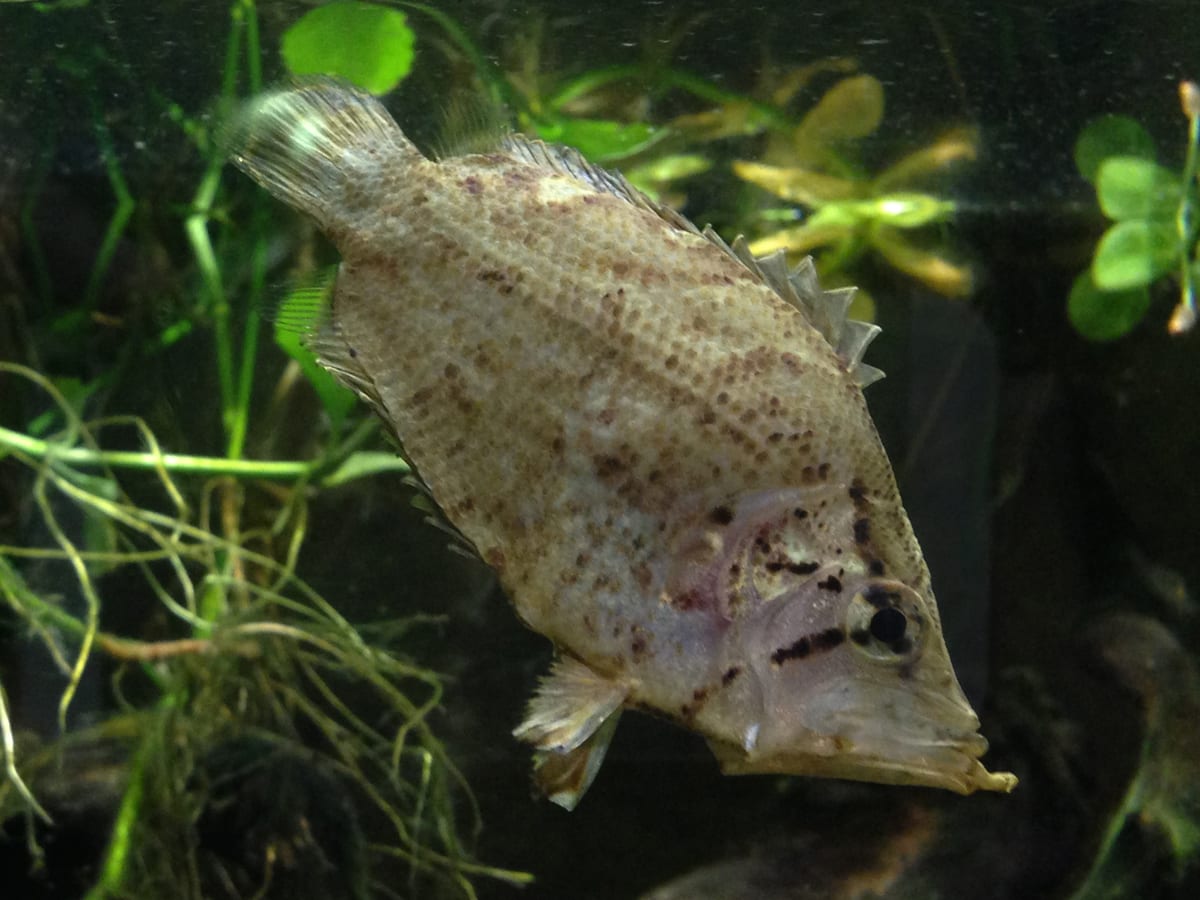
A South American predator famous for mimicking a dead leaf, with a flat body, vein-like markings and a stalk-like chin barbel. It drifts toward prey like a falling leaf, then engulfs it in an instant.
Difficulty
Advanced
Temperature
22〜25℃
Lifespan
Few reliable data
Size
Up to 8 cm SL (FishBase)
Diet
Piscivore (mainly live small fish)
About
The Amazon leaffish, Monocirrhus polyacanthus, is a polycentrid found in the Amazon basin in Peru, Brazil, Bolivia, Colombia and Venezuela (FishBase). It reaches 8 cm SL. Its body shape and pattern mimic a dead leaf, it can change colour to match its surroundings, and a chin barbel resembles a leaf stalk. It stalks prey head-down, propelled by tiny movements of its transparent fins, then shoots out its mouth to engulf it. A piscivore in the wild, it accepts almost only live food in captivity, so a constant supply of live fish is a prerequisite. It lives in shallow, still water where leaves collect and prefers soft, acidic water. Up to 300 eggs are laid on the underside of a large leaf and guarded by the male. It was formerly placed in the family Nandidae. In Japan it is sold by specialist shops as an unusual fish.
Source: Wikipedia (CC BY-SA 4.0)
Size of the Amazon leaffish
The Amazon leaffish grows to Up to 8 cm SL (FishBase).
Temperature & humidity for the Amazon leaffish
The ideal temperature for the Amazon leaffish is 22〜25℃.
Basic Info
Origin
South America (Amazon basin: Peru, Brazil, Bolivia, Colombia, Venezuela)
Lifespan
Few reliable data
Size
Up to 8 cm SL (FishBase)
Temperature
22〜25℃
References & Sources
Edited & verified by: BreederDirect editorial team
The taxonomic, regulatory, and husbandry data on this page are compiled and verified against the authoritative primary sources below.
Taxonomy & Authority
Regulations & Conservation Status
Not CITES-listedIUCN LC · Least Concern
Not listed in the CITES Appendices (checked on Species+). Under Japan's Invasive Alien Species Act, all species of the family Nandidae require an identification certificate on import; this species was formerly placed in Nandidae but is now classified in Polycentridae. It is neither a designated nor an uncategorised alien species, so keeping or trading fish already in Japan needs no permit under the Act. Never release aquarium fish into the wild.
Sources: Species+ (CITES) / FishBase / Ministry of the Environment: list of regulated alien species (species requiring an identification certificate)
Regulations may change. Always verify the latest information with the relevant authorities.
Amazon leaffish Listings
Loading latest listingsFind listings for this species