Ramshorn Snail
BeginnerSeptaria porcellana
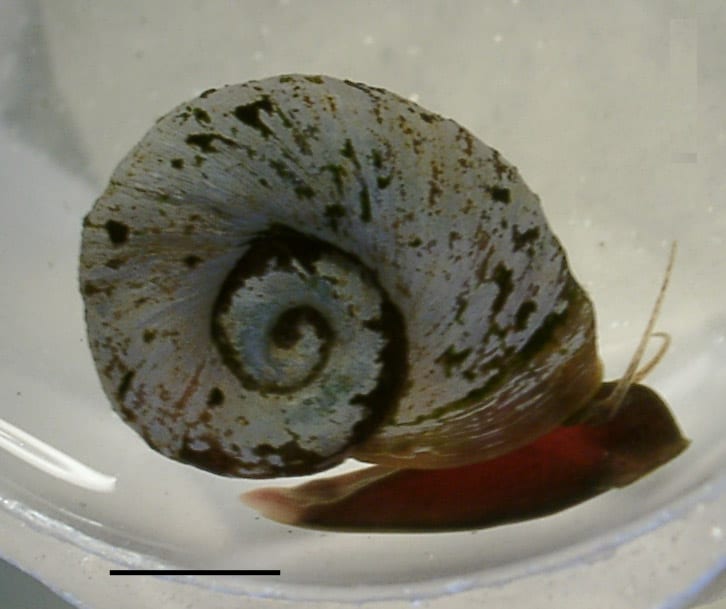
A nerite snail with a flat, cap-like shell about 13mm long, yellow-brown with a pattern of black or purple-pink triangles and horizontal lines. It clamps hard to solid surfaces and rasps algae from them.
Septaria porcellana is a freshwater nerite snail. The English Wikipedia gives a range covering India, the Philippines, Indonesia, New Guinea and New Caledonia, and finds it on stones in both still and swift water from a few metres from the sea to five or six kilometres inland. The shell reaches 13.1mm in length. It is symmetrical and cap-like, relatively deep and wide, yellow-brown outside with a pattern of black or purple-pink triangles and horizontal lines, and white to light grey inside with a narrow septum whose curved edge is tinged yellow. Males are generally smaller than females. Two subspecies are recognised, S. p. borbonica and the nominate S. p. porcellana. SeaLifeBase treats it as a benthic omnivore of fresh and brackish water. The Neritopsina are generally gonochoric broadcast spawners with a planktonic larval stage, so it cannot be bred through generations in fresh water alone. It is traded for freshwater aquaria.
Source: Wikipedia (CC BY-SA 4.0)
The Abalone Snail grows to Shell length about 13mm.
Origin
India, the Philippines, Indonesia, New Guinea and New Caledonia
Size
Shell length about 13mm
Temperature
22〜28℃
Algae and biofilm
Sources: Wikipedia (Septaria porcellana) / SeaLifeBase / WoRMS
Edited & verified by: BreederDirect editorial team
The taxonomic, regulatory, and husbandry data on this page are compiled and verified against the authoritative primary sources below.
Accepted name: Septaria porcellana (Linnaeus, 1758)
Authority databases: GBIF
Nomenclature follows global taxonomic authority databases.
Sources: CITES Appendices (species not listed) / IUCN Red List
Regulations may change. Always verify the latest information with the relevant authorities.
Find listings for this species
Provide hard surfaces where algae grow; it clamps onto glass, stone and driftwood as it moves. Its grip is strong, so prising it off damages the foot. It climbs above the waterline and can fall, so fit a lid.
No verifiable pH, hardness or temperature figures exist for this species, so none are given. It is tropical and occurs in both fresh and brackish water, and the basic requirement is to avoid strongly acidic or very soft water, which erodes the shell.
Peaceful and harmless to other animals. Do not house it with snail-eating fish or with assassin snails. Its flat, cap-like shell leaves it exposed to fish that suck snails out.
It rasps algae and biofilm from hard surfaces and clears glass well, but loses condition once the tank runs out of algae, so supplement with a sinking plant-based food or blanched vegetables.
The Neritopsina are generally gonochoric broadcast spawners whose embryos pass through a planktonic larval stage, so it does not reproduce within a freshwater tank. Even where spawning occurs, the larvae cannot complete their development in fresh water.
Its grip is strong and pulling it off injures the foot, so shift it gently with a spatula under the shell instead. It cannot always right itself if turned over, so put it back when you find one. Never use copper-based fish medications, which are toxic to snails.
Beginner. This is a beginner-friendly species. No special equipment or experience is required, and it can be kept successfully with basic care setup.
Abalone Snail typically reaches Shell length about 13mm as an adult. Size may vary depending on care conditions and individual genetics.
Abalone Snail feeds on: Algae and biofilm. Aim for a balanced diet with appropriate feeding frequency.
The price of Abalone Snail varies significantly depending on morph, size, and lineage. Check our market price page for the latest pricing information.
Last updated: September 16, 2026