Role of Tank Mates in Medaka Tanks
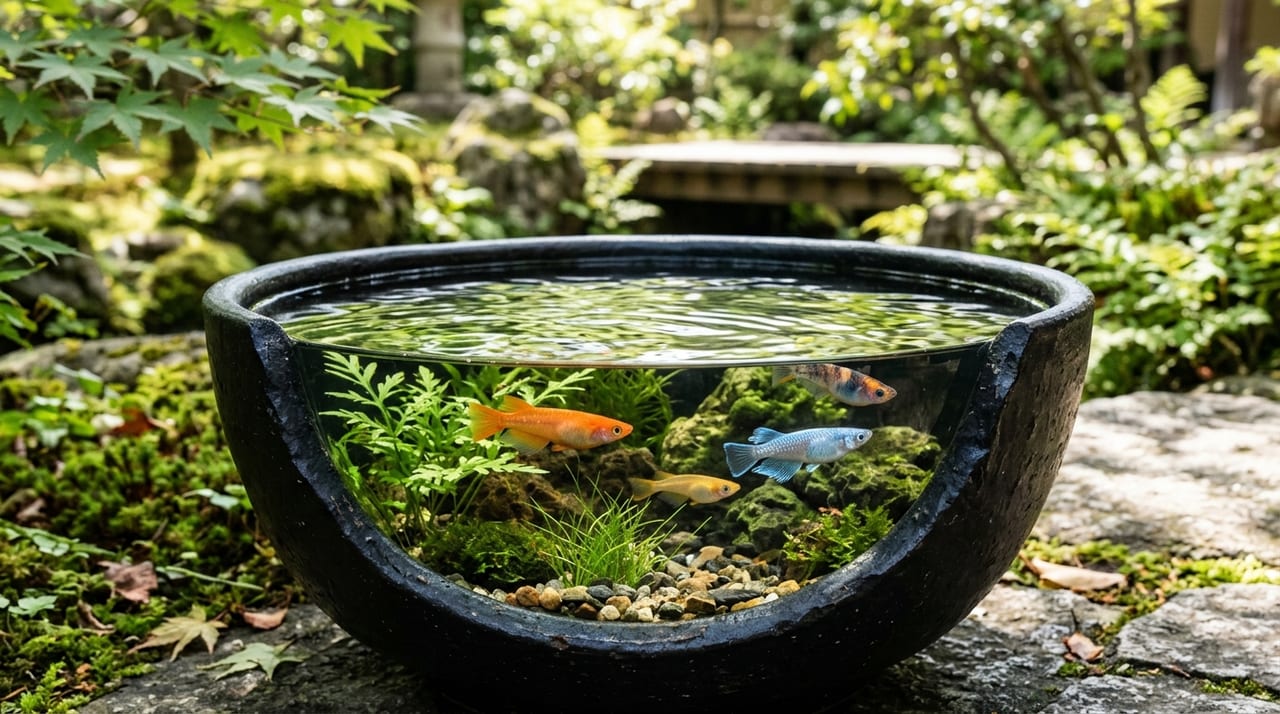
There are many benefits to keeping shrimp and snails together with medaka in a tank. They function as "cleaners" that maintain the ecosystem balance of the tank, such as removing algae, processing leftover food, and stabilizing water quality. In single-species medaka tanks, uneaten food and dead aquatic plants accumulate on the bottom, making ammonia and nitrite concentrations more likely to rise. By introducing appropriate tank mates, it's possible to distribute this load, reduce the frequency of water changes, and maintain stable water quality.
On the other hand, there are risks of impacts on breeding and predation damage, so it's important to introduce them after correctly understanding the characteristics of each. Especially breeders who prioritize medaka breeding need to carefully consider the impact on fry and eggs.
Do Medaka Eat Shrimp? Do Shrimp Attack Medaka?
This is the most pressing concern before cohabitation, so let me summarize the conclusion first.
| Combination | What Happens | Conclusion |
|---|
| Adult medaka → baby shrimp (1 cm or smaller) | They will eat them. Shrimp small enough to fit in their mouth are predatory targets | Hiding places needed |
| Adult medaka → adult shrimp (2 cm or larger) | They won't eat them. They don't fit in their mouth | No problem |
| Amano shrimp → adult medaka | They don't attack. They won't chase them either | No problem |
| Amano shrimp → medaka eggs and newly hatched fry | They may eat them | Separate spawning beds |
| Yamato shrimp → medaka fry | They may prey on them (they are large and strong) | Don't put in fry tanks |
| Yamato shrimp → weakened or dead medaka | They will eat them (they won't attack healthy living individuals) | Don't mistake it for a corpse |
| Dwarf snail / zebra snail → medaka and eggs | They won't eat them. Filter feeding and algae consumption are their main diet | No problem |
In other words, "there's no need to worry if they're all adults; it's always the smaller generation that's at risk," that's the reality. Medaka won't exterminate shrimp, and shrimp won't attack medaka, but if left unchecked, baby shrimp and fry will decline in numbers due to each other.
How to handle if you want to breed both
- Add willow moss and hornwort generously to create crevices where baby shrimp can hide (this alone will clearly change the survival rate)
- Move medaka spawning mats by transferring the collected eggs to separate containers. This is the most reliable method and increases hatching rates regardless of whether shrimp are present.
- Don't put Yamato shrimp in breeding or fry tanks. If the goal is algae removal, limit them to adult-only tanks.
Also, people sometimes misunderstand scenes where "shrimp are swarming over a dead medaka" as predation, but this is almost a state where they are eating an already-dead individual. Since the shrimp weren't the cause of the medaka's death, check the water quality and temperature in such cases.
Amano Shrimp: The Standard Tank Mate for Medaka
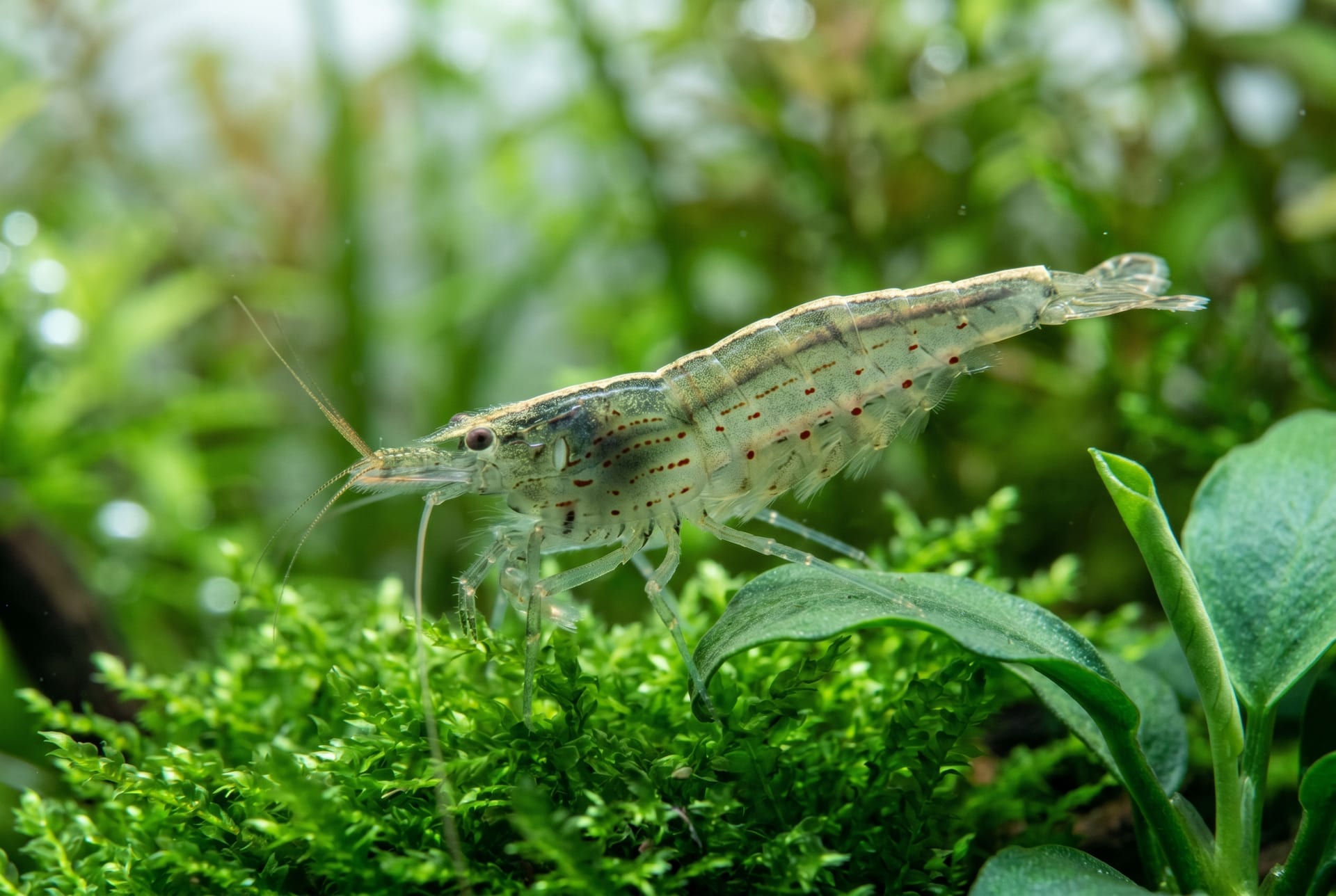
Amano shrimp have excellent compatibility with medaka and are easy for beginners to handle. They are small at 2–3 cm in body length and have gentle movements. They almost never chase or attack medaka.
Benefits
- They clean thread algae, leftover food, and dead aquatic plant leaves
- Their small size doesn't stress medaka
- They breed easily and multiply on their own (capable of freshwater breeding)
- They're inexpensive and easy to buy in bulk
Points to note
- Adult medaka may predate on baby shrimp 1 cm or smaller
- The shrimp may also eat medaka eggs and newly hatched fry
- If breeding is a priority, we recommend moving the spawning bed to a separate container
- They are very sensitive to sudden water quality changes and pesticides. Acclimation using the drip method is essential when introducing them
The recommended number is about 5–10 shrimp per 10 liters. Adding plenty of aquatic plants and willow moss significantly improves the survival rate of baby shrimp. Choosing soil or fine gravel as substrate makes it easier for shrimp to secure footing and settle down. The ideal water temperature is 15–25°C, and care must be taken during summer when temperatures exceed 30°C.
Yamato Shrimp: The Strongest Algae-Eating Powerhouse
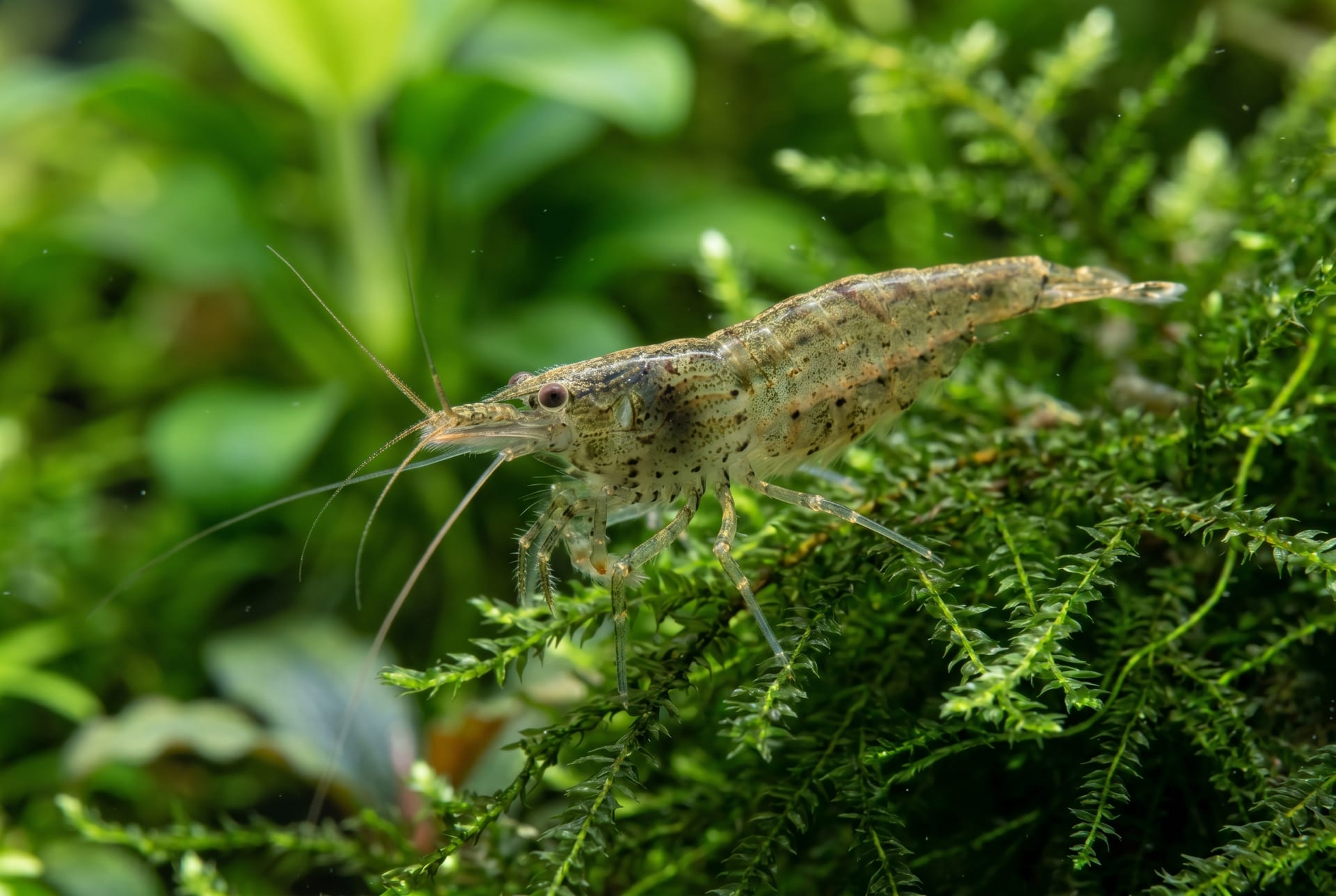
Yamato shrimp are larger than Amano shrimp (4–6 cm body length) and have significantly superior algae-removal abilities. They are a standard cleaner for planted tanks, capable of handling stubborn algae like beard algae and thread green algae.
Benefits
- They actively remove stubborn algae (thread green algae and beard algae)
- They have hearty appetites and excellent leftover food-processing abilities
- They don't breed in freshwater, so population numbers don't get out of control
Points to note
- Their large size poses a risk of predating on small fry and baby shrimp
- They are sensitive to high temperatures (over 28°C) and require cooling measures in summer
- They are more expensive than Amano shrimp
- Jump-out accidents are common, so pay attention to gaps in the lid
It's safest to limit introduction to medaka tanks to about 1–2 shrimp in a 30 cm tank. We strongly recommend not putting them in fry tanks or tanks during spawning season. When algae becomes scarce, they may nibble on aquatic plants and driftwood, so supplemental feeding can prevent damage to plants.
Snails (Dwarf Snails): Unsung Heroes of Water Quality Improvement
Dwarf snails exert a unique "filtering effect" in medaka tanks. They possess a feeding method (filter feeding) where they strain suspended particles and phytoplankton (algae) from the water using their gills, which is the mechanism by which they clarify greenwater.
Benefits
- They improve water quality by taking in suspended particles and excess nutrients
- They clean leftover food and decaying leaves on the bottom (benthic feeding)
- They are hardy and long-lived (2–3 years or more in proper conditions)
- They are ovoviviparous, so they don't scatter eggs
Points to note
- They are incompatible with greenwater-cultivated tanks (they clarify the water)
- They reproduce by giving birth to baby snails, so overpopulation can crowd the tank
- They are hardy at low temperatures, but during summer heat, some individuals may gather at the water surface and weaken
The recommended number is about 3–5 snails per 10 liters. Gravel-type substrates work better than soil, and shells develop stronger in hard water that contains minerals. Adding a small amount of crushed oyster shells to the filter as a calcium supplement is also effective.
Zebra Snails: Glass Panel Algae-Removal Specialists
Zebra snails are specialist cleaners that scrape diatoms and green algae from glass surfaces and stones using their radula. While dwarf snails handle the bottom, zebra snails primarily clean algae on glass surfaces, stones, and driftwood.
Characteristics and Points to Note
- Their ability to remove diatoms and green algae from glass surfaces is among the best of all aquatic animals
- They lay white eggs on glass surfaces, but they don't hatch in freshwater (egg marks can be removed with a sponge)
- They have a tendency to escape from tanks, so sealing lid gaps is essential
- For a 30 cm tank, 1–2 snails is the guideline. Too many will starve due to insufficient food (algae)
If zebra snails frequently gather near the water surface, it may be a sign of water quality deterioration or oxygen deficiency. If you observe such behavior, reconsider your water change frequency.
Setting Up a Cohabitation Environment and Management Tips
To maintain a healthy cohabitation tank with shrimp and snails, management conscious of the following points is important.
Layout and Environmental Setup
- Abundantly place aquatic plants such as willow moss, water sprite, and hornwort to provide hiding places for shrimp
- Use fine gravel or soil as substrate to make it easy for cleaning organisms to move around
- Avoid overstocking; aim for a maximum of 5–7 medaka per 10 liters
Feeding and Water Quality Management
- Feed small amounts; a basic rule is to give only what can be eaten in 3–5 minutes
- Regularly remove leftover food with a siphon or gravel cleaner
- Perform water changes once per week, replacing 20–30% of the total water volume
Population Control
- Amano shrimp multiply rapidly, so check their population regularly
- If overpopulation occurs, consider moving them to separate containers or selling/distributing them
- Snails also breed, so thin out the population when baby snail numbers increase
Cohabitation of medaka with shrimp and snails can greatly reduce the effort needed for water quality maintenance if properly managed. Understanding the characteristics of each organism and selecting tank mates suited to your goals (algae control, breeding priority, aesthetics, etc.) is the shortcut to building a stable tank in the long term.