Source: Wikimedia Commons
Twinspot goby
AdvancedSignigobius biocellatus
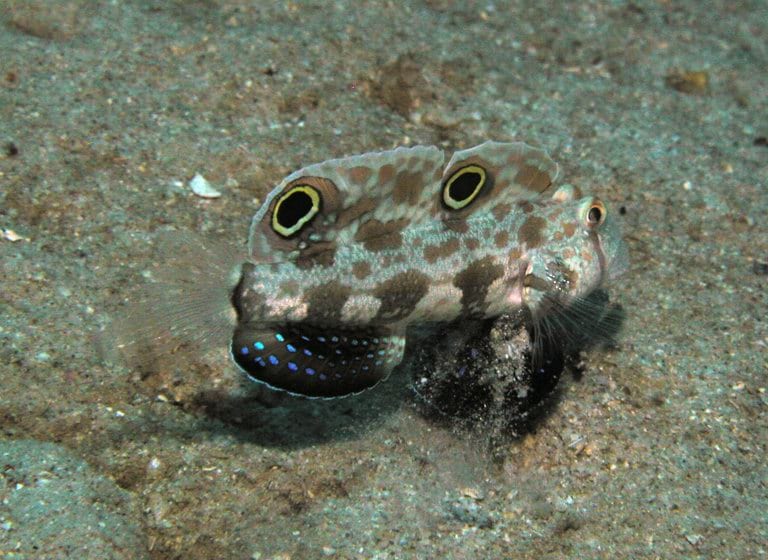
A goby with a large black eyespot on each dorsal fin that looks like a crab's eyes when raised. Pairs share sandy burrows, and its sand-sifting diet makes it hard to feed.
Difficulty
Advanced
Temperature
22〜27℃
Size
Up to 10 cm SL
Diet
Carnivore (small animals sifted from sand)
About
The signal or twinspot goby (Signigobius biocellatus) is the only member of its genus. It ranges through the western Pacific from the Philippines to the Solomon Islands and Vanuatu, south to the southern Great Barrier Reef, and in Palau (FishBase), reaching 10 cm SL. It is pale bluish grey to yellowish tan with brown blotches and bars, and each of its two dorsal fins bears a large, blue-edged black eyespot; with the fins raised it resembles a crab, hence names such as crab-eye goby. It lives on sandy to silty bottoms in lagoons and bays near rubble or leaf litter, alone or in monogamous pairs sharing a burrow, and feeds by sifting small invertebrates from mouthfuls of sand. Provide a sand bed at least 5 cm deep with flat stones to burrow under (Saltcorner). Because it feeds by sifting sand it is slow to accept prepared foods; Saltcorner rates it as an expert fish, noting that most slowly starve. Offer meaty frozen foods about four times a day. It is peaceful and does not harm corals. It is handled by Japanese specialist shops.
Source: Wikipedia (CC BY-SA 4.0)
Size of the Twinspot goby
The Twinspot goby grows to Up to 10 cm SL.
Temperature & humidity for the Twinspot goby
The ideal temperature for the Twinspot goby is 22〜27℃.
Basic Info
Origin
Western Pacific (Philippines to the Solomon Islands and Vanuatu, south to the Great Barrier Reef, and Palau)
Size
Up to 10 cm SL
Temperature
22〜27℃
Care Specifications
- Water Temp.
- 22–27℃
- Specific Gravity
- 1.02–1.026
- Min. Tank
- 110 L
PeacefulReef safe
Sources: FishBase (Signigobius biocellatus) / Saltcorner Fish Library (Bob Goemans)
References & Sources
Edited & verified by: BreederDirect editorial team
The taxonomic, regulatory, and husbandry data on this page are compiled and verified against the authoritative primary sources below.
Taxonomy & Authority
Regulations & Conservation Status
Not CITES-listedIUCN LC · Least Concern
Not listed in the CITES Appendices (checked on Species+). Not designated as an Invasive Alien Species under Japanese law. Never release aquarium animals into the sea.
Sources: Species+ (CITES) / Ministry of the Environment: List of Designated Invasive Alien Species / FishBase
Regulations may change. Always verify the latest information with the relevant authorities.
Twinspot goby Listings
Loading latest listingsFind listings for this species