Source: Wikimedia Commons
Scooter dragonet
AdvancedNeosynchiropus ocellatus
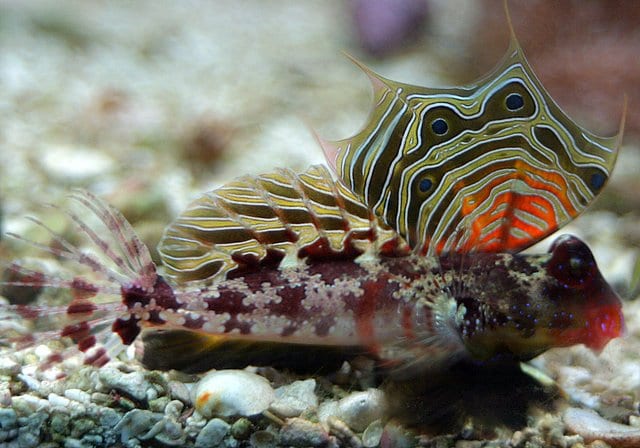
A small dragonet mottled brown with white and black blotches and a starry pattern; males have a tall first dorsal fin. It glides over the sand in short hops.
Difficulty
Advanced
Temperature
22〜27℃
Size
Up to 8.9 cm TL
Diet
Carnivore (small benthic crustaceans)
About
The scooter dragonet or ocellated dragonet (Neosynchiropus ocellatus) ranges across the Pacific from Indonesia to the Pitcairn Islands, north to Japan and south to Australia (FishBase). Aquarium literature and trade listings often still use the old name Synchiropus ocellatus, but the valid name in WoRMS is Neosynchiropus ocellatus. Despite the name "scooter blenny" it is not a blenny. It reaches 8.9 cm TL. It is mottled brown with white and black blotches forming a starry pattern, and males have a tall first dorsal fin. It lives in small groups on sandy lagoon and seaward reefs, rubble and algal turf on shallow rocky reefs, feeding on small benthic invertebrates. Because live rock and sand supply its main food - tiny crustaceans - it needs a mature tank. Wikipedia notes that it can often be weaned onto frozen or even prepared foods, more readily than related dragonets such as the mandarin, but Saltcorner rates it as an expert fish, and individuals vary. It is peaceful and does not harm corals. Keep only one male per tank.
Source: Wikipedia (CC BY-SA 4.0)
Size of the Scooter dragonet
The Scooter dragonet grows to Up to 8.9 cm TL.
Temperature & humidity for the Scooter dragonet
The ideal temperature for the Scooter dragonet is 22〜27℃.
Basic Info
Origin
Pacific (Indonesia to the Pitcairn Islands, north to Japan, south to Australia)
Size
Up to 8.9 cm TL
Temperature
22〜27℃
Care Specifications
- Water Temp.
- 22–27℃
- Specific Gravity
- 1.02–1.026
- Min. Tank
- 110 L
PeacefulReef safe
Sources: FishBase (Neosynchiropus ocellatus) / Saltcorner Fish Library (Bob Goemans)
References & Sources
Edited & verified by: BreederDirect editorial team
The taxonomic, regulatory, and husbandry data on this page are compiled and verified against the authoritative primary sources below.
Taxonomy & Authority
Accepted name: Neosynchiropus ocellatus (Pallas, 1770)
Synonyms: Callionymus microps Günther, 1877, Callionymus ocellatus Pallas, 1770, Callionymus punctulatus Lacepède, 1800, Synchiropus lili Jordan & Seale, 1906, Synchiropus ocellatus (Pallas, 1770), Synchiropus rhodonotus Fowler, 1946, Synchiropus shoe Okada & Ikeda, 1937
Authority databases: WoRMS · GBIF · GBIF · WoRMS · FishBase
Nomenclature follows global taxonomic authority databases.
Regulations & Conservation Status
Not CITES-listedIUCN LC · Least Concern
Not listed in the CITES Appendices (checked on Species+). Not designated as an Invasive Alien Species under Japanese law. Never release aquarium animals into the sea.
Sources: Species+ (CITES) / Ministry of the Environment: List of Designated Invasive Alien Species / FishBase
Regulations may change. Always verify the latest information with the relevant authorities.
Scooter dragonet Listings
Loading latest listingsFind listings for this species