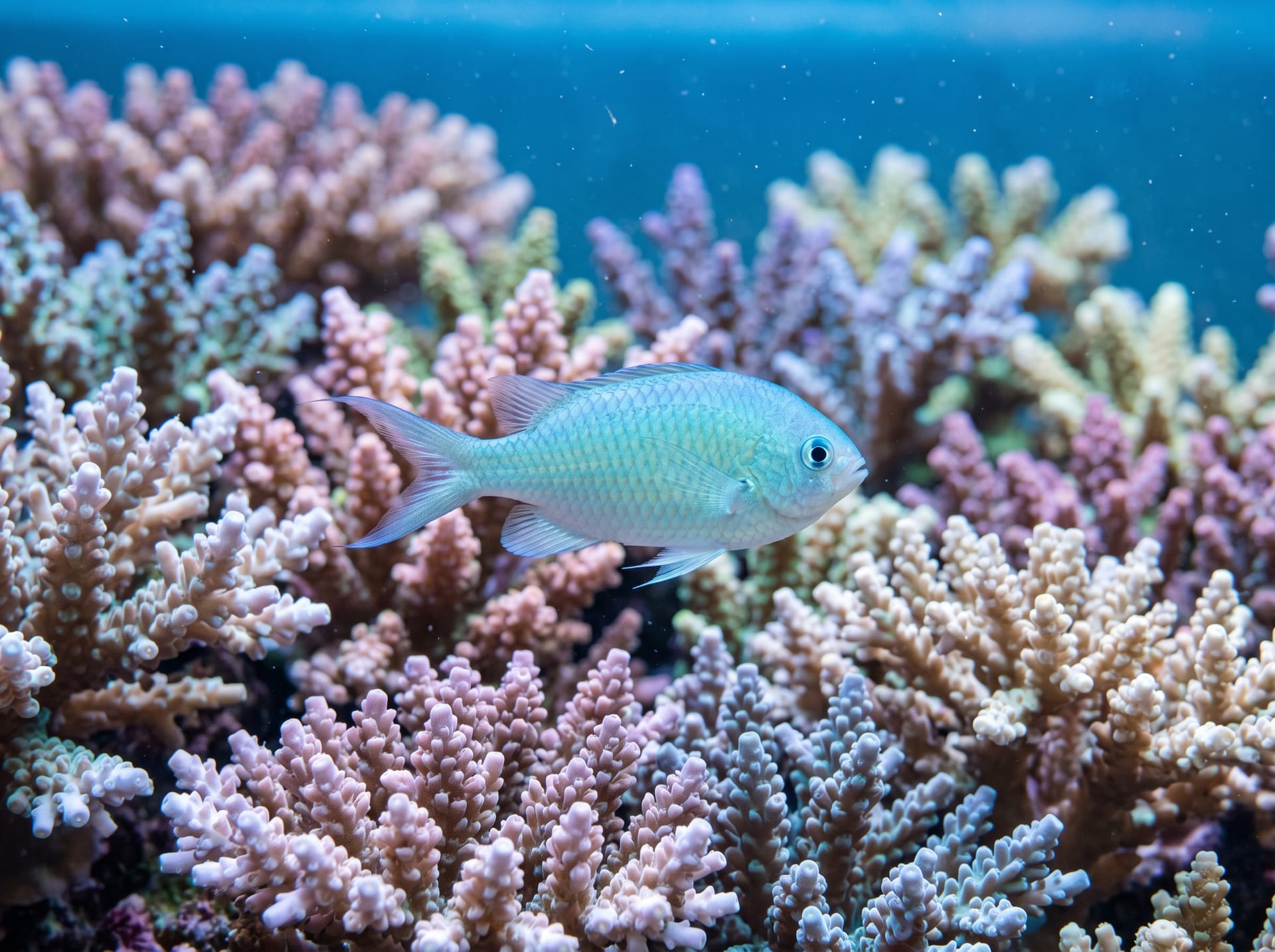
AI-generated image
Blue Green Chromis
BeginnerChromis atripectoralis
A schooling damselfish shining pale blue-green. Peaceful and affordable, most classic beginner saltwater.
Difficulty
Beginner
Temperature
24〜26℃
Lifespan
5-8 years
Size
5-8cm
Diet
Pellets, Frozen food
About
The black-axil chromis (Chromis atripectoralis) is a small damselfish found on reefs throughout the Indo-Pacific. It closely resembles the blue-green chromis but is told apart by the dark blotch at the pectoral fin base. Its pale blue-green sheen looks its best under aquarium lighting, and adults stay at 5-8 cm. In the wild it shoals above branching corals such as Acropora and dives into the branches when threatened. In the tank a group looks far better than a single fish, so five or more are usually introduced together. It is peaceful, reef-safe and takes prepared foods easily, which has kept it a standard beginner marine fish for decades. As the group matures a pecking order forms and subordinate fish can be chased, so provide plenty of cover.
Lifespan of the Blue Green Chromis
The Blue Green Chromis lives 5-8 years.
Size of the Blue Green Chromis
The Blue Green Chromis grows to 5-8cm.
Temperature & humidity for the Blue Green Chromis
The ideal temperature for the Blue Green Chromis is 24〜26℃.
Basic Info
Lifespan
5-8 years
Size
5-8cm
Temperature
24〜26℃
Diet
Pellets, Frozen food
Care Guide
Water Temperature & Quality
Keep the water at 24–26°C and specific gravity around 1.023–1.025. It is hardy and beginner-friendly, but keep fluctuations small.
Tank Mates & Compatibility
Peaceful and reef-safe. Adding five or more at once gives a natural-looking school.
Housing
In the wild they school above branching corals and dart between the branches when threatened. A pecking order forms as they grow, so provide plenty of hiding places.
Diet & Feeding
Easy to wean onto prepared food, and also takes frozen food. Adults are only 5–8cm, so small food is sufficient.
Blue GreenBlue-greenSchoolingMost classic
Blue Green Chromis FAQ
QHow difficult is it to keep Blue Green Chromis?
A
Beginner. This is a beginner-friendly species. No special equipment or experience is required, and it can be kept successfully with basic care setup.
QWhat is the ideal temperature for Blue Green Chromis?
A
The ideal temperature for Blue Green Chromis is 24〜26℃. Avoid sudden temperature changes and maintain a stable environment.
QWhat is the lifespan of Blue Green Chromis?
A
The average lifespan of Blue Green Chromis is 5-8 years. With proper care and nutrition, they can live a long and healthy life.
QHow large does Blue Green Chromis get?
A
Blue Green Chromis typically reaches 5-8cm as an adult. Size may vary depending on care conditions and individual genetics.
QWhat should I feed Blue Green Chromis?
A
Blue Green Chromis feeds on: Pellets, Frozen food. Aim for a balanced diet with appropriate feeding frequency.
QWhat is the typical price for Blue Green Chromis?
A
The price of Blue Green Chromis varies significantly depending on morph, size, and lineage. Check our market price page for the latest pricing information.
Last updated: June 23, 2026
Care Specifications
- pH
- 8.1–8.4
- Water Temp.
- 24–26℃
- Specific Gravity
- 1.02–1.025
- Salinity
- 33–35 ppt
- Min. Tank
- 114 L
PeacefulReef safeGroup
Sources: LiveAquaria
References & Sources
Edited & verified by: BreederDirect editorial team
The taxonomic, regulatory, and husbandry data on this page are compiled and verified against the authoritative primary sources below.
Taxonomy & Authority
Regulations & Conservation Status
Not CITES-listed
Sources: CITES Appendices (species not listed) / Ministry of the Environment Specified Animal List / Ministry of the Environment: List of Designated Invasive Species
Regulations may change. Always verify the latest information with the relevant authorities.
Related Species
Blue Green Chromis Listings
Loading latest listingsFind listings for this species
Related Articles
Green Chromis Group Swimming Care Guide | Tank Introduction, Tank Mates, and Breeding
A comprehensive guide to group swimming care for Green Chromis (Chromis viridis), a quintessential saltwater fish for beginners. Covers tips for introducing 6+ fish simultaneously to distribute territorial disputes, quarantine protocols, tank mate compatibility in reef tanks, feeding management, prevention of white spot disease and velvet disease, and even in-tank breeding records—a practical guide to enjoying the beautiful group swimming of Green Chromis for years to come.
Cobalt Damselfish Care Guide | How to Keep Beginner-Friendly Saltwater Fish, Tank Mates, and Tank Management
A guide explaining how to care for Cobalt Damselfish. Covering tank equipment, water quality management, feeding, tank mate compatibility, and white spot disease prevention—a comprehensive guide summarizing the key points for long-term care of beginner-friendly saltwater fish.
Comparison Guide to Keeping Blue Damselfish (Chrysiptera cyanea) and Yellow-tail Blue Damselfish (Chrysiptera parasema) | Appearance Differences, Aggression, and Tank Compatibility
A detailed comparison of the appearance, temperament, aggression, and tank compatibility of the often-confused Blue Damselfish and Yellow-tail Blue Damselfish. This guide covers selection tips for beginners, layout techniques to minimize territorial behavior, and important considerations when using damselfish to establish a new aquarium.
Damselfish Care Guide: Popular Species Beyond Sergeant Major Damselfish and Mixed-Tank Considerations
Introducing popular species of the damselfish family (Pomacentridae), which includes numerous types beyond the common sergeant major damselfish. Learn the care methods, territorial management, and reef tank compatibility of colorful species such as blue damselfish, black damselfish, and yellow-tailed blue damselfish.
🩺 Common diseases
Coral BleachingRapid Tissue NecrosisBrown Jelly DiseaseFlatworm InfestationRed Slime (Cyanobacteria)Tissue Recession (Polyp Recession)Nudibranch PredationAlkalinity Burn (KH Burn)Marine Ich / CryptocaryoniasisMarine Velvet / AmyloodiniosisBrooklynelliasis / Clownfish DiseaseHead and Lateral Line Erosion (HLLE)