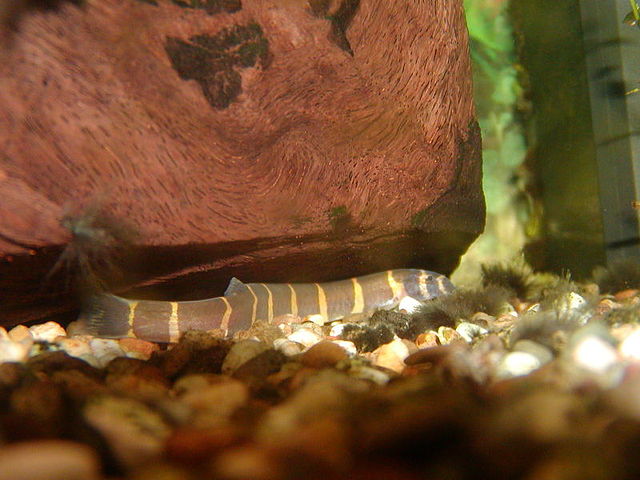
Source: Wikimedia Commons
Kuhli Loach
BeginnerPangio kuhlii
Cute eel-like banded loach. Shy and hides often but active in groups. Fun to watch wriggling through substrate.
Difficulty
Beginner
Temperature
22〜28℃
Lifespan
5-10 years
Size
8-12cm
Diet
Sinking tablets, frozen bloodworms
About
The kuhli loach (Pangio kuhlii) is a slender, eel-like loach native to the freshwater habitats of Java, Borneo, and the Malay Peninsula in Indonesia. Its striking orange-pink body traversed by dark brown to black transverse bands gives it a distinctive serpentine appearance. Growing to 8–12 cm, kuhli loaches are nocturnal bottom dwellers that spend daylight hours hidden beneath soft substrate, driftwood, or inside tubes, becoming active after lights out. Fine, soft sand substrate accommodates their burrowing behavior. Group housing of three or more individuals encourages more visible, active behavior compared to solitary keeping. Like corydoras, they practice intestinal breathing and tolerate low-oxygen conditions. Diet consists of sinking tablets, frozen bloodworms, and bottom-feeding foods; feeding after lights out ensures they receive sufficient nutrition before more aggressive tankmates claim the food. Peaceful with most community fish, they must be protected from predatory species. Breeding in captivity is extremely rarely achieved.
Source: Wikipedia (CC BY-SA 4.0)
Lifespan of the Kuhli Loach
The Kuhli Loach lives 5-10 years.
Size of the Kuhli Loach
The Kuhli Loach grows to 8-12cm.
Temperature & humidity for the Kuhli Loach
The ideal water temperature for the Kuhli Loach is 24〜30℃.
They prefer slightly acidic to neutral water (pH 6.0–7.0) at 24–28°C.
Basic Info
Origin
the island of Java in Indonesia
Care Specifications
- pH
- 5.5–6.5
- Hardness (GH)
- 5 dGH
- Water Temp.
- 24–30℃
- Min. Tank
- 75.7 L
PeacefulGroupBreeding: Hard
Sources: FishBase / Aquarium Co-op
Captive Breeding
Egg-laying
Breeding notes
Captive breeding is rarely successful without hormonal induction (chorionic gonadotropin injection), which is standard in commercial production. To encourage natural spawning, simulating the rainy season is reported as effective: raise temperature slightly, maintain soft, acidic water (pH 6.0–7.0), and provide dense floating plant cover. Spawning typically occurs at night, with eggs deposited among the roots of floating plants. Reliable primary-source numeric data on clutch size, incubation temperature, and hatch time are not currently available from FishBase, Seriously Fish, or peer-reviewed literature; numeric fields are therefore omitted.
Breeding requires planning, proper husbandry, and responsibility. These figures are general guidelines.
Sources: FishBase – Pangio kuhlii Reproduction Summary / Wikipedia – Kuhli loach
References & Sources
Edited & verified by: BreederDirect editorial team
The taxonomic, regulatory, and husbandry data on this page are compiled and verified against the authoritative primary sources below.
Taxonomy & Authority
Accepted name: Pangio kuhlii (Valenciennes, 1846)
Synonyms: Acanthophtalmus kuhli (Valenciennes, 1846), Acanthophthalmus fasciatus Bleeker, 1860, Acanthophthalmus fasciatus van Hasselt, 1823, Acanthophthalmus kuhlii (Valenciennes, 1846), Acanthophthalmus kuhlii sumatranus Fraser-Brunner, 1940, Acanthophthalmus sumatranus Fraser-Brunner, 1940
Authority databases: FishBase · GBIF
Nomenclature follows global taxonomic authority databases.
Regulations & Conservation Status
Not CITES-listed
Pangio kuhlii is not CITES-listed.
Sources: FishBase / Aquarium Co-op / CITES Appendices (Checklist)
Regulations may change. Always verify the latest information with the relevant authorities.
Kuhli Loach Listings
Loading latest listingsFind listings for this species