Source: Wikimedia Commons
Bolivian Ram
IntermediateMikrogeophagus altispinosus
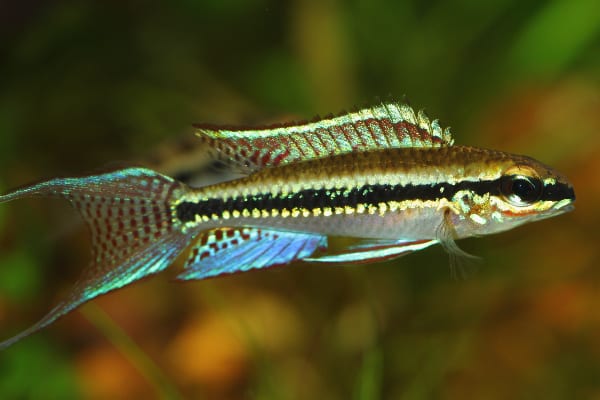
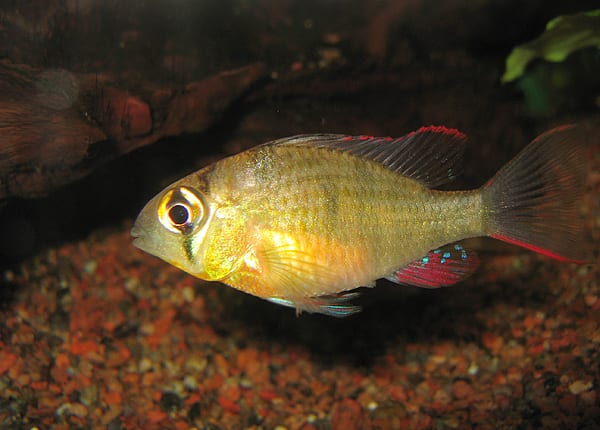
A small cichlid with a black bar through the eye and a dark blotch on the flank, set against a grey-brown body. The throat, belly and fins are washed with yellow and red.
Difficulty
Intermediate
Temperature
24〜28℃
Size
5.6-8cm
Diet
Sinking dried foods, frozen bloodworm, Artemia, Daphnia
About
Mikrogeophagus altispinosus is a small cichlid from the upper Madeira basin, specifically the Rio Mamore and Rio Guapore drainages of Bolivia and Brazil. FishBase records 5.6cm standard length and Seriously Fish gives 8cm. A black bar crosses the eye and a dark blotch marks the flank, while the throat, belly and fins carry yellow and red. It tolerates a wider range of water chemistry than its congener M. ramirezi and is markedly hardier, though it is not a fish for a general community tank. Aquarium conditions are 24-28C, pH 6.0-7.5 and 1-10dGH, with a 90 x 45cm base and roughly 182 litres as the guide. It sifts mouthfuls of substrate for food, so a deep layer of fine rounded sand is important. Pairs are biparental substrate spawners; eggs hatch in 2-3 days and the fry stay immobile for 5-8 days before swimming. The IUCN Red List assesses it as Least Concern.
Source: Wikipedia (CC BY-SA 4.0)
Size of the Bolivian Ram
The Bolivian Ram grows to 5.6-8cm.
Temperature & humidity for the Bolivian Ram
The ideal temperature for the Bolivian Ram is 24〜28℃.
Basic Info
Origin
South America (upper Madeira basin, Rio Mamore and Rio Guapore, Bolivia)
Size
5.6-8cm
Temperature
24〜28℃
Diet
Care Specifications
- pH
- 6–7.5
- Hardness (GH)
- 1–10 dGH
- Water Temp.
- 24–28℃
- Min. Tank
- 182 L
PeacefulGroupBreeding: Moderate
Sources: FishBase / Seriously Fish
References & Sources
Edited & verified by: BreederDirect editorial team
The taxonomic, regulatory, and husbandry data on this page are compiled and verified against the authoritative primary sources below.
Taxonomy & Authority
Accepted name: Mikrogeophagus altispinosus (Haseman, 1911)
Authority databases: FishBase
Nomenclature follows global taxonomic authority databases.
Regulations & Conservation Status
Not CITES-listedIUCN LC · Least Concern
Sources: CITES Appendices (species not listed) / IUCN Red List
Regulations may change. Always verify the latest information with the relevant authorities.
Bolivian Ram Listings
Loading latest listingsFind listings for this species