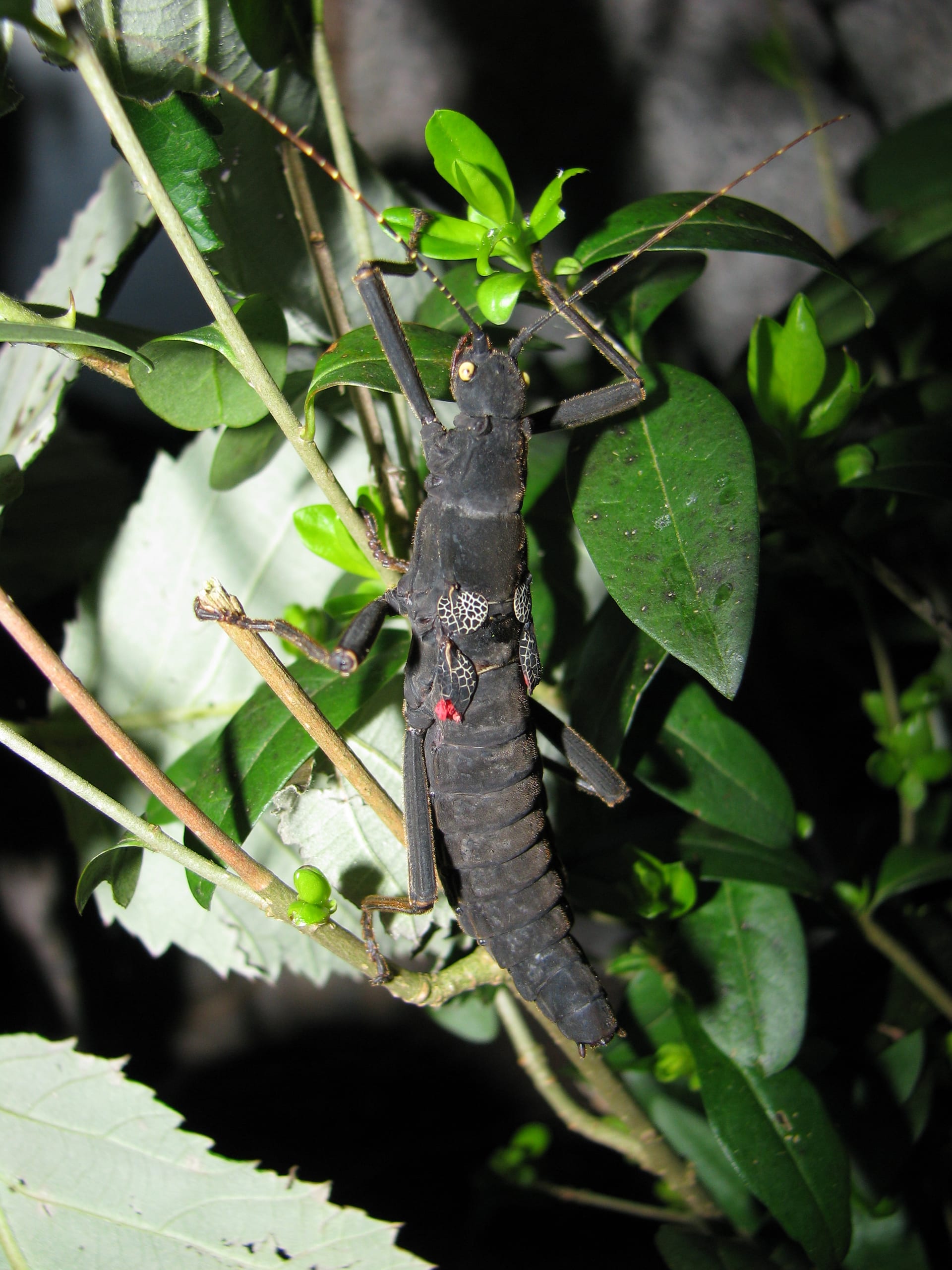
Source: Wikimedia Commons
Black Beauty Stick Insect
BeginnerPeruphasma schultei
A stick insect native to a very small area of northern Peru. A velvety black body contrasts with yellow eyes, a red upper lip and red hindwings. It can be kept at room temperature, but it sprays a defensive fluid when disturbed and so needs careful handling.
Difficulty
Beginner
Temperature
18〜24℃
Lifespan
Adult females 6 months to 1 year / adult males 4-6 months
Size
Females 55-70mm, males 40-50mm
Humidity
40〜60%
Diet
Mainly privet, with forsythia, lilac, Japanese laurel and honeysuckle also taken; in the wild the leaves of Schinus
About
Peruphasma schultei was found in 2004 in the Cordillera del Condor of northern Peru and occupies less than five hectares in the wild. Females are 55 to 70 mm long and males 40 to 50 mm. A velvety black body is set against yellow eyes, antennae ringed with yellow and a vivid red upper lip. The hindwings are deep red over their rear portion, while the front quarter, like the very small forewings, is black with a striking white network. The insects are nocturnal and spend the day hidden in the dense foliage of their food plant, species of Schinus. Disturbed, they raise the coloured hindwings, arch the tip of the abdomen upward and run off quickly, and they can also spray a defensive fluid from glands behind the head that stings the eyes or mucous membranes for several minutes without causing lasting harm. A breeding programme run by a local conservation organisation after the discovery spread the species to keepers worldwide, and it is no longer rare in culture. The Phasmid Study Group lists it as PSG 270.
Source: Wikipedia (CC BY-SA 4.0)
Lifespan of the Black Beauty Stick Insect
The Black Beauty Stick Insect lives Adult females 6 months to 1 year / adult males 4-6 months.
Size of the Black Beauty Stick Insect
The Black Beauty Stick Insect grows to Females 55-70mm, males 40-50mm.
Temperature & humidity for the Black Beauty Stick Insect
The ideal temperature for the Black Beauty Stick Insect is 18〜24℃. Ideal humidity is 40〜60%.
Basic Info
Origin
Northern Peru, in the Cordillera del Condor
Care Specifications
PeacefulGroupBreeding: Easy
Sources: Peruphasma schultei - Wikipedia (DE; size, colouring, composition of the defensive spray, egg numbers and development, rearing temperature and humidity, food plants, enclosure size, PSG number) / Peruphasma schultei - Wikipedia (EN; extent of range, conservation status, food plants in captivity) / GBIF species page for Peruphasma schultei Conle & Hennemann, 2005 (accepted)
References & Sources
Edited & verified by: BreederDirect editorial team
The taxonomic, regulatory, and husbandry data on this page are compiled and verified against the authoritative primary sources below.
Primary sources
- Wikipedia
- CITES Appendices (species not listed)
- IUCN Red List: Peruphasma schultei (Critically Endangered)
- Japan Plant Protection Station: permission to import prohibited articles (definition of quarantine pests and the Article 7 exemption)
- e-Gov: Plant Protection Act, Article 7 (prohibition of import)
- Ministry of the Environment: list of Invasive Alien Species (no Phasmatodea listed)
- Peruphasma schultei - Wikipedia (EN; extent of range, conservation status, food plants in captivity)
- GBIF species page for Peruphasma schultei Conle & Hennemann, 2005 (accepted)
Taxonomy & Authority
Accepted name: Peruphasma schultei Conle & Hennemann, 2005
Authority databases: GBIF
Nomenclature follows global taxonomic authority databases.
Regulations & Conservation Status
Not CITES-listedIUCN CR · Critically Endangered
Plant Protection Act: Phasmids feed on leaves, and live specimens of foreign species that do not occur in Japan count as quarantine pests under the Plant Protection Act. Article 7 of that Act makes quarantine pests prohibited imports, so they may not be brought in except with prior permission from the Minister of Agriculture, Forestry and Fisheries for research, exhibition or a similar purpose. Stock available in Japan is therefore limited to animals bred domestically over generations, and the Plant Protection Station should be asked about any individual case.
Sources: CITES Appendices (species not listed) / IUCN Red List: Peruphasma schultei (Critically Endangered) / Japan Plant Protection Station: permission to import prohibited articles (definition of quarantine pests and the Article 7 exemption) / e-Gov: Plant Protection Act, Article 7 (prohibition of import) / Ministry of the Environment: list of Invasive Alien Species (no Phasmatodea listed)
Regulations may change. Always verify the latest information with the relevant authorities.
Black Beauty Stick Insect Listings
Loading latest listingsFind listings for this species