Teaching Children Insect Care: The Educational Value of Raising Beetles and Stag Beetles
Discover the educational benefits of raising beetles and stag beetles with your children, and learn practical tips for enjoying insect care as a family.
Key Takeaways
Discover the educational benefits of raising beetles and stag beetles with your children, and learn practical tips for enjoying insect care as a family.
Powers Children Gain from Raising Insects
Raising beetles and stag beetles with children holds educational value that goes beyond mere hobby. Caring for living creatures is one of the best opportunities to cultivate responsibility, observational skills, and respect for life.
Insects are relatively easy to raise, pose little danger, and require less space and expense compared to dogs or cats. Because they can be kept even in apartments or rental homes, they are ideal introductory pets for families with children who want to keep animals.
✍️
BreederDirect Editorial
The BreederDirect editorial team specializes in care information for animals, covering veterinary care and breeding to deliver beginner-friendly guides.
Find Insects on BreederDirect
Buy directly from verified breeders
Browse Related Listings
Find Insects listings related to this article on BreederDirect. Buy directly from verified breeders.
Observing the drama of complete metamorphosis—from egg to larva to pupa to adult—at home is a unique insect experience. Through this metamorphosis process, children can visually learn about "the cycle of life." When what they learn in school science textbooks connects with real-world experience, their interest in learning deepens.
In particular, insect metamorphosis gives children a sense of "wonder at transformation." A white larva moving through soil becomes a brown pupa, and finally transforms into an adult with a gleaming exoskeleton. Children who witness this mysterious transformation up close often develop a deep interest in the natural world.
Age-Based Approaches to Insect Care
It is important to adjust how children interact with insects based on their age.
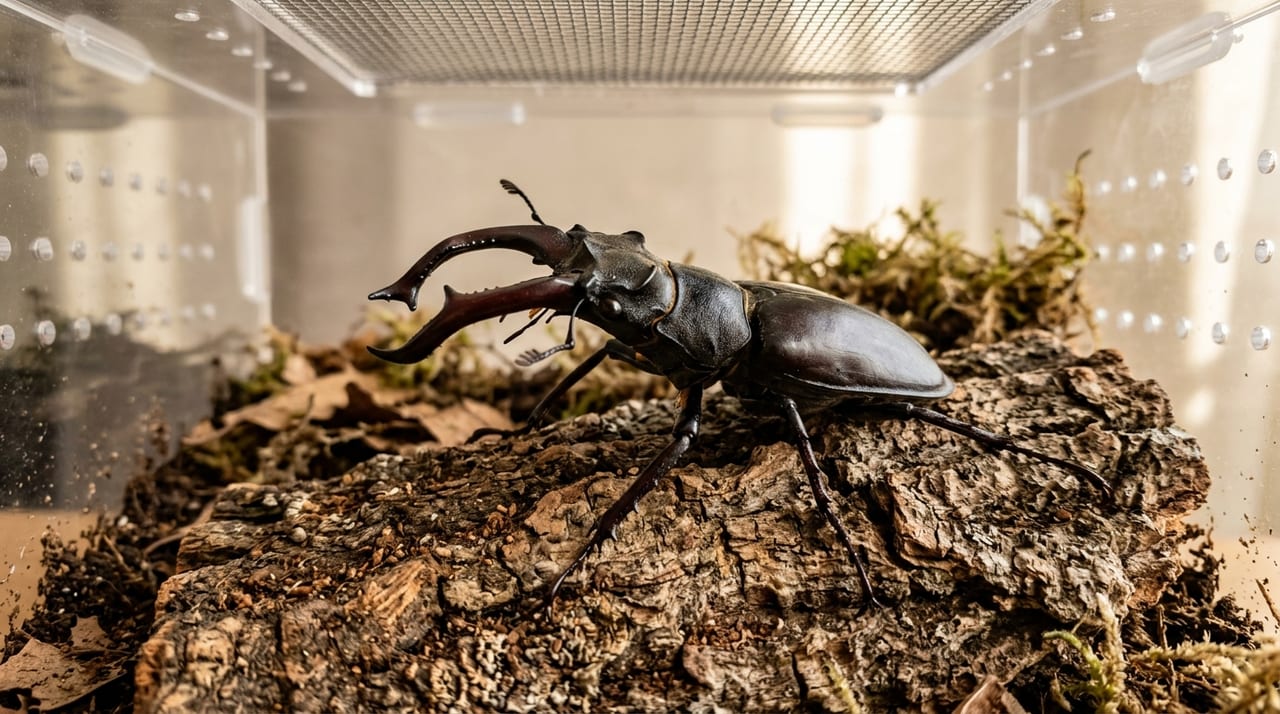
Early Childhood (Ages 3–5): Start with "observing" rather than direct handling. Simply watching beetles move through a transparent case provides sufficient stimulation. Parents should take the lead in care, while children help with simple tasks like replacing food jelly. The habit of checking together each day—"Is it still doing well today?"—contributes to emotional education.
Lower Elementary School (Ages 6–8): This is an ideal age for observing larvae. Children enjoy raising beetle larvae in transparent containers and using sets where they can watch larvae move through the soil. Begin entrusting children with daily care tasks like feeding and misting. Keeping a care diary cultivates both observational skills and written expression. Additionally, borrowing insect guides from the library and researching "what type of larva I'm raising" boosts learning motivation.
Upper Elementary School (Ages 9–12): This is an age for attempting breeding. By experiencing all stages—mating, egg-laying, hatching, larva management, and emergence—with their parents, children gain a deeper understanding of life. At this stage, breeding can be combined with field guides and insect collecting to broaden interest in species identification and ecology. Furthermore, having children calculate care costs or organize records in charts creates connections with math and science.
Life Education Through Insect Care
Insects have relatively short lifespans, and their death provides an opportunity to learn about "death." Adult beetles reach the end of their lives from summer into autumn. How parents respond when children witness this death is crucial.
Gentle words like "It was happy because you cared for it so well" and "Let's raise one from an egg again next year" help transform loss into learning. Children who can grieve the end of life grow into adults with respect for all living things.
Additionally, when children witness a larva creating its own pupation chamber in the substrate and the moment of emergence, they experience "wonder at being alive." These moving moments often become lifelong memories. In fact, many breeders say, "Watching a beetle emerge when I was a child sparked my interest." Even if parents are not knowledgeable about insects, showing the attitude of investigating and learning together with children greatly nurtures their sense of inquiry.
Beyond the experience of death, the wonder of birth is equally important. The moment eggs hatch and tiny first-instar larvae appear, or when adults break through the pupation chamber, carry an impact that words cannot fully convey. By witnessing these moments, children's interest in life naturally deepens.
Creating an Environment for Family Enjoyment
The first priority in raising insects with children is establishing a safe, clean rearing environment.
Odor and Cleanliness: Insect substrate can develop a fermented odor. Placing it in a well-ventilated location and regularly replacing the substrate keeps odors in check. Make sure children wash their hands thoroughly after handling.
Fruit Fly Prevention: Fruit flies are a common challenge in insect keeping. Using cases with built-in fruit fly shutters or placing paper towels over the case lid is effective. Rather than getting upset if fruit flies appear, thinking through "why did they come?" with your child becomes a valuable learning opportunity.
Escape Prevention: Beetles are strong and will escape through any gap. Choose cases with secure lids and place them in locations where furniture gaps are minimal. Since hunting for an escaped beetle around the house can be time-consuming, prevention from the start is essential.
Photo and Video Recording: Recording larval development, emergence moments, and adult beetles on a smartphone creates a treasure to revisit as they grow. Having children take photos themselves makes them more active observers. Videos become records for the family to watch later, preserving family memories alongside deepened affection for the insects.
Experiencing insects is a rich opportunity to cultivate children's sensitivity, responsibility, and curiosity. Through raising beetles and stag beetles, let's nurture together the ability to notice the wonders of nature. What matters most is not "perfect care" but "engaging together." The process of experiencing alongside your child—including failures—creates irreplaceable moments.