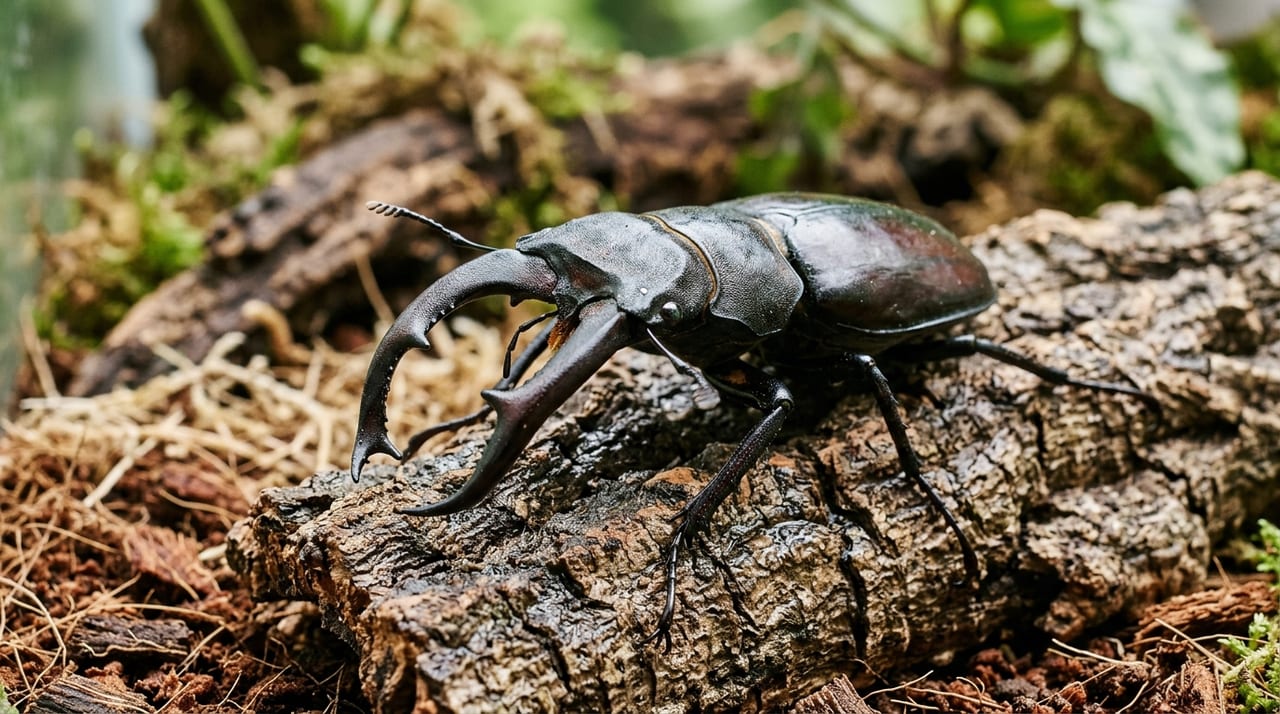
The Difference Between Wild-Caught (WF) and Captive-Bred (CB) Beetles | Essential Knowledge Before Purchasing Stag Beetles and Rhinoceros Beetles
Explaining the difference between "Wild-Caught (WF)" and "Captive-Bred (CB)" stag beetles and rhinoceros beetles. We break down how to choose when purchasing and important considerations from a breeder's perspective.
Key Takeaways
Explaining the difference between "Wild-Caught (WF)" and "Captive-Bred (CB)" stag beetles and rhinoceros beetles. We break down how to choose when purchasing and important considerations from a breeder's perspective.
What is a Wild-Caught (WF) Specimen?
When viewing product listings on insect marketplaces or specialty shops, you may encounter abbreviations like "WF1," "CB," and "F2." These notations indicate how an individual specimen was born and are extremely important information for making purchasing decisions.
✍️
BreederDirect Editorial
The BreederDirect editorial team specializes in care information for animals, covering veterinary care and breeding to deliver beginner-friendly guides.
Find Insects on BreederDirect
Buy directly from verified breeders
Browse Related Listings
Find Insects listings related to this article on BreederDirect. Buy directly from verified breeders.
A Wild-Caught specimen, abbreviated as WF, refers to an individual collected from the wild. WF1 means "the first-generation captive-bred offspring born from the pairing of wild-caught specimens." WF0 sometimes refers to the collected specimen itself (field specimen). Wild-caught specimens possess the natural genetic diversity of their species and carry strong wild bloodlines.
In particular, for foreign stag beetle species, wild-caught specimens are collected from localities such as Indonesia, Thailand, and Malaysia, and distributed throughout Japan via importers. Specimens from rare localities or highland areas have limited distribution, and being wild-caught can itself add significant value.
Conversely, CB (Captive Bred) specimens are captive-bred individuals that have been bred and managed in captivity. These are specimens raised over multiple generations by Japanese breeders and have become increasingly adapted to captive environments. As generations progress—such as F1 (first generation with both parents wild-caught) and F2 (offspring from F1 pairings)—there is a tendency for captive suitability to improve. By accurately understanding these notations, you can prevent post-purchase problems and select individuals suited to your goals.
Notation
Meaning
WF
Wild-Caught specimen. Refers to individuals collected from the wild
WF1
First-generation captive-bred offspring born from pairing wild-caught specimens
WF0
The collected specimen itself (field specimen)
CB
Captive Bred specimen. Individuals bred and managed in captivity
F1
First generation with both parents wild-caught
F2
Offspring from F1 pairings
Advantages and Disadvantages of Wild-Caught Specimens
Advantages:
Specimens that survived in the wild are fundamentally healthy and robust.
In particular, wild males are proven competitors that triumphed in natural selection, with size and jaw shape showing natural variation.
Since the purity of their locale is preserved, they are valued as a "foundation" for bloodline management.
Additionally, wild-caught specimens with a long history of natural selection tend to have strong vitality and high egg-laying rates.
Disadvantages:
Wild-caught specimens may take time to adapt to captive environments after collection.
Since there is a risk of introducing parasites and mites that they carried in the wild, treatment (isolation and transfer to clean substrate) is recommended before housing with other individuals.
Additionally, females may already be mated, making it impossible to pair them with a male of your choice.
Imported wild-caught specimens may have experienced prolonged shipping stress, so it's important to allow them to rest in a stable environment for a period after arrival. Damage and missing parts are not uncommon in wild specimens, so it's essential to check their condition before purchase.
Advantages and Disadvantages of Captive-Bred (CB) Specimens
Advantages:
The greatest advantage of CB specimens born and raised domestically is their high adaptability to captive environments, making them easy for beginners to handle.
Since husbandry management is standardized, there is abundant information on food preferences and optimal temperatures.
Additionally, some breeders publish detailed bloodline records, making it possible to conduct selective breeding aimed at producing larger specimens through pairings of large individuals.
Bloodlines with a proven track record of consistent egg-laying and emergence over multiple generations tend to have higher breeding success rates.
Disadvantages:
Extended inbreeding over many generations can lead to weakening due to inbreeding depression.
Issues such as reduced breeding rates, increased emergence failures, and shorter adult lifespans may occur.
To avoid these problems, outbreeding (crossing with external bloodlines) is practiced.
When maintaining CB specimens over an extended period, regularly introducing external bloodlines contributes to maintaining a healthy colony.
How to Choose When Purchasing and Important Considerations
Choose based on your purpose: If your goal is observation or display, CB specimens are recommended for their ease of handling. Wild-caught specimens are more suitable if you seek purer locality specimens or wish to establish a breeding foundation.
Verify locality and generation information: Trustworthy sellers clearly state the locality, collection year, and generation (WF1, F2, etc.). Be cautious of listings where this information is unclear. Particularly with foreign species, there are cases where something is claimed to be wild-caught but is actually a CB specimen of unknown locality. Also refer to the seller's profile and past reviews.
Check health status: For parasite prevention, wild-caught specimens should be transferred to clean new substrate after acquisition and isolated from other individuals for 2–3 weeks. Even CB specimens experience shipping stress, so allow them to settle in a quiet location for a period after arrival.
Assess price reasonableness: Wild-caught specimens from rare localities, large individuals, and CB specimens from renowned bloodlines command high prices. If the price seems unusually low, be cautious as there may be locality misrepresentation or poor condition.
Both wild-caught and CB specimens have their own unique appeal. The true pleasure of insect breeding lies in selecting individuals suited to your goals and passing them on to the next generation. Carefully manage locality information and bloodline records, and enjoy responsible breeding.