Source: Wikimedia Commons
Harlequin Rasbora
BeginnerTrigonostigma heteromorpha
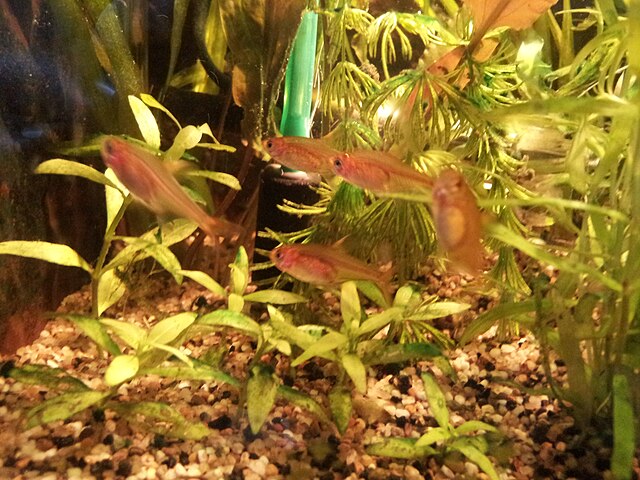
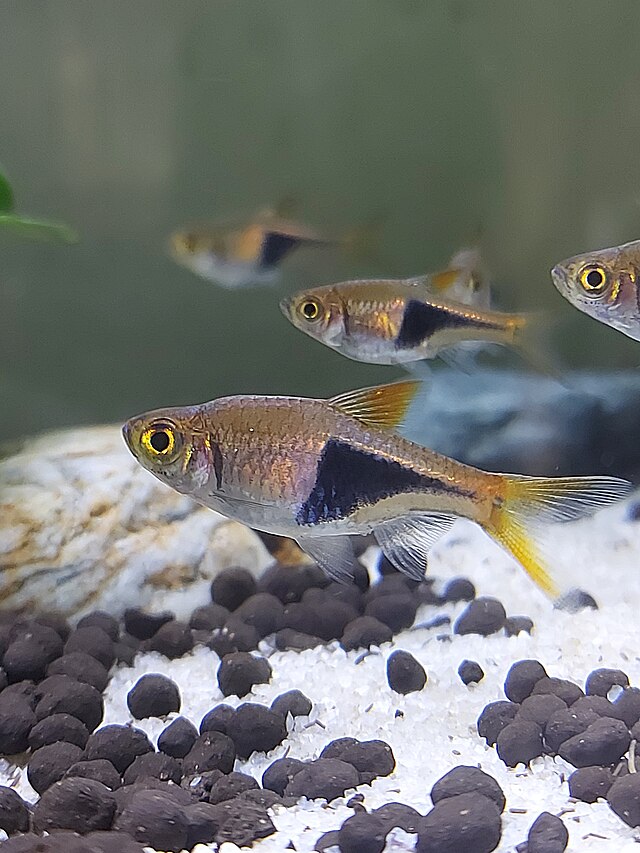
A beautiful small fish with orange body and black triangle mark. Schooling looks best in planted tanks.
Difficulty
Beginner
Temperature
22〜28℃
Lifespan
3-5 years
Size
3-4cm
Diet
Pellets, Frozen food
About
The harlequin rasbora (Trigonostigma heteromorpha) is a small cyprinid native to slow-moving, blackwater streams and swamps of the Malay Peninsula, Thailand, Sumatra, and Borneo. At 3–4 cm, its copper-orange to pinkish body with a distinctive bold black triangular patch covering the rear half creates an immediately recognizable profile — giving rise to its alternative name, the 'black wedge rasbora.' Introduced to the aquarium hobby in the early 1900s, it achieved iconic status when featured on the cover of William T. Peaceful and schooling, a group of ten or more produces a cohesive, beautiful display. Compatible with virtually all small community fish. Omnivorous and accepts quality granules, flake food, and frozen daphnia. Breeding occurs on the undersides of broad-leafed plants such as Anubias in soft, acidic conditions. A true classic of the freshwater aquarium, beloved consistently across more than a century of the hobby.
Source: Wikipedia (CC BY-SA 4.0)
Lifespan of the Harlequin Rasbora
The Harlequin Rasbora lives 3-5 years.
Size of the Harlequin Rasbora
The Harlequin Rasbora grows to 3-4cm.
Temperature & humidity for the Harlequin Rasbora
The ideal water temperature for the Harlequin Rasbora is 22〜25℃.
Innes' landmark 1935 book 'Exotic Aquarium Fishes.' Soft, slightly acidic water (pH 5.5–7.0) at 24–28°C is ideal; blackwater setups with tannins enhance coloration.
Basic Info
Origin
streams and swamps of the Malay Peninsula, Thailand, Sumatra, and Borneo
Care Specifications
- pH
- 5–7
- Hardness (GH)
- 5–12 dGH
- Water Temp.
- 22–25℃
PeacefulGroupBreeding: Moderate
Sources: FishBase / Seriously Fish
References & Sources
Edited & verified by: BreederDirect editorial team
The taxonomic, regulatory, and husbandry data on this page are compiled and verified against the authoritative primary sources below.
Taxonomy & Authority
Regulations & Conservation Status
Not CITES-listed
Trigonostigma heteromorpha is not CITES-listed.
Sources: Seriously Fish / CITES Appendices (Checklist)
Regulations may change. Always verify the latest information with the relevant authorities.
Harlequin Rasbora Listings
Loading latest listingsFind listings for this species