Source: Wikimedia Commons
Elephantnose Fish
AdvancedGnathonemus petersii
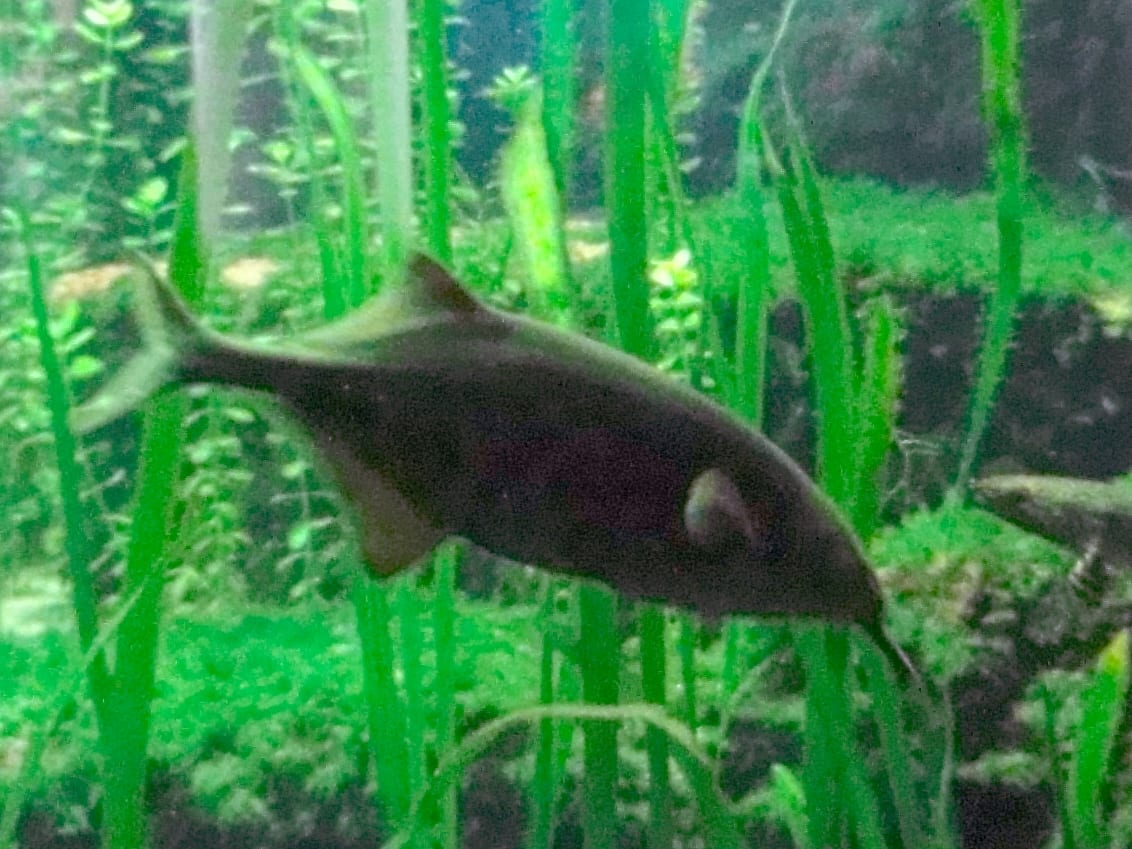
A remarkable freshwater fish that senses its surroundings with weak electric pulses. The trunk-like organ is an extension of the lower jaw, probed into sand to find food. Fine sand and dim lighting are prerequisites for keeping it.
Difficulty
Advanced
Temperature
23〜28℃
Lifespan
6-10 years
Size
Up to about 35cm standard length (some sources give 22.5cm)
Diet
Bloodworm and other worms live or frozen, plus dried foods
About
Gnathonemus petersii is a mormyrid from the Niger to Congo basins, living in muddy, slow-moving rivers and pools with submerged branches, and reaching about 35cm standard length (some sources give 22.5cm). The trunk-like projection is not a nose but an extension of the lower jaw, densely covered in electroreceptors; the fish reads distortions in the weak electric field generated by an organ in its tail to find food and obstacles. Its brain accounts for the largest brain-to-body oxygen use ratio known in vertebrates, around 0.6. A fine sand bed is essential because the fish probes the substrate with this organ, and gravel prevents normal feeding behaviour. Keep the lighting dim with plenty of cover, at pH 6.0-7.5, 5-15 dGH and 23-28C in a tank of about 120x45cm, 243 litres. It lives 6-10 years and captive breeding is not thought to have been achieved.
Source: Wikipedia (CC BY-SA 4.0)
Lifespan of the Elephantnose Fish
The Elephantnose Fish lives 6-10 years.
Size of the Elephantnose Fish
The Elephantnose Fish grows to Up to about 35cm standard length (some sources give 22.5cm).
Temperature & humidity for the Elephantnose Fish
The ideal temperature for the Elephantnose Fish is 23〜28℃.
Basic Info
Origin
Africa: Niger to Congo river basins, widespread in the Congo basin
Lifespan
6-10 years
Care Specifications
- pH
- 6–7.5
- Hardness (GH)
- 5–15 dGH
- Water Temp.
- 23–28℃
- Min. Tank
- 243 L
Semi-aggressiveSolitaryBreeding: Very hard
Sources: Seriously Fish: Gnathonemus petersii / FishBase: Gnathonemus petersii
References & Sources
Edited & verified by: BreederDirect editorial team
The taxonomic, regulatory, and husbandry data on this page are compiled and verified against the authoritative primary sources below.
Taxonomy & Authority
Accepted name: Gnathonemus petersii Günther, 1862
Authority databases: FishBase
Nomenclature follows global taxonomic authority databases.
Regulations & Conservation Status
Not CITES-listedIUCN LC · Least Concern
Sources: CITES Appendices (species not listed) / IUCN Red List
Regulations may change. Always verify the latest information with the relevant authorities.
Elephantnose Fish Listings
Loading latest listingsFind listings for this species