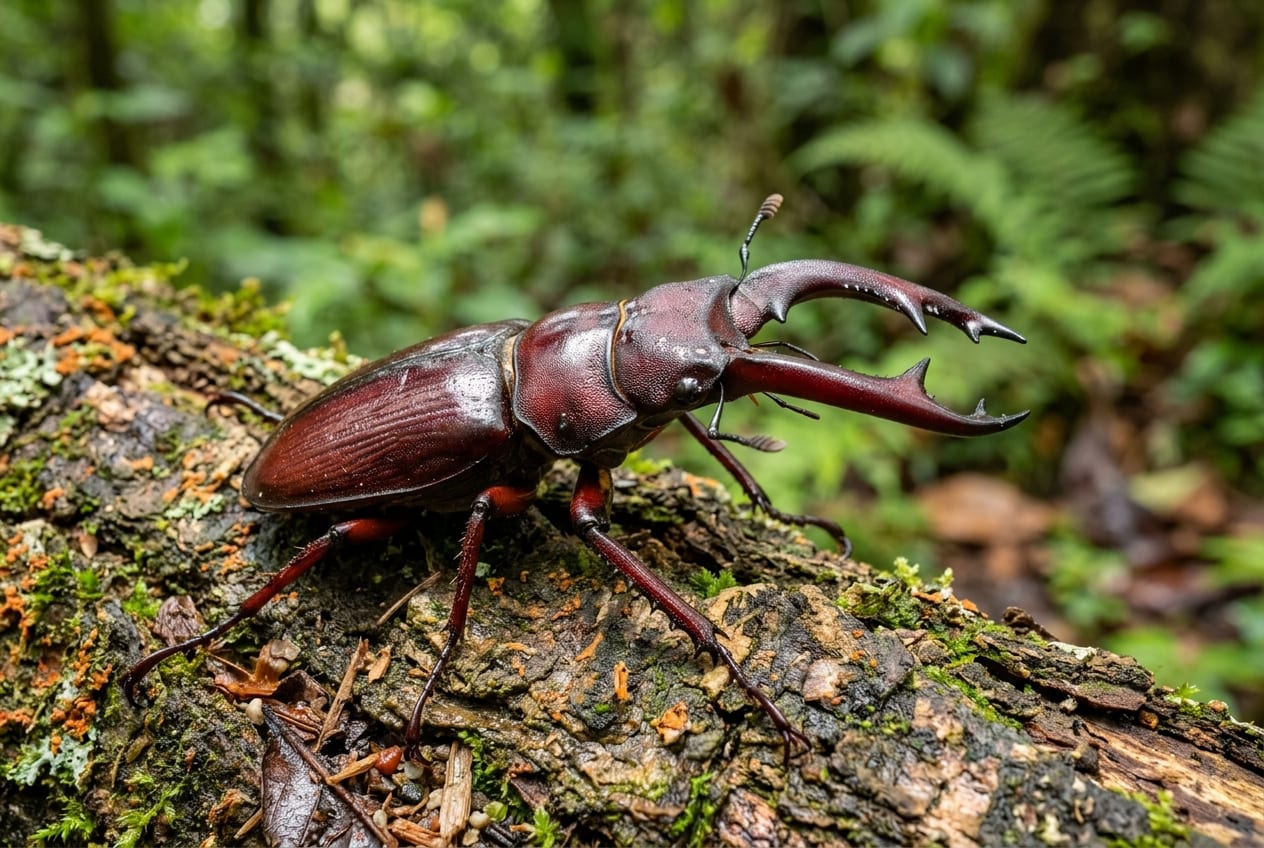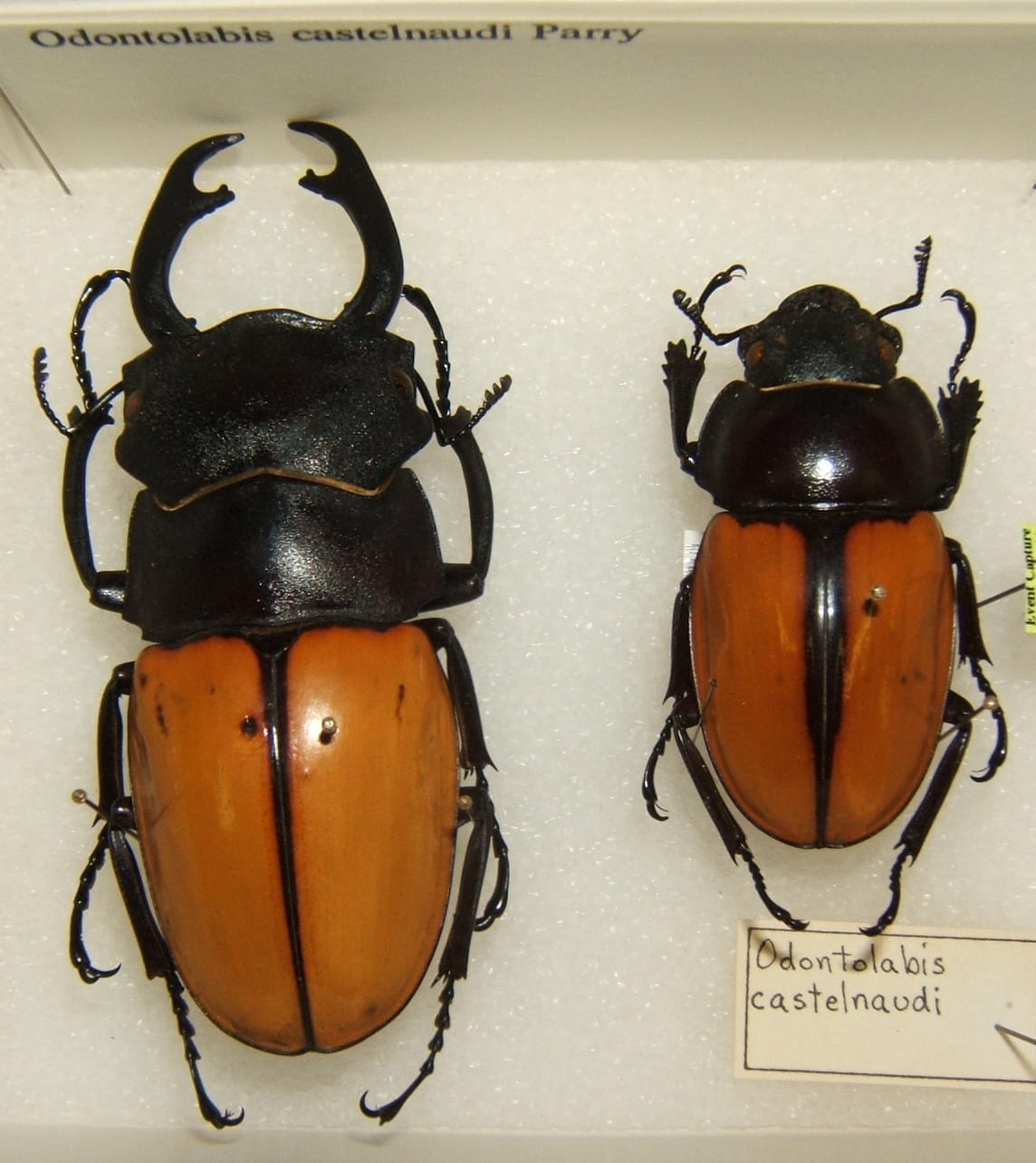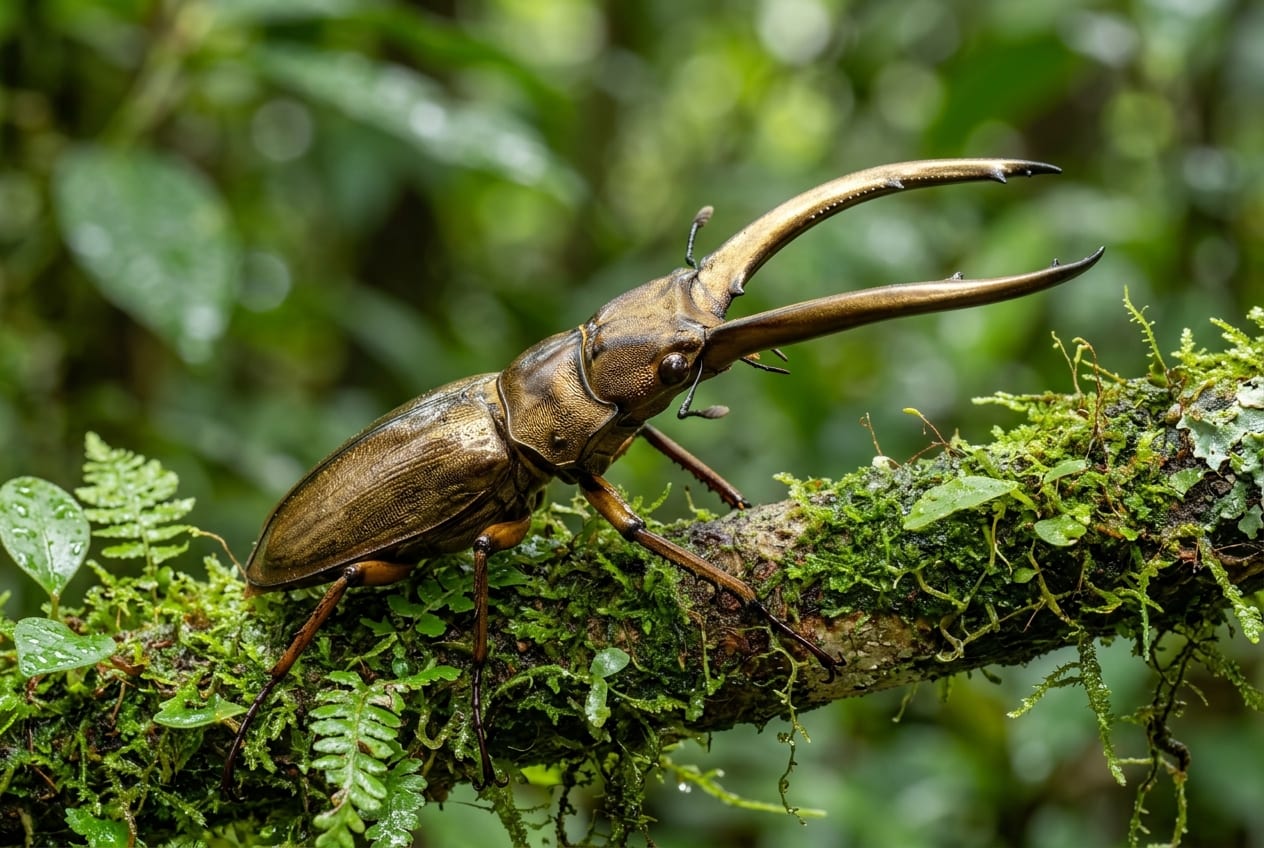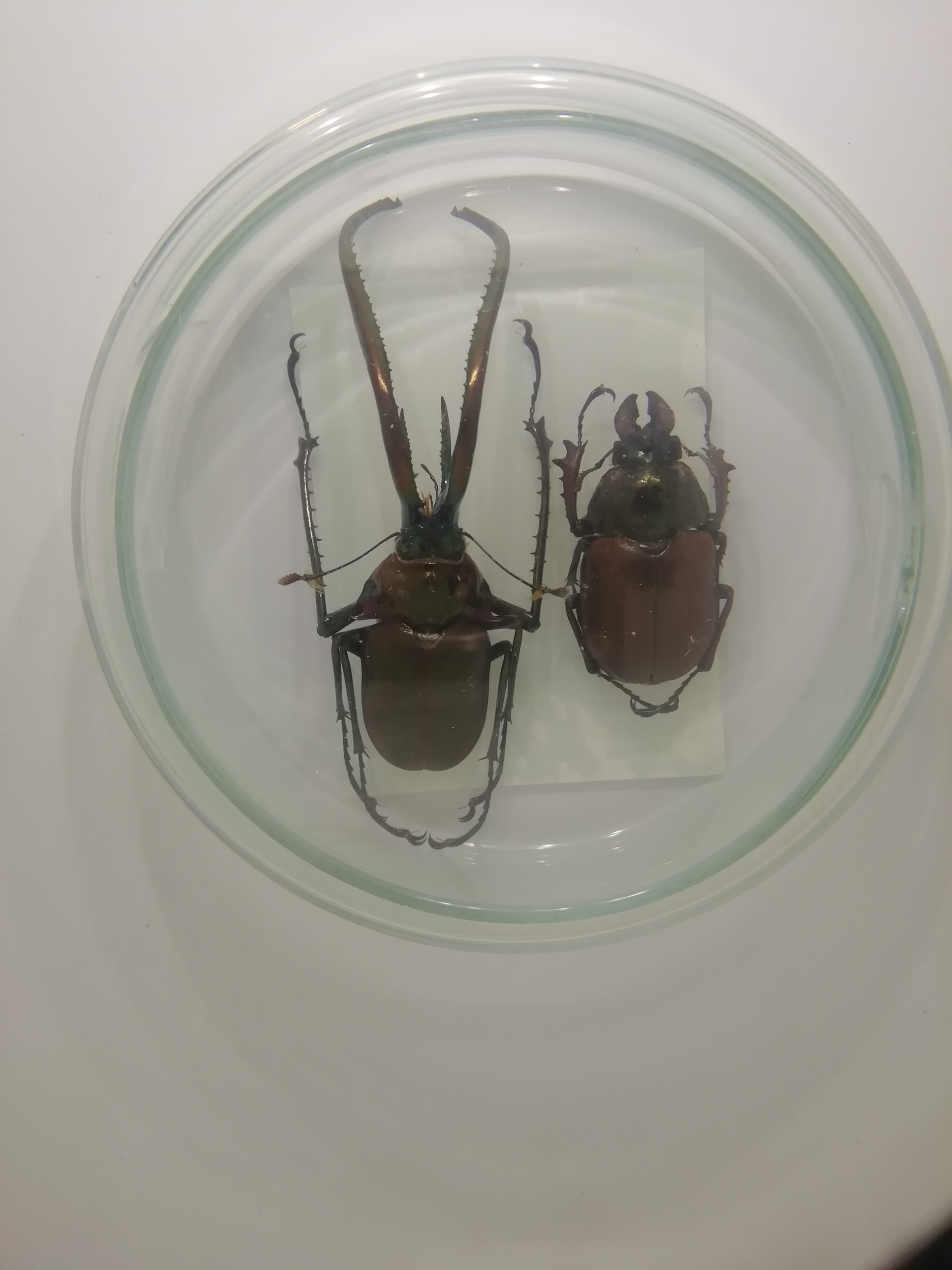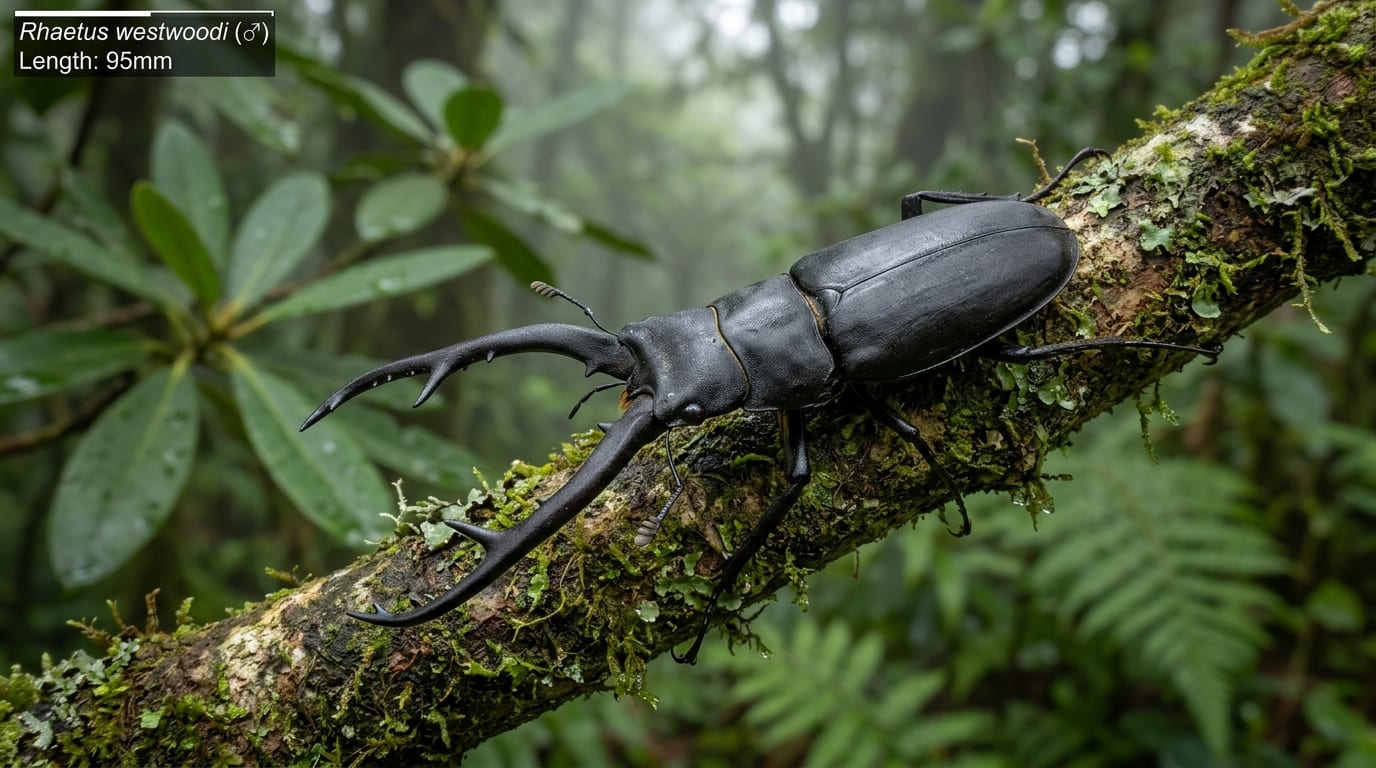
AI-generated image
Westwood's Giant Deer Stag Beetle
AdvancedRhaetus westwoodi
The largest of the deer stag beetle group, found along the eastern Himalaya, with a dull sheen on the black body of both sexes. The antler-like mandibles are its mark, and in Japan it is a sought-after beetle known simply as Woody.
Difficulty
Advanced
Temperature
18〜23℃
Lifespan
6 months to a year as an adult (females 2-3 months once active)
Size
Nominate males 50.0-96.1mm, females 39.5-51.1mm (captive record 94.1mm, wild record 97.1mm)
Humidity
60〜80%
Diet
Adults take the sap of oaks and beetle jelly; larvae are reared in beech-based Coriolus or oyster-mushroom mycelium bottles
About
This beetle is the only species placed in the genus Rhaetus and is the largest of the deer stag beetle group, ranging widely along the eastern Himalaya. The nominate subspecies is recorded from eastern Nepal, northeastern India, western Bhutan and southeastern Tibet, while northern Myanmar has the subspecies kazumiae. Both sexes are black with a dull sheen, and the male carries long, curved mandibles. Nominate males run 50.0 to 96.1 mm and females 39.5 to 51.1 mm, and according to the survey by Mushi-sha the largest males on record are 97.1 mm in the wild and 94.1 mm in captivity. It is commonest above about 1,500 m, the adults are active mainly from June to August and gather at the sap of oaks, and they rarely come to lights. Hiroshi Fujita rates rarity in the field on a six-point scale, and both the nominate form and kazumiae are placed at five stars, meaning rare. The rearing optimum is 18 to 23 degrees, and at 22 degrees eggs take 22 to 30 days to hatch.
Source: Wikipedia (CC BY-SA 4.0)
Lifespan of the Westwood's Giant Deer Stag Beetle
The Westwood's Giant Deer Stag Beetle lives 6 months to a year as an adult (females 2-3 months once active).
Size of the Westwood's Giant Deer Stag Beetle
The Westwood's Giant Deer Stag Beetle grows to Nominate males 50.0-96.1mm, females 39.5-51.1mm (captive record 94.1mm, wild record 97.1mm).
Temperature & humidity for the Westwood's Giant Deer Stag Beetle
The ideal temperature for the Westwood's Giant Deer Stag Beetle is 18〜23℃.
Basic Info
Care Specifications
AggressiveSolitaryBreeding: Very hard
Sources: Rhaetus westwoodii - Wikipedia (JA; generic placement, subspecies and ranges, size, biology, rearing temperatures and egg-laying, larval rearing, dormancy) / GBIF species page for Rhaetus westwoodi (Parry, 1862) / BE-KUWA Certified Breeding Records (Mushi-sha, FY2025 edition PDF, JA)
Breeding Records & Localities
Captive record (♂)
94.1 mm
Wild record (♂)
97.1 mm
Record source: BE-KUWA 2025 edition, captive records for imported stag beetles (westwoodii nominate: captive 94.1 mm, m1905, registered 2016, wild 97.1 mm, expected maximum 102 mm; subspecies kazumiae: captive 89.0 mm, Taiga Sasaki, registered 2021, wild 86.3 mm, expected maximum 95 mm). The Japanese Wikipedia cites the same figures from the Mushi-sha survey
Notable localities
Arunachal Pradesh, IndiaWest Bengal, IndiaEastern NepalWestern BhutanTibet, ChinaNorthern Myanmar
Regional subspecies
- Rhaetus westwoodii westwoodii(The nominate form of this entry; also proposed as the Indian giant deer stag) — Eastern Nepal, northeastern India, western Bhutan, southeastern Tibet
- Rhaetus westwoodii kazumiae(Described in 2000) — Kachin and Sagaing in northern Myanmar
Generation codes
- WD
References & Sources
Edited & verified by: BreederDirect editorial team
The taxonomic, regulatory, and husbandry data on this page are compiled and verified against the authoritative primary sources below.
Taxonomy & Authority
Accepted name: Rhaetus westwoodi (Parry, 1862)
Synonyms: Rhaetus westwoodii, Rhaetus westwoodi, Hexarthrius westwoodii
Authority databases: GBIF
Nomenclature follows global taxonomic authority databases.
Regulations & Conservation Status
Not CITES-listed
Plant Protection Act: When importing live specimens of Scarabaeoidea (including rhinoceros beetles, stag beetles, flower beetles, etc.), a species identification certificate issued by the exporting country government agency or equivalent must be attached in accordance with the Invasive Species Act (import ports are limited to Narita, Chubu, Kansai, Fukuoka, and Kagoshima airports). This species itself is not a designated invasive species, and import is possible upon submission of the certificate.
Sources: Ministry of the Environment, Invasive Species Act: "Guidance for Those Importing Live Insects in Scarabaeoidea" / CITES Appendix (checklist.cites.org)
Regulations may change. Always verify the latest information with the relevant authorities.
Westwood's Giant Deer Stag Beetle Listings
Loading latest listingsFind listings for this species