Source: Wikimedia Commons
Melly's Stag Beetle
IntermediateHomoderus mellyi
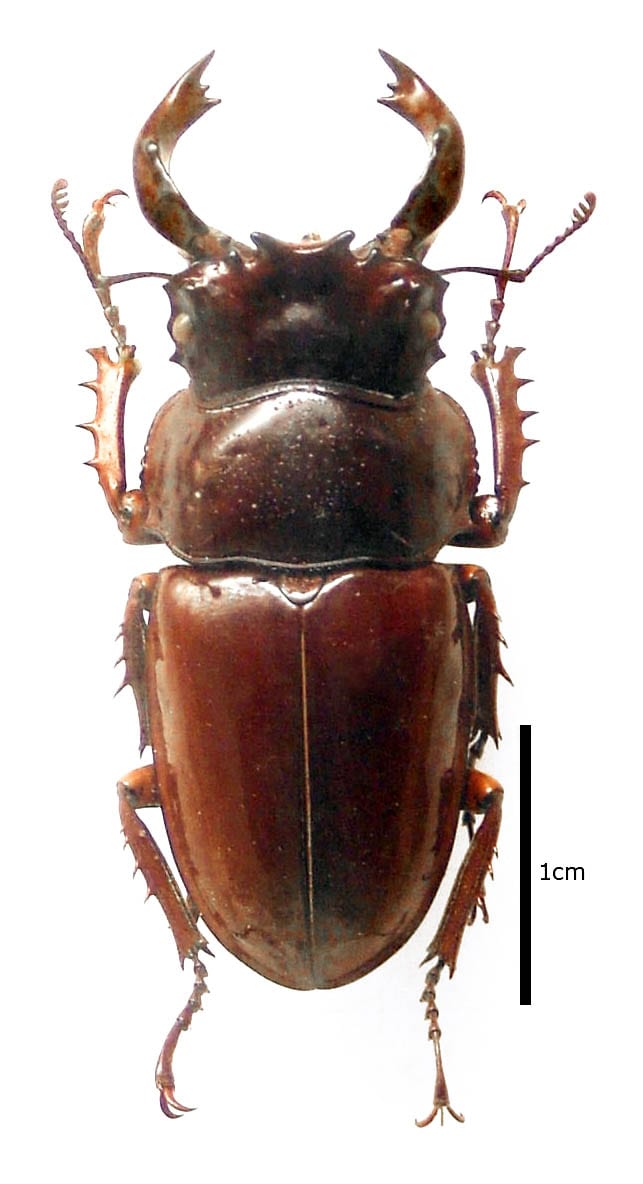
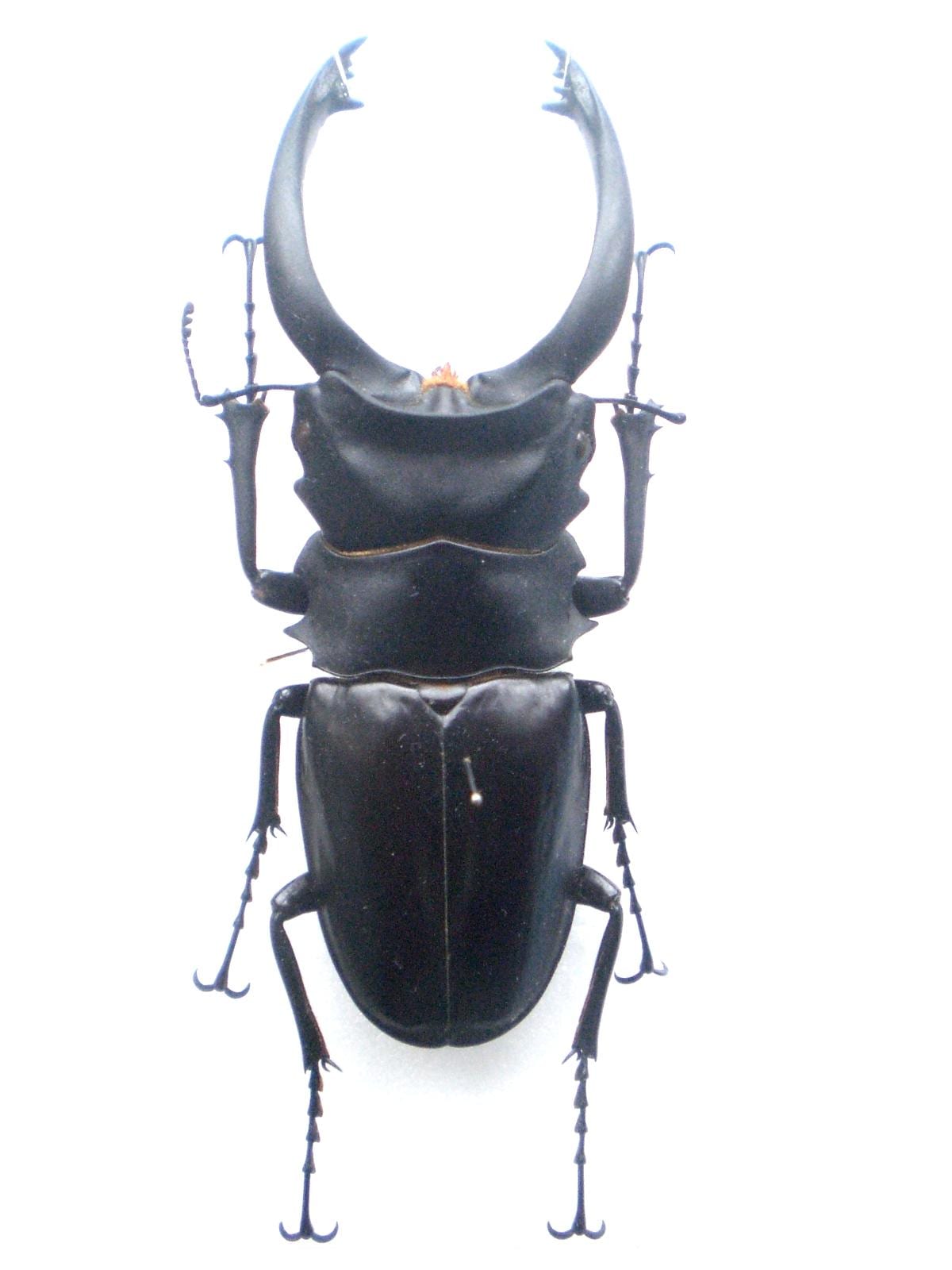
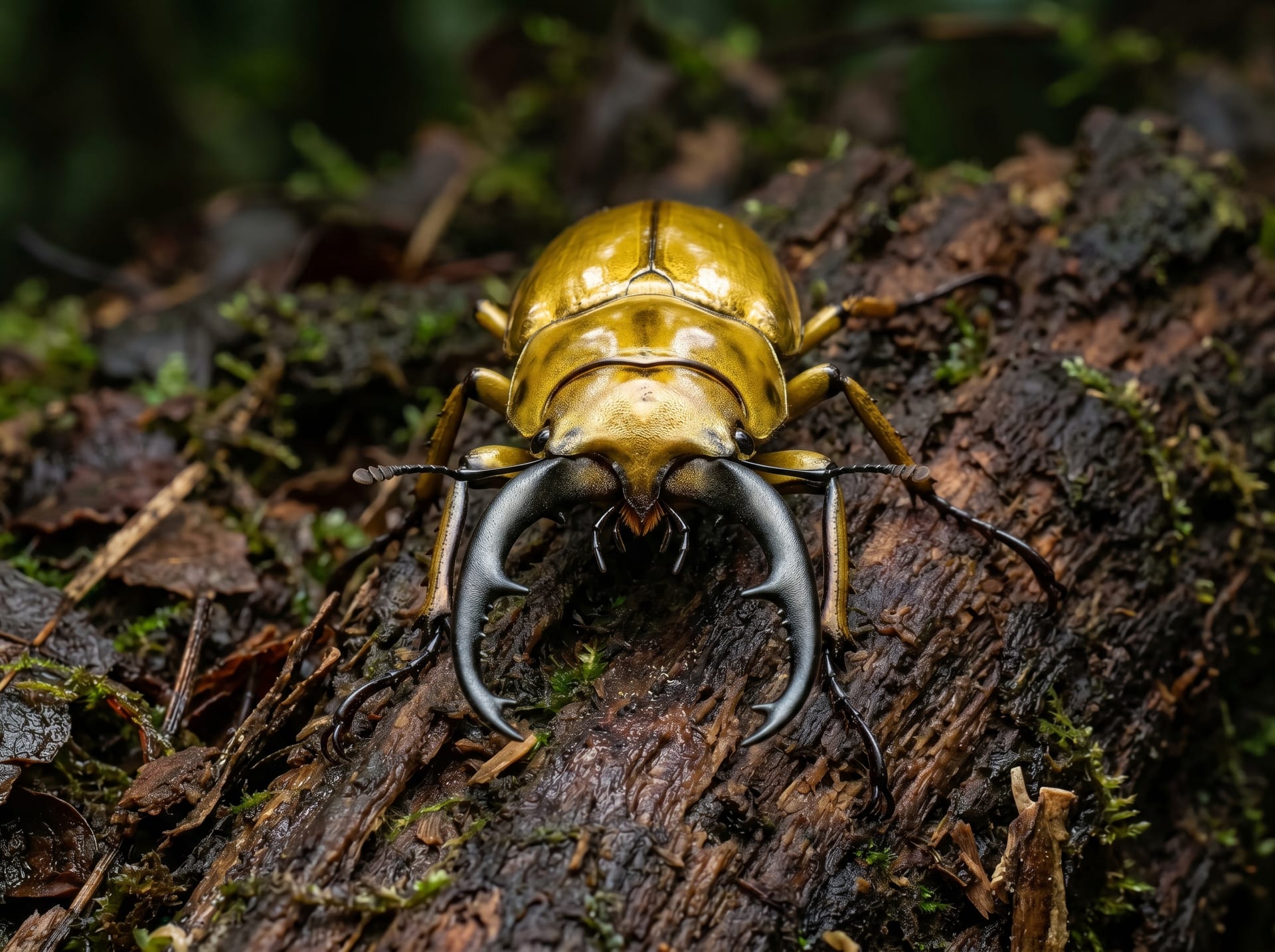
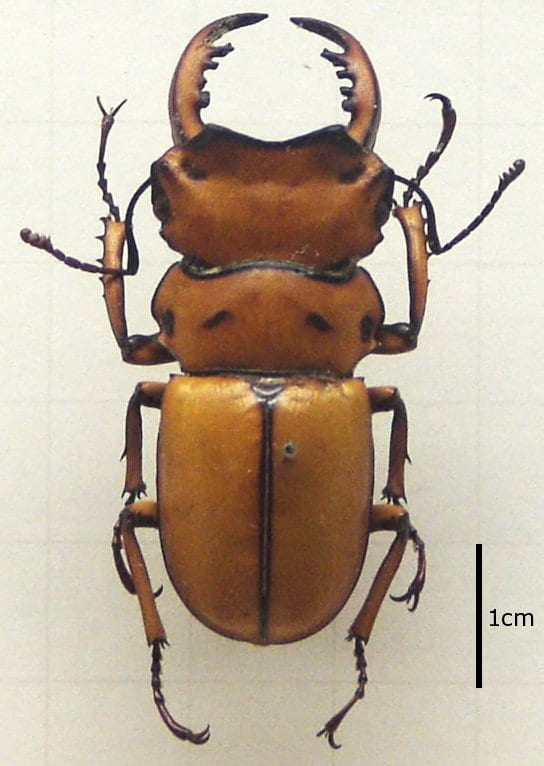
A yellowish-brown stag beetle of central Africa. The male carries a large shield-like process on the head, which is what its Japanese name refers to, and the pronotum bears two or four black spots on either side.
Difficulty
Intermediate
Temperature
20〜28℃
Lifespan
Short once sexually mature
Size
Captive record 58.5mm, wild record 53.6mm
Humidity
60〜80%
Diet
Adults take tree sap and beetle jelly; larvae are reared on fermented substrate or in mycelium bottles
About
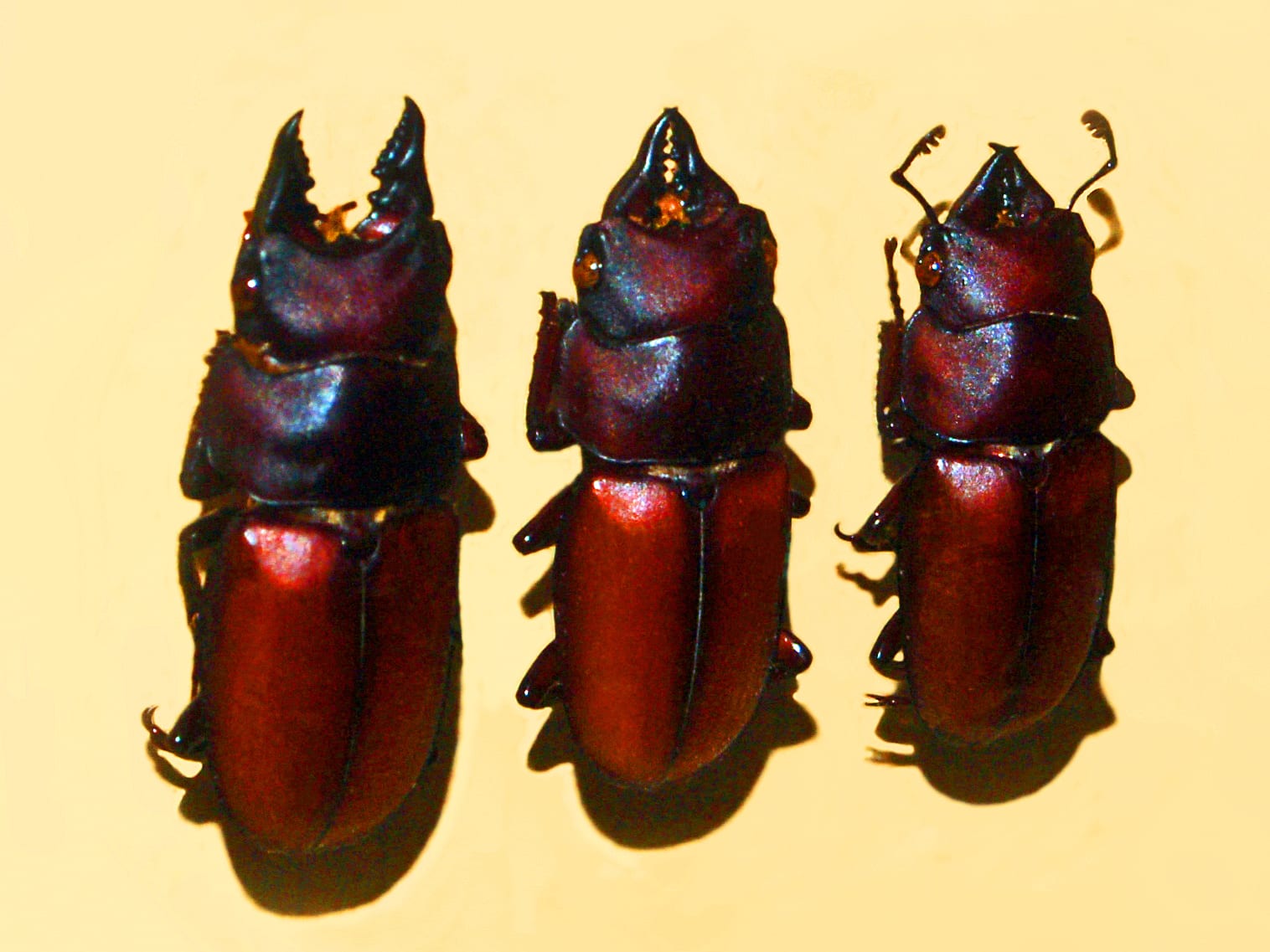
Homoderus mellyi is a central African member of Homoderus, a genus that also holds H. gladiator. The specific name honours the insect collector Andre Melly. The male carries a large shield-like process on the head above the clypeus, which is what the Japanese name refers to; it is better developed in larger beetles and serves as a shield, keeping a rival's mandibles off the head during a fight. The body is yellowish brown with two or four black spots on either side of the pronotum, and in the female those spots are larger while the elytra are black with two tortoiseshell lines running lengthwise. The unusual yellowish-brown colouring is thought to be an adaptation that moderates the absorption of radiant heat from sunlight. The female lays into the surface of soft white-rotted wood, leaving the same clear laying scars as the Japanese Dorcus rectus. The larvae eclose in about six months, but under Japanese conditions the new adults need a dormancy of over six months before they become sexually mature.
Source: Wikipedia (CC BY-SA 4.0)
Size of the Melly's Stag Beetle
The Melly's Stag Beetle grows to Captive record 58.5mm, wild record 53.6mm.
Basic Info
Origin
Central Africa
Lifespan
Short once sexually mature
Size
Captive record 58.5mm, wild record 53.6mm
Temperature
20〜28℃
Humidity
Care Specifications
Semi-aggressiveSolitaryBreeding: Moderate
Sources: Homoderus - Wikipedia (JA; the shield-like head process, colour, egg-laying scars, larval period and dormancy, temperature, identification of the species) / Homoderus mellyi - Wikipedia (EN; origin of the specific name) / GBIF species page for Homoderus mellyi Parry, 1862 / BE-KUWA Certified Breeding Records (Mushi-sha, FY2025 edition PDF, JA)
Breeding Records & Localities
Captive record (♂)
58.5 mm
Wild record (♂)
53.6 mm
Record source: BE-KUWA 2025 edition, captive records for imported stag beetles (Melly's stag: captive 58.5 mm, Tokio Hayafune, registered 2004; wild 53.6 mm; expected maximum 63 mm)
Notable localities
CameroonCentral Africa
Generation codes
- WD
- Wild-caught
- WF1
- Offspring of a wild-caught female
- F1〜
- Captive generations (same locality)
- CBF1
- Cross-locality captive-bred (reset)
Sources: BE-KUWA Certified Breeding Records (Mushi-sha, FY2025 edition PDF, JA) / Homoderus - Wikipedia (JA; the shield-like head process, colour, egg-laying scars, larval period and dormancy, temperature, identification of the species)
References & Sources
Edited & verified by: BreederDirect editorial team
The taxonomic, regulatory, and husbandry data on this page are compiled and verified against the authoritative primary sources below.
Primary sources
- Wikipedia
- Ministry of the Environment, Invasive Species Act: "Guidance for Those Importing Live Insects in Scarabaeoidea"
- CITES Appendix (checklist.cites.org)
- Homoderus mellyi - Wikipedia (EN; origin of the specific name)
- GBIF species page for Homoderus mellyi Parry, 1862
- BE-KUWA Certified Breeding Records (Mushi-sha, FY2025 edition PDF, JA)
Taxonomy & Authority
Accepted name: Homoderus mellyi Parry, 1862
Authority databases: GBIF
Nomenclature follows global taxonomic authority databases.
Regulations & Conservation Status
Not CITES-listed
Plant Protection Act: When importing live specimens of Scarabaeoidea (including rhinoceros beetles, stag beetles, flower beetles, etc.), a species identification certificate issued by the exporting country government agency or equivalent must be attached in accordance with the Invasive Species Act (import ports are limited to Narita, Chubu, Kansai, Fukuoka, and Kagoshima airports). This species itself is not a designated invasive species, and import is possible upon submission of the certificate.
Sources: Ministry of the Environment, Invasive Species Act: "Guidance for Those Importing Live Insects in Scarabaeoidea" / CITES Appendix (checklist.cites.org)
Regulations may change. Always verify the latest information with the relevant authorities.
Melly's Stag Beetle Listings
Loading latest listingsFind listings for this species