Source: Wikimedia Commons
Julia Flower Beetle
IntermediateStephanorrhina julia
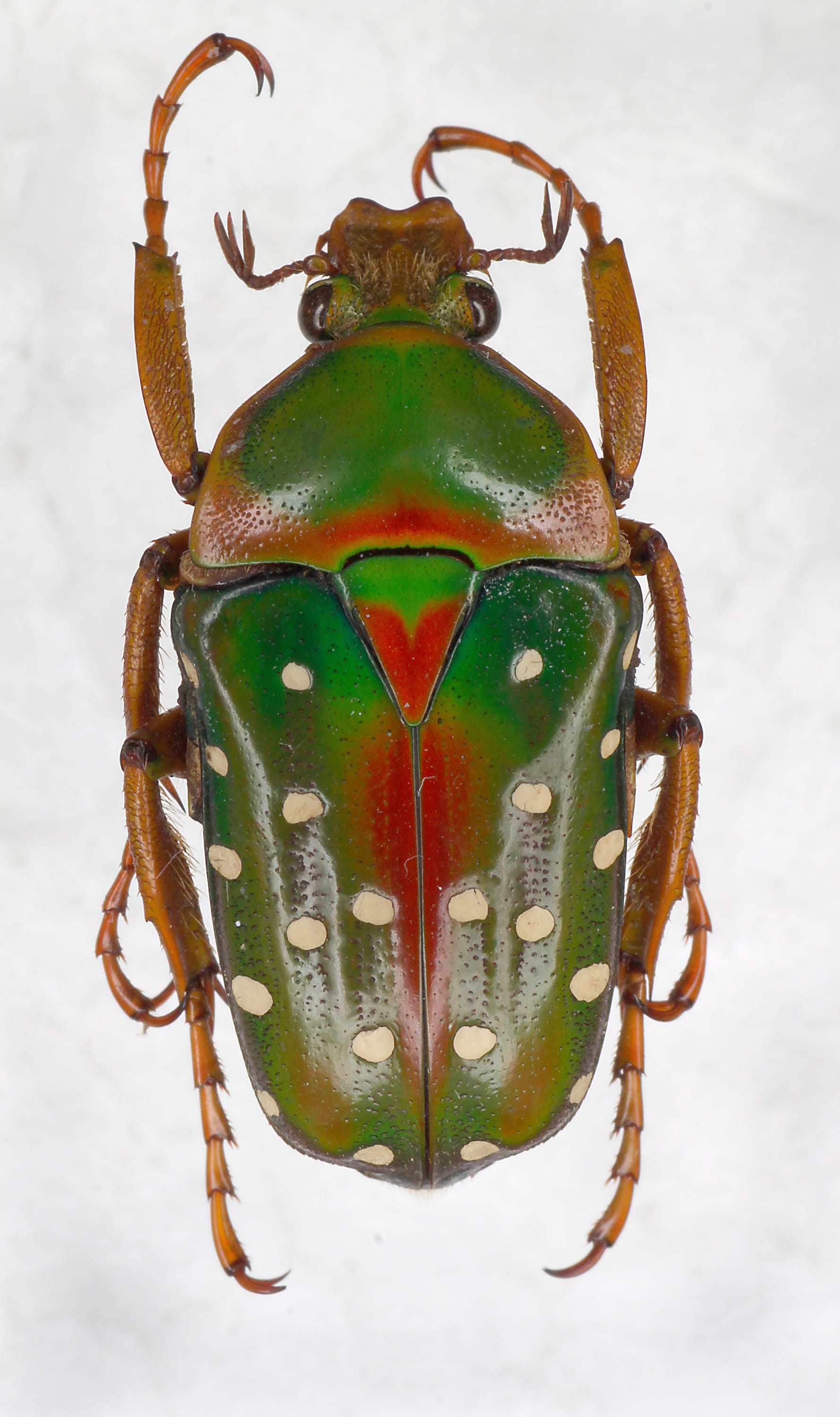
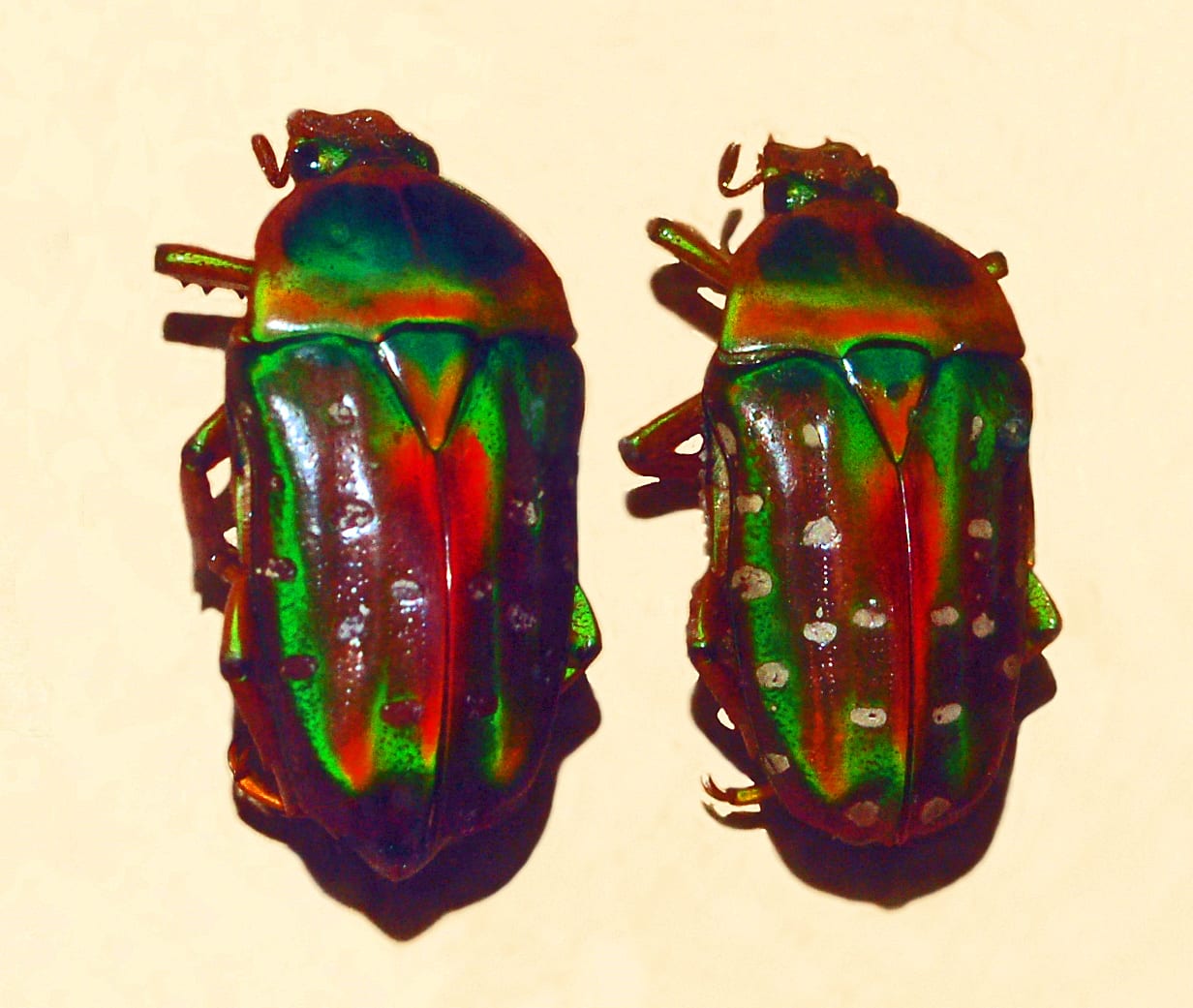
A small central African flower beetle, metallic green and red with whitish spots. Even museum records are few, and both live stock and husbandry information are very limited.
Difficulty
Intermediate
Temperature
20〜28℃
Lifespan
Adults 3-6 months
Size
25-30mm
Humidity
60〜80%
Diet
Adults take fruit and beetle jelly; larvae feed on rotten wood and leaf litter
About
Stephanorrhina julia was described by Waterhouse in 1879. It is 25-30 mm long, brilliant metallic green and red with whitish spots on the elytra. It resembles the congeneric spotted flower beetle but differs in how the markings are laid out and how the colours are distributed. GBIF holds only eight occurrence records, two from Cameroon and two from Gabon, which is remarkably few for a central African rainforest species. The account of the genus notes that males carry two large and two small horns and that the cycle from egg to adult takes six to eight months, two to four of them inside the cocoon. Little is known of husbandry or captive breeding specific to this species, and in Japan it circulates mainly as set specimens.
Source: Wikipedia (CC BY-SA 4.0)
Lifespan of the Julia Flower Beetle
The Julia Flower Beetle lives Adults 3-6 months.
Size of the Julia Flower Beetle
The Julia Flower Beetle grows to 25-30mm.
Basic Info
Origin
Central Africa (Cameroon, Gabon)
Lifespan
Adults 3-6 months
Size
25-30mm
Temperature
20〜28℃
Humidity
Care Specifications
References & Sources
Edited & verified by: BreederDirect editorial team
The taxonomic, regulatory, and husbandry data on this page are compiled and verified against the authoritative primary sources below.
Primary sources
- Wikipedia
- Ministry of the Environment, Invasive Species Act: "Guidance for Those Importing Live Insects in Scarabaeoidea"
- CITES Appendix (checklist.cites.org)
- Stephanorrhina - Wikipedia (EN; genus coloration, four male horns, 6-8 months from egg to imago, 2-4 months in the cocoon)
- GBIF occurrence records for Stephanorrhina julia (counts by country)
- GBIF
Taxonomy & Authority
Accepted name: Stephanorrhina julia (Waterhouse, 1879)
Authority databases: GBIF
Nomenclature follows global taxonomic authority databases.
Regulations & Conservation Status
Not CITES-listed
Plant Protection Act: When importing live specimens of Scarabaeoidea (including rhinoceros beetles, stag beetles, flower beetles, etc.), a species identification certificate issued by the exporting country government agency or equivalent must be attached in accordance with the Invasive Species Act (import ports are limited to Narita, Chubu, Kansai, Fukuoka, and Kagoshima airports). This species itself is not a designated invasive species, and import is possible upon submission of the certificate.
Sources: Ministry of the Environment, Invasive Species Act: "Guidance for Those Importing Live Insects in Scarabaeoidea" / CITES Appendix (checklist.cites.org)
Regulations may change. Always verify the latest information with the relevant authorities.
Julia Flower Beetle Listings
Loading latest listingsFind listings for this species