Jewel Beetle (Tamamushi) Diet & Care | Leaves, Lifespan, Larval Rearing
Adult Japanese jewel beetles eat enoki and keyaki leaves — not insect jelly or sap. Covers feeding, the 1-2 month adult lifespan, collecting, and larval rearing.
Key Takeaways
Adult Japanese jewel beetles eat enoki and keyaki leaves — not insect jelly or sap. Covers feeding, the 1-2 month adult lifespan, collecting, and larval rearing.
Related Species
What Kind of Insect Is the Tamamushi?
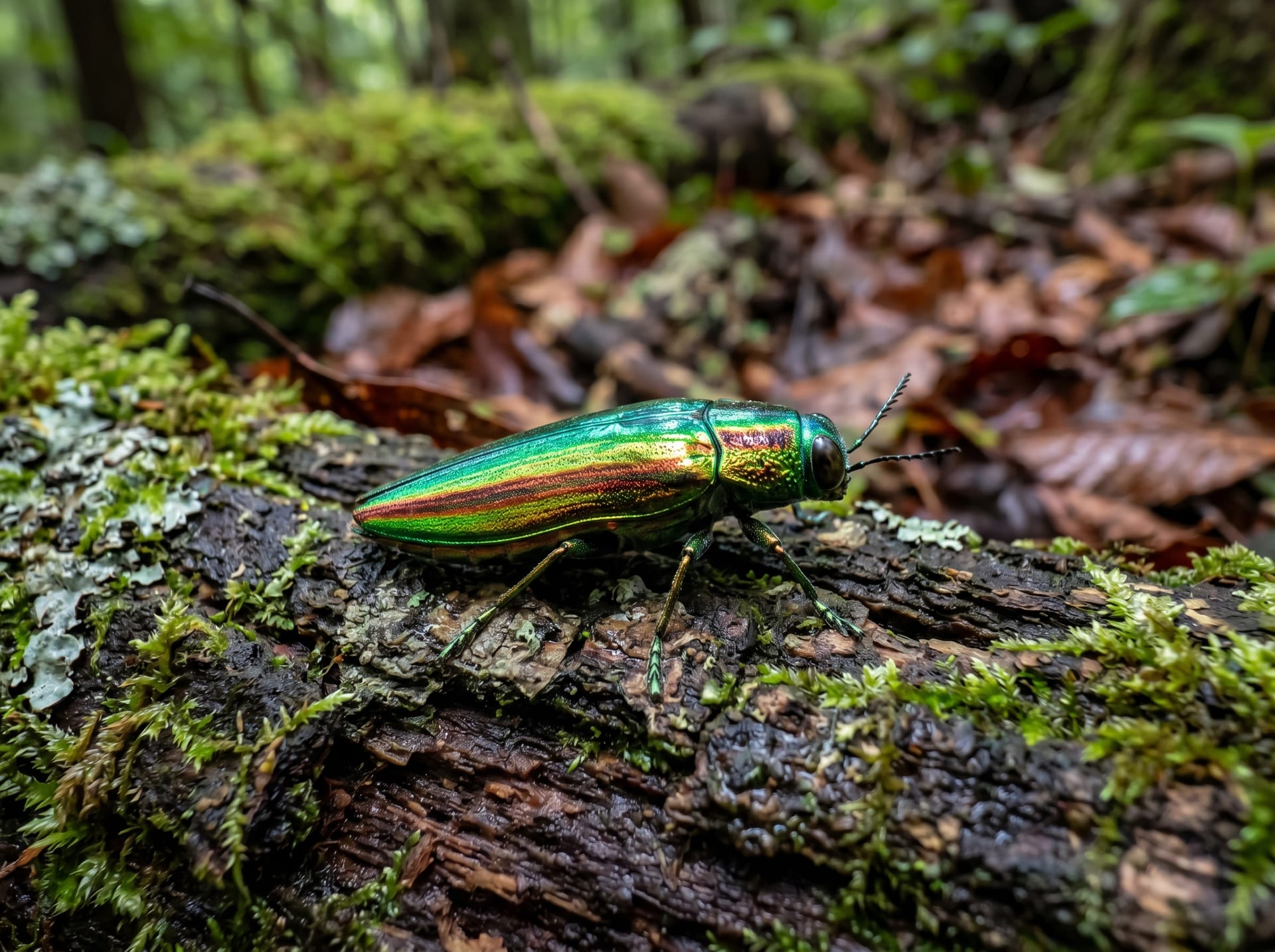
The Tamamushi (Jewel Beetle, scientific name: Chrysochroa fulgidissima) is a beetle endemic to Japan belonging to the order Coleoptera, family Buprestidae. As its name suggests, its most distinctive feature is its iridescent metallic elytra that shine in shades of green, gold, and red-purple. The structural coloration that changes depending on viewing angle is historically the origin of the Japanese expression "tamamushi-iro" (jewel beetle color).
The "Tamamushi Zushi" (jewel beetle shrine), a treasure of Horyu-ji Temple, incorporates approximately 9,000 jewel beetle elytra, demonstrating that this insect has been cherished by the Japanese people since the Asuka period.
Basic Data
- Body length: Adults approximately 30–40 mm
- Emergence period: June–August (peak season in July)
- Habitat: Bright woodland edges with enoki and keyaki trees in plains to hilly regions
- Flight ability: Extremely strong, flying in straight lines
- Larval diet: Feed from inside dead and living wood of enoki, keyaki, elm, etc.
Basic Data for Tamamushi Care
| Item | Details |
|---|---|
| Adult body length | 30–40 mm |
| Adult emergence period | June–August (peak in July) |
| Adult food | Enoki and keyaki leaves |
| Larval host trees | Dead and living wood of enoki, keyaki, and elm |
| Larval period | Typically 2–3 years (sometimes 4 years or more) |
| Adult lifespan | Approximately 1–2 months |
| Care difficulty | Medium to high (obtaining host wood is key) |
Collecting Methods
Tamamushi beetles fly around enoki and keyaki trees during the day, particularly between 10 a.m. and 2 p.m.
Collection Tips
- Location: Shrines, parks, and rural wooded areas with abundant enoki and keyaki trees. They gather particularly easily where there are dead trees.
- Time of day: 10 a.m. to 2 p.m. on clear days. Activity decreases on cloudy or rainy days.
- Method: Capture with a net when they walk on branches and leaves, or observe the tree trunk and catch them by hand.
- Note: Tamamushi prefer areas with strong direct sunlight. They are difficult to find in shaded spots.
Collection Techniques
If they are on enoki, shaking the branch may cause them to drop (play dead). Spreading a sheet below before shaking the branch is effective. Additionally, since tamamushi are attracted to light, setting out a white cloth spread in sunny areas can sometimes work as an effective trap.
Adult Care and Management
Case and Setup
- Case size: Insect rearing case 30 × 20 × 30 cm or larger
- Substrate: Insect bedding (approximately 5 cm) or slightly dry leaf mold
- Perches: Install several thick branches of enoki or keyaki (climbing wood)
- Temperature: 25–30 °C is appropriate. They weaken easily if temperatures exceed 30 °C.
- Ventilation: Use a well-ventilated mesh lid. Avoid high humidity.
Adult Food
Adult Tamamushi beetles primarily feed on leaves of enoki, keyaki, and similar trees.
- Place collected branches with leaves in a vase of water and replace with fresh ones every few days.
- Insect jelly, fruit, and tree sap are not substitutes for leaves (jewel beetles are folivorous and rarely eat them). On days when enoki is unavailable, use keyaki, Ezo-enoki, or muku tree leaves instead.
- Water supply: Lightly mist the leaves with a spray bottle (avoid spraying directly on the body excessively).
Mating and Egg-Laying
- Sex determination: Observe the abdominal tip. Females have a slightly thicker and rounder abdomen.
- Mating typically occurs naturally within the adult case.
- Dead wood (decaying wood) of enoki or keyaki is necessary for egg-laying. Prepare living wood trunks or thick branches.
- Use wood with bark intact and place on the case bottom or lean it against the case side.
- Females lay eggs beneath the bark from cracks or wounds in the wood.
Larval Rearing
Rearing Tamamushi larvae requires unique management because they are wood-boring insects that grow while feeding inside the wood.
Egg-Laying Wood Management
- Prepare thick branches (diameter 5 cm or larger) or logs of enoki or keyaki.
- Lightly moisten and place in a breathable container (larval rearing bottle, etc.).
- Maintain humidity by lightly misting once or twice a month to prevent over-drying.
- Observing from outside is difficult since larvae feed inside the wood.
Larval Period and Development
- Egg to adult: Typically takes 2–3 years (sometimes 4 years or more depending on species).
- Larvae are "grub-type larvae" that grow while winding their way through the wood, feeding as they go.
- Pupation occurs in a pupal chamber inside the wood.
- Newly emerged adults chew through the wood to exit.
Care Precautions
- Replacing consumed wood: Depleted wood must be replaced with fresh enoki or keyaki wood.
- Avoid over-drying: Larvae die if the wood dries completely.
- Avoid excessive moisture: Mold on wood weakens larvae. Proper humidity management is essential.
- Obtaining wood: Can sometimes be sourced from hardware store firewood, pruned branches in parks (enoki/keyaki), or forestry contractors.
The Joy of Raising Tamamushi
The greatest pleasure in raising Tamamushi is breeding individuals you collected yourself and watching beautiful adults emerge from larvae. The moment when adults you've reared over a long larval period (2–3 years) emerge from the wood is truly extraordinary.
Success in breeding also yields "captive-bred individuals" different from wild-collected specimens, offering the additional enjoyment of selective breeding to obtain larger individuals over multiple generations.
Common Failures and Solutions
Adults Die Quickly
Immediately after collection, they may be weakened by transport stress. Place them in a quiet environment at appropriate temperature (25–28 °C) and provide fresh enoki or keyaki leaves to help them settle down.
No Egg-Laying
The egg-laying wood species may not be suitable. Always use wood from enoki, keyaki, or elm, and ensure it has bark intact. If mating has not been observed, house a pair together.
Larvae Are Invisible or It's Unclear If They're Dead
Tamamushi larvae cannot be directly observed since they live inside the wood. Hold the wood to your ear and gently tap it; you may hear the sound of larvae feeding (a light scratching sound).
What Do Tamamushi Eat? How to Feed Them and Important Notes
Adult Tamamushi (Yamato Jewel Beetles) are folivorous insects that feed on "leaves" of ulmaceous broadleaf trees such as enoki and keyaki. This is fundamentally different from rhinoceros beetles and stag beetles, which feed primarily on sap, fruit, and insect jelly. Misunderstanding this is the main reason rearing fails.
There are clear preferences for which leaves they eat, and the priority guide is as follows.
| Food | Preference | Notes |
|---|---|---|
| Enoki leaves | ◎ Most preferred | Primary food to prioritize |
| Keyaki leaves | ○ Eaten readily | Alternative when enoki is unavailable |
| Ezo-enoki and muku tree leaves | ○ | Easier to obtain in some regions |
| Cherry leaves | △ | Eaten occasionally |
| Insect jelly, fruit, tree sap | × Rarely eaten | Fundamentally unsuitable for folivorous insects |
The basic feeding method is to cut branches and leaves from collected enoki or keyaki, insert the cut ends in water (or wrap in moistened tissue), or place them in a small vase within the case. Since leaves wilt and dry within 2–3 days, replace them with fresh ones regularly. Lightly misting with a spray bottle helps leaves last longer and provides water for the adults. If enoki cannot be found locally, you may obtain pruned branches from garden centers or street trees (with the manager's permission).
Note that adult lifespan is inherently short at 1–2 months, and the main reason they "weaken without eating" is usually that the host plant is unsuitable or the leaves are old. Securing fresh enoki leaves first is the quickest path to successfully raising healthy Tamamushi. For timing and locations where you can encounter Tamamushi, the Rhinoceros Beetle and Stag Beetle Collecting Season Guide covering the same woodland habitat is also helpful.
Summary
Tamamushi are jewel-like beetles that represent the Japanese summer. With three distinct appeals—the joy of collecting, the fulfillment of lengthy larval rearing, and the emotion of emergence—they are highly recommended for those who want to deepen their experience with insect rearing. If you have access to enoki and keyaki wood, breeding and successive-generation cultivation are entirely feasible.