Flower Chafer Care Guide | How to Raise White-spotted, Blue-green, and Small Blue-green Flower Chafers and Larval Management
Beginner's guide to raising flower chafers that gather on flowers. Detailed explanation of various species such as white-spotted flower chafers and blue-green flower chafers, as well as management of adults and larvae, and how to set up an egg-laying setup.
Key Takeaways
Beginner's guide to raising flower chafers that gather on flowers. Detailed explanation of various species such as white-spotted flower chafers and blue-green flower chafers, as well as management of adults and larvae, and how to set up an egg-laying setup.
What Kind of Beetle Is a Flower Chafer?
Flower chafers (lit. "flower diver") are a collective term for beetles belonging to the order Coleoptera, family Scarabaeidae, subfamily Cetoniinae. The main species found in Japan include the white-spotted flower chafer, blue-green flower chafer (Cetonia roelofsi), and small blue-green flower chafer (Gametis jucunda).
The most distinctive characteristic of flower chafers is their unique flight method of keeping their elytra closed while expanding only their hindwings to fly, which is rare among beetles. Additionally, their name "flower diver" comes from the fact that adults feed primarily on flower nectar and pollen.
Like rhinoceros beetles, they are members of the Scarabaeidae family, and since the basic concepts of larval care are similar, they are a familiar insect to those with prior beetle-keeping experience. On the other hand, since they do not grow as large as rhinoceros beetles, less rearing space is required, making them suitable for apartment keeping.
Representative Species and Characteristics
White-spotted Flower Chafer
Body length 18–28 mm. Body color ranges from green to copper-brown with scattered white spots. It is the most widely available species with abundant breeding information, making it the most recommended species for beginners. Adults live 2–3 months, are active in summer, and die in autumn. Larvae are raised on rotting wood, leaf mold, or fermented substrate.
Blue-green Flower Chafer
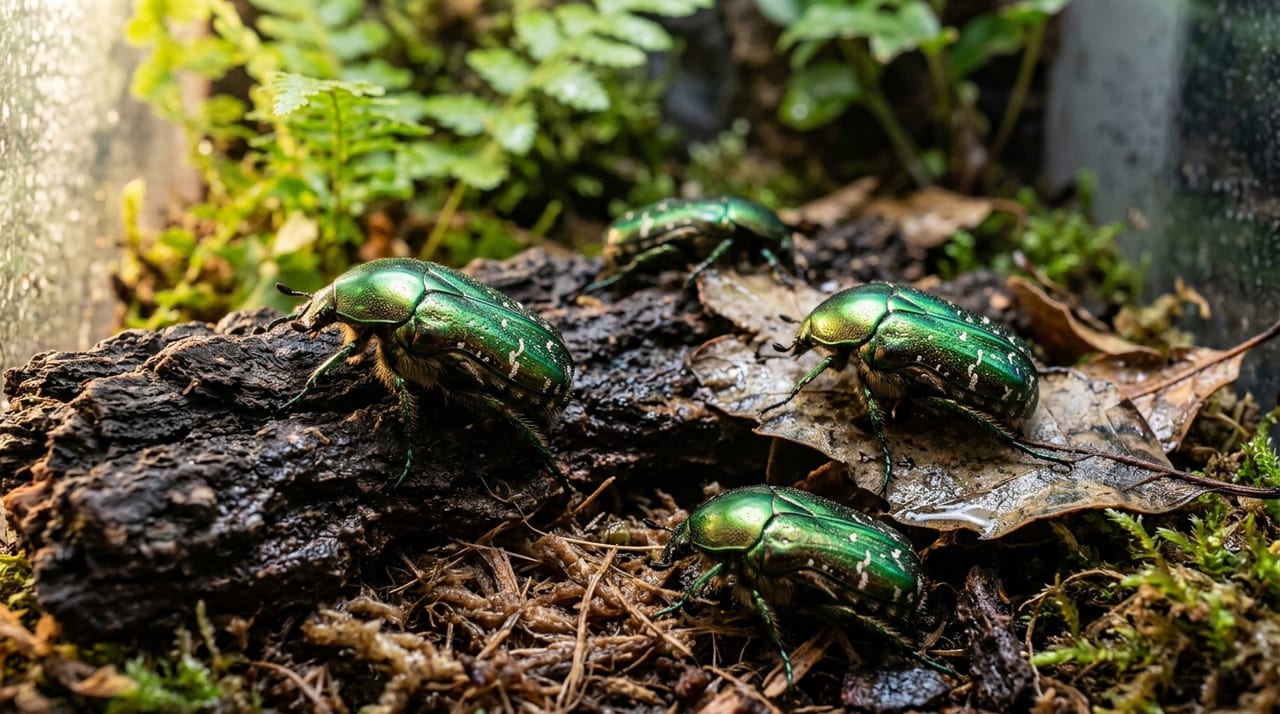
Body length 15–23 mm. Its brilliant metallic green color is beautiful and popular among collectors. It is somewhat more difficult to rear than the white-spotted species, and rotted wood substrate is often necessary for egg-laying.
Small Blue-green Flower Chafer
A small species with body length 11–16 mm, frequently gathering on flowers and easy to observe. Larvae are hardy in humus-rich soil, making the species easy to rear.