Rainbow Stag Beetle (Iridescent) Care Guide | Australian Large Stag Beetle Characteristics, Larval Management, and Tips for Maintaining Beautiful Colors
A detailed guide to caring for the Rainbow Stag Beetle (Iridescent), native to Australia. Covers the beautiful coloration characteristics of adults, necessary temperature and humidity management, substrate selection, methods for growing large larvae, and practical tips for long-term care.
Key Takeaways
A detailed guide to caring for the Rainbow Stag Beetle (Iridescent), native to Australia. Covers the beautiful coloration characteristics of adults, necessary temperature and humidity management, substrate selection, methods for growing large larvae, and practical tips for long-term care.
Related Species


About the Rainbow Stag Beetle
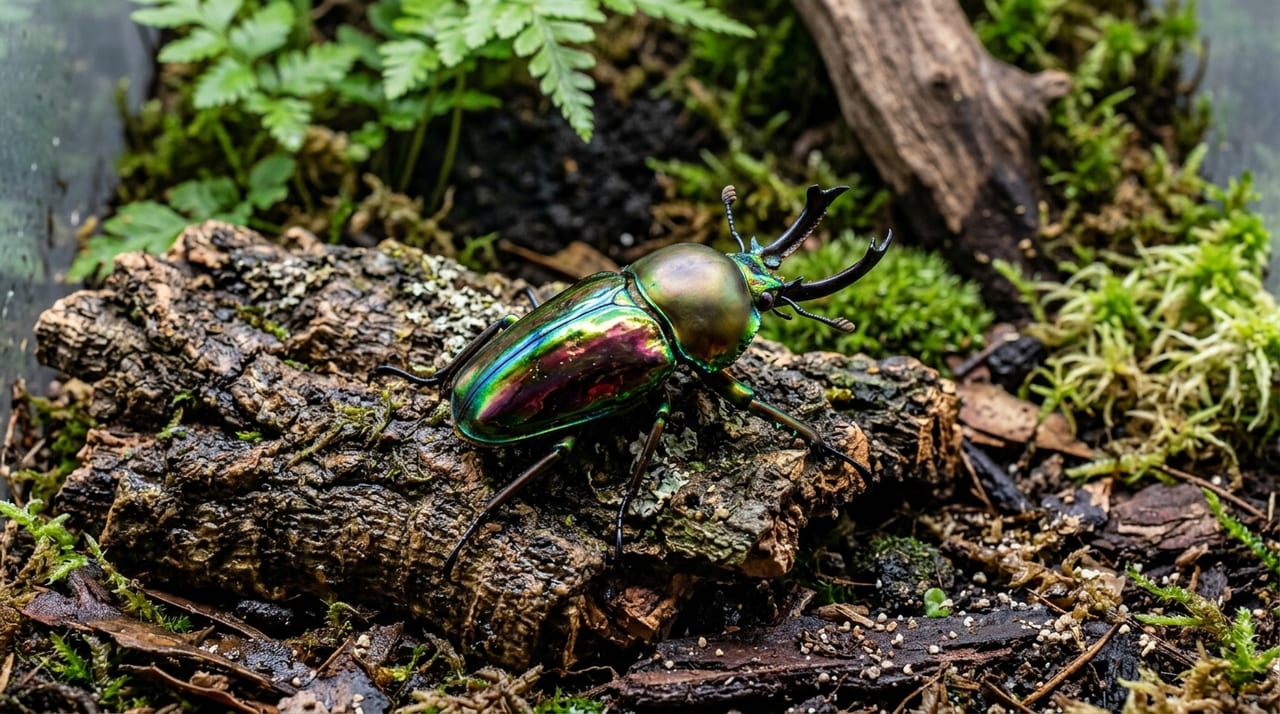
The Rainbow Stag Beetle (scientific name: Phalacrognathus muelleri) is a large stag beetle species primarily distributed in eastern Australia, particularly in Queensland. As its name suggests, the adults display structural coloration (iridescent like jewel beetles) that shifts between green, blue, gold, red, and purple depending on the angle of light. It is one of the most beautiful stag beetle species in the world and is popular among collectors globally. Males measure approximately 45–65 mm in length, while females are about 40–55 mm. Compared to other large stag beetles, the mandibles are less developed, and the body has a characteristic flat, broad shape.
They are relatively easy to care for and adapt well to Japan's temperate climate, making them widely available as pet insects domestically. Many breeders list them on BreederDirect, making them enjoyable for both beginners and advanced hobbyists.
Adult Care Environment and Management
The basic rule for adult care is to house males and females in separate enclosures. Housing males together risks severe fighting that can damage mandibles or legs. They should only be kept together during pairing (mating), and should be separated immediately after successful mating is confirmed.
Enclosure size for a single male can be medium (approximately 20 cm tall × 30 cm wide). Use fermented substrate (insect bedding) 5–8 cm deep as the base layer, and arrange wooden supports, bark, cork, or similar materials to create hiding spots.
Temperature control is critical for Rainbow Stag Beetle care. The ideal temperature range is 20–26°C. Temperatures exceeding 30°C cause rapid energy depletion and shorten lifespan. In summer, consider using cooling packs, air conditioning, or cool, dark locations like basements. In winter, maintain temperatures above 15°C, though they have better cold tolerance than Hercules beetles.
Food typically consists of insect jelly (high protein, pro-jelly). Rainbow Stag Beetles consume substantial amounts of jelly, so it should be replaced every 2–3 days to prevent mold and spoilage. While they also enjoy watermelon and banana, excess moisture can cause diarrhea and shortened lifespan; it's best to stick primarily to jelly. Adult lifespan is typically 12–18 months for males and slightly shorter for females, though proper care may extend it close to 2 years.
Larval Management and Fungal Media and Substrate Rearing
Rainbow Stag Beetle larvae can be raised using either fungal media bottles or substrate. Fungal media bottles (containing Trametes versicolor or Pleurotus ostreatus cultures) are advantageous for producing larger adults, but cost-conscious breeders can achieve good sizes using fully fermented substrate.
Fungal media bottle rearing proceeds as follows: First-instar larvae should be kept in small cups for 1–2 weeks after hatching, then transferred to 800–1,000 mL fungal media bottles when reaching the second instar. In the late third instar, transfer them to larger bottles (1,400–1,700 mL). The timing for bottle changes depends on fungal consumption (less white mycelium visible) and larval size. Large third-instar larvae may completely consume the media in a bottle within 2–3 months, so regular monitoring is essential.
Substrate rearing uses fully fermented hardwood substrate. Growth is slightly slower than with fungal media, but it offers better cost-effectiveness and reduces the "thrashing" behavior (larvae aggressively burrowing) sometimes seen in bottles. Larval development time varies with temperature but typically takes 10–14 months under 20–24°C conditions.
Pupation, Eclosion, and Color Stabilization
The pupation stage is extremely critical for Rainbow Stag Beetles. Before becoming a pre-pupa, the larva constructs a pupal chamber within the substrate or fungal media. During this period, avoid moving the bottle and minimize temperature fluctuations to prevent chamber collapse. Pupation to eclosion typically takes 4–6 weeks.
Newly eclosed adults are still soft-bodied with white to pale tan coloration. Color develops gradually, but the beautiful iridescent structural color of Rainbow Stag Beetles stabilizes over approximately 2–3 weeks after eclosion. Intense light or impact during this period can affect color development. Once post-eclosion feeding begins, it indicates maturity; breeding can occur 2–3 months later.
Tips for Maintaining Beautiful Coloration
The structural coloration of Rainbow Stag Beetles results from a combination of genetics, environment, and husbandry conditions. There are management practices that can help produce more vibrant individuals.
- Proper temperature control: High-temperature rearing has been reported to diminish color vibrancy. Slightly cooler conditions of 20–22°C are recommended during the larval stage.
- Consistent high-quality nutrition: High-quality fungal media or fermented substrate rich in protein and lipids supports larval development and is believed to influence adult coloration.
- Proper post-eclosion maturation: Allowing adequate maturation time after eclosion, without immediate pairing or disturbance, helps stabilize body color.
Many breeders on BreederDirect carefully select and list colorful individuals, allowing you to verify color characteristics through photos before purchasing. There is considerable color variation—green, red, and purple morphs—making it enjoyable to find your preferred specimen.
Breeding Basics: Setting Up Spawning Substrate and Improving Hatch Rates
The spawning setup uses a medium to large plastic container packed firmly to 70–80% capacity with fully fermented substrate, with 1–2 softwood logs (such as Quercus mongolica or Quercus serrata) partially buried. While Rainbow Stag Beetles primarily lay eggs in substrate, they also use logs. Three to four weeks after introducing the female, excavating the logs and substrate reveals white eggs and small larvae. Key factors for improving hatch rates are maintaining proper substrate moisture (form-retaining when squeezed) and temperature (22–25°C).
A single spawning set typically yields 10–40 eggs and larvae. Successive breeding allows selective breeding for color and size improvements. Once breeding becomes established, listing larvae and adults on BreederDirect offers the opportunity to exchange specimens with other breeders, adding to the hobby's enjoyment.