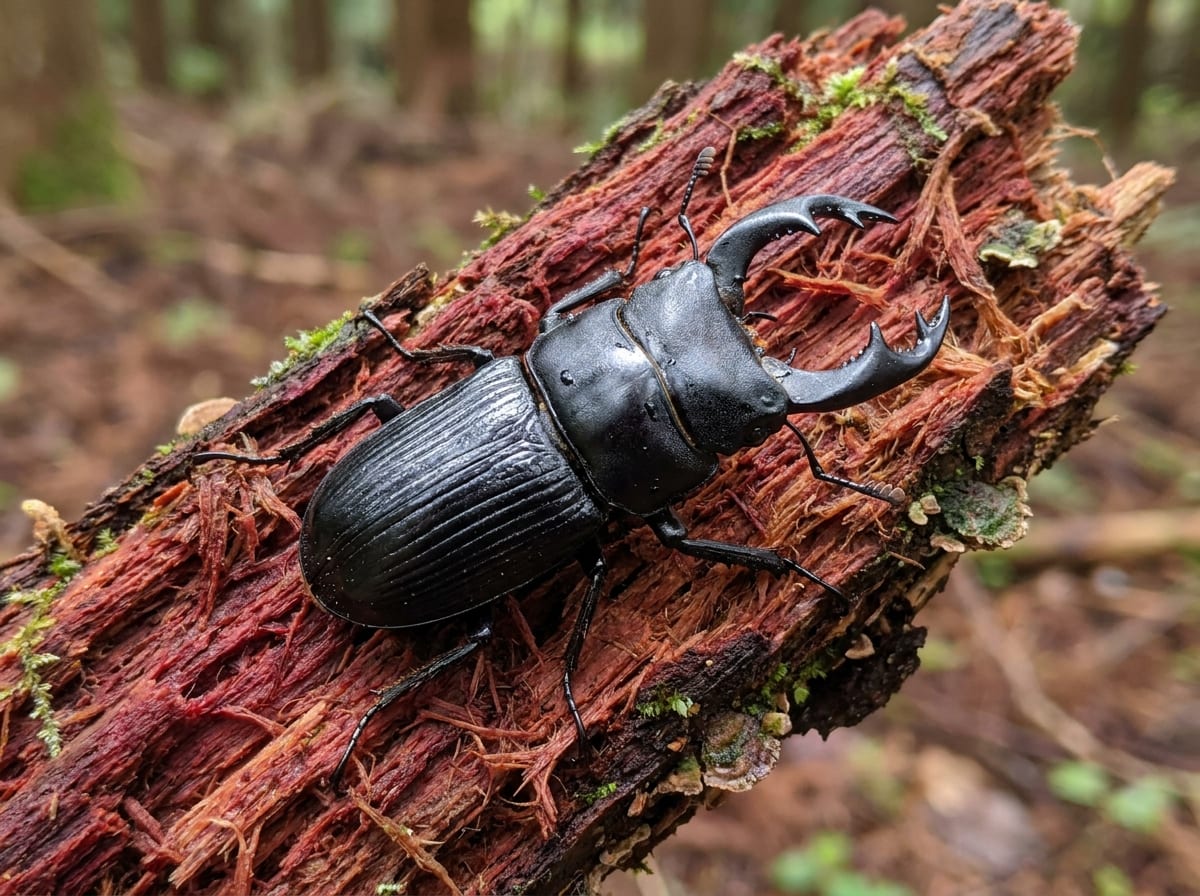
Source: Wikimedia Commons
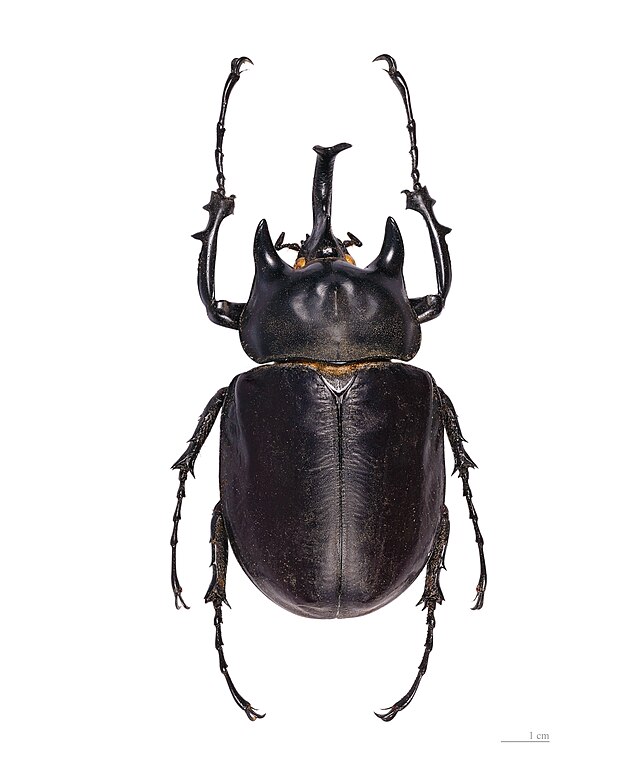
Japanese Giant Stag Beetle
IntermediateDorcus hopei binodulosus
The king of Japanese stag beetles. Thick mandibles and jet-black body. Larvae grow large on fungus bottles. Long-lived at 2-3 years.
Difficulty
Intermediate
Temperature
18〜25℃
Lifespan
Adult 2-3 years / Larva ~1 year
Size
25-85mm
Humidity
60〜80%
Diet
Jelly (adult) / Fungus bottle (larva)
About
Dorcus is a large genus of stag beetles in the subfamily Lucaninae, comprising over 100 species distributed primarily across Asia and India, with two species in Europe and two in North America. These beetles inhabit deciduous forests, where larvae develop inside decaying hardwood logs. In captivity, small to medium enclosures with ventilated lids are suitable. Egg-laying occurs inside hardwood logs such as oak, and larvae thrive in fungal substrate bottles, which can produce exceptionally large specimens.
Source: Wikipedia (CC BY-SA 4.0)
Lifespan of the Japanese Giant Stag Beetle
The Japanese Giant Stag Beetle lives Adult 2-3 years / Larva ~1 year.
Adults are glossy black and have notably long lifespans of one to three years compared to many other beetles. Their long adult lifespan and moderate care requirements make Dorcus beetles highly popular among collectors.
Size of the Japanese Giant Stag Beetle
The Japanese Giant Stag Beetle grows to 25-85mm.
Males possess powerful, flattened mandibles used in competition for mates and feeding sites, with body lengths ranging from 30–90 mm depending on species.
Basic Info
Origin
Asia and India primarily, with species also found in Europe and North America
Lifespan
Adult 2-3 years / Larva ~1 year
Size
25-85mm
Breeding Records & Localities
Captive record (♂)
94.1 mm
Wild record (♂)
76.6 mm
Record source: BE-KUWA 2025 Edition (captive 94.1 mm Kensei Nara 2023 / wild 76.6 mm)
Notable localities
NoseKurumeKawanishiYamanashiSaga
Japanese large stag beetle. Larger size is advancing through bloodlines (strains) such as Nose YG and Kurume. Captive records are updated annually in the BE-KUWA (Mushi-sha) contest. Individual value varies significantly by locality, generation (CBF/WF/WD), and size.
Generation codes
- WD
- Wild-caught
- WF1
- Offspring of a wild-caught female
- F1〜
- Captive generations (same locality)
- CBF1
- Cross-locality captive-bred (reset)
Sources: BE-KUWA Certified Breeding Records (Mushi-sha, FY2025 edition, JA) /
References & Sources
Edited & verified by: BreederDirect editorial team
The taxonomic, regulatory, and husbandry data on this page are compiled and verified against the authoritative primary sources below.
Primary sources
Taxonomy & Authority
Accepted name: Dorcus hopei binodulosus (Saunders, 1854)
Synonyms: Platyprosapus hopei Saunders, 1854
Authority databases: GBIF
Nomenclature follows global taxonomic authority databases.
Regulations & Conservation Status
Not CITES-listed
Plant Protection Act: When importing live specimens of Scarabaeoidea (including rhinoceros beetles, stag beetles, flower beetles, etc.), a species identification certificate issued by the exporting country government agency or equivalent must be attached in accordance with the Invasive Species Act (import ports are limited to Narita, Chubu, Kansai, Fukuoka, and Kagoshima airports). This species itself is not a designated invasive species, and import is possible upon submission of the certificate.
Sources: Ministry of the Environment, Invasive Species Act: "Guidance for Those Importing Live Insects in Scarabaeoidea" / CITES Appendix (checklist.cites.org)
Regulations may change. Always verify the latest information with the relevant authorities.
Japanese Giant Stag Beetle Listings
Loading latest listingsFind listings for this species