Japanese Saw Stag Beetle Breeding & Larval Care Guide | Egg-Laying Setup for Wood-Laying vs. Substrate-Laying & Larval Rearing
Complete guide to domestic Japanese saw stag beetle husbandry and breeding. This practical guide covers the full cycle from setting up substrate-laying egg-laying bins, timing and procedures for larvae excavation, larval rearing methods using fermented substrate with temperature management, substrate exchange timing, and important notes on pupation to adult emergence management.
Key Takeaways
Complete guide to domestic Japanese saw stag beetle husbandry and breeding. This practical guide covers the full cycle from setting up substrate-laying egg-laying bins, timing and procedures for larvae excavation, larval rearing methods using fermented substrate with temperature management, substrate exchange timing, and important notes on pupation to adult emergence management.
Related Species
About the Japanese Saw Stag Beetle
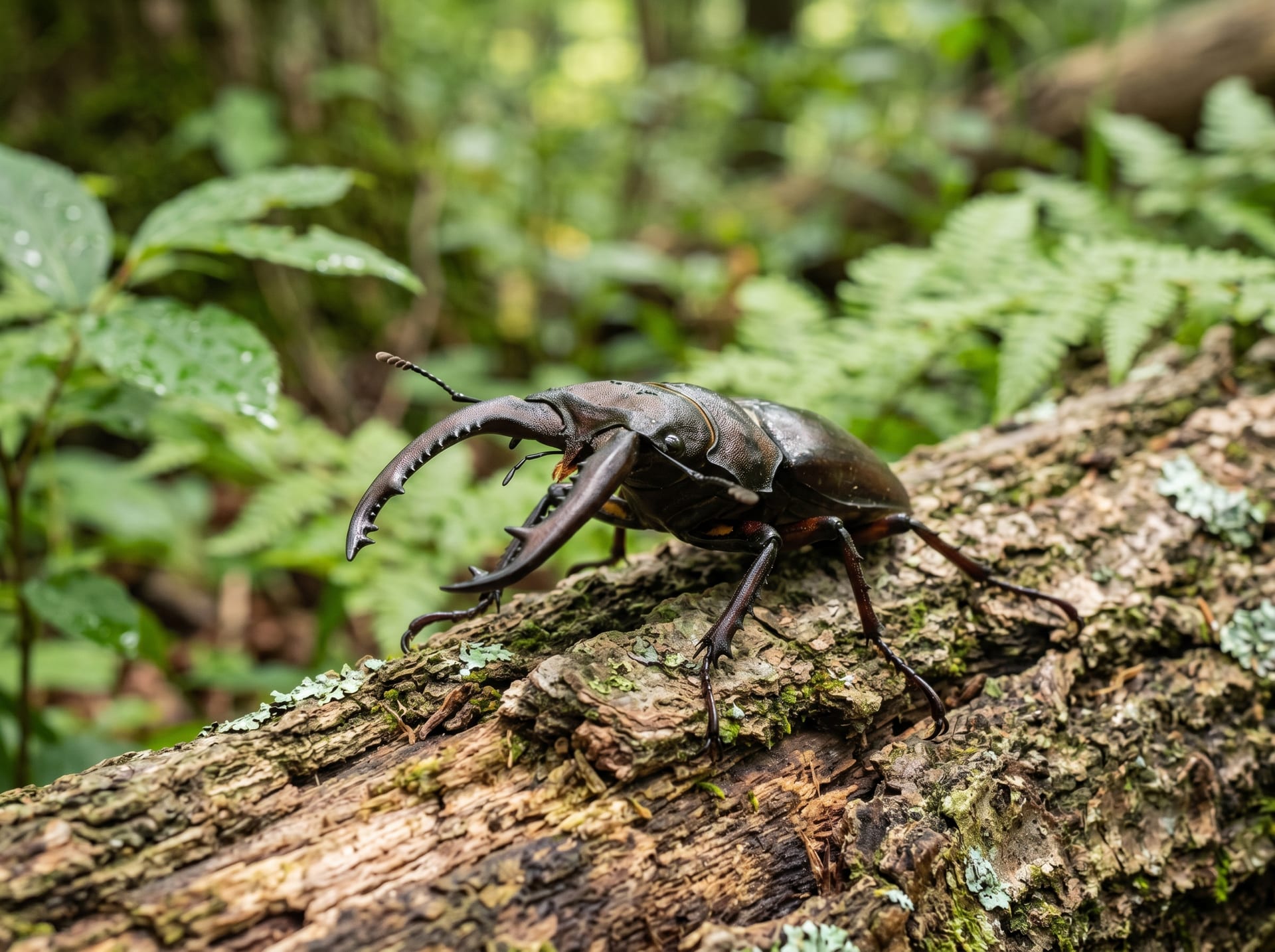
The Japanese saw stag beetle (Prosopocoilus inclinatus) is one of the most familiar stag beetle species in Japan, named after the saw-like shape of its large mandibles. Widely distributed from Hokkaido to Okinawa, they can be observed gathering around tree sap on summer nights.
Characteristics of the Japanese Saw Stag Beetle
- Body length: Males 25–75 mm (ranging from small to large specimens)
- Body form: Mandible morphs vary between "inner-tooth type" (buffalo-horn) and "pointed-tooth type" (spoon-shaped)
- Active period: June–September (summer only; does not overwinter)
- Larval period: 1–2 years (varies significantly with rearing temperature and substrate quality)
Adult Care
Housing and Setup
Adult care is relatively straightforward.
Required items:
- Plastic container (medium to large): Approximately 40 cm H × 25 cm W × 30 cm D
- Fermented substrate: Layer 5–10 cm deep (deeper if also used as an egg-laying bed)
- Anti-tipping materials: Wood chips, cork, or insect jelly holders
- High-protein insect jelly: Primary food
Temperature: 20–28°C (avoid high heat and humidity; lifespan shortens above 30°C)
Feeding
The primary food for adults is insect jelly.
- Select high-protein, high-sugar jelly (standard 16–18 g size)
- Replacement frequency: Once every 1–2 days in summer (spoils easily)
- Fruits (watermelon, banana) are also eaten but offer only supplementary nutrition, as they tend to cause fruit fly infestations and diarrhea
Nutrition during mating and egg-laying: Post-laying females experience significant energy depletion; providing extra high-protein jelly extends lifespan.
Setting Up the Egg-Laying Bin
Japanese saw stag beetles exhibit both wood-laying and substrate-laying breeding behaviors.
Wood-laying: Eggs are laid inside rotted wood (breeding logs)
Substrate-laying: Eggs are laid in fermented substrate
Domestic Japanese saw stag beetles show a strong preference for substrate-laying, making the following setup highly effective.
Egg-Laying Bin Composition
| Material | Details |
|---|---|
| Container | Medium to large container (10 L capacity minimum recommended) |
| Fermented substrate | Coarse secondary fermented substrate or fully matured black soil substrate |
| Packing method | Firmly packed layer (15–20 cm) + loose layer (5 cm) |
| Breeding log | Soft wood (degree 2–3 decomposed Castanopsis/Quercus) placed horizontally |
| Temperature/Humidity | 24–28°C / Moisture level that forms a ball when squeezed |
Instructions:
- Moisten the fermented substrate evenly with water (moisture guideline: forms a ball when squeezed but crumbles when released)
- Layer 10–15 cm of firmly packed fermented substrate on the container bottom
- Place the breeding log horizontally and bury it with substrate around it
- Add approximately 5 cm of loose substrate on top
- Introduce one mated female, cover, and place in a dark location
- Leave undisturbed for 3–4 weeks, then excavate
Larval Excavation Timing
3–5 weeks after setup is the typical excavation timing. Too early and eggs remain unhatched (prone to damage); too late and larvae scatter.
Excavation procedure:
- Empty the substrate from the container into a bucket
- Break apart the breeding log by hand and search for larvae and eggs
- Examine larvae for color and shape; white, C-shaped larvae are healthy
- Wrap eggs (white, oval-shaped) in tissue, transfer to a small cup, and wait for hatching
Larval Rearing (Fungal Substrate Bottles vs. Fermented Substrate)
Excavated larvae are reared in either fungal substrate bottles or fermented substrate.
Suitability comparison for Japanese saw stag beetles:
| Rearing method | Large growth | Cost | Difficulty | Notes |
|---|---|---|---|---|
| Fungal substrate bottles | ◎ (maximum) | High | Moderately high | Some individuals have difficulty digesting fungal substrate |
| Fermented substrate | ○ | Low | Low | Most stable for Japanese saw stag beetles |
Recommendation: Japanese saw stag beetles are most reliably and stably reared on fermented substrate (secondary to tertiary fermentation). Some larvae cannot keep pace with fungal substrate digestion and prefer to return to fermented substrate.
Larval Care
Instars and rearing containers:
| Instar | Recommended container | Substrate volume |
|---|---|---|
| 1st–2nd instar | 200–500 mL cup | 80% of container |
| 3rd instar (final) | 1–2 L bottle or 1.5 L jar | 80–90% of container |
Temperature management:
- Ideal: 20–25°C. Above 28°C, larvae experience significant depletion
- In winter, growth proceeds normally at around 20°C at ambient temperature (heating is usually unnecessary)
Substrate replacement:
- Replace approximately every 2–3 months; replace when feces comprise over half the substrate
- Recording larval weight and length at each replacement allows growth tracking
Pupation to Adult Emergence Management
When larvae reach the latter half of the final instar (3rd instar), they begin constructing pupation chambers.
Signs of impending pupation:
- Larva yellows slightly (prepupa stage)
- Larva moves to the surface of the substrate
- Movement becomes sluggish
Important notes:
- Do not disturb or excavate the pupation chamber
- Avoid impacts or vibrations
- Avoid direct sunlight
After pupation, adults emerge within 3–4 weeks. Do not immediately remove freshly emerged adults; leave them undisturbed in the pupation chamber for 2–3 weeks. Once they begin feeding, transfer them to an adult rearing container.
Although Japanese saw stag beetles have a long larval period, they grow to excellent size with proper basic care and are ideal for beginners in stag beetle keeping. Experiencing the complete cycle from egg-laying through larval care to adult emergence deepens understanding of beetle ecology.