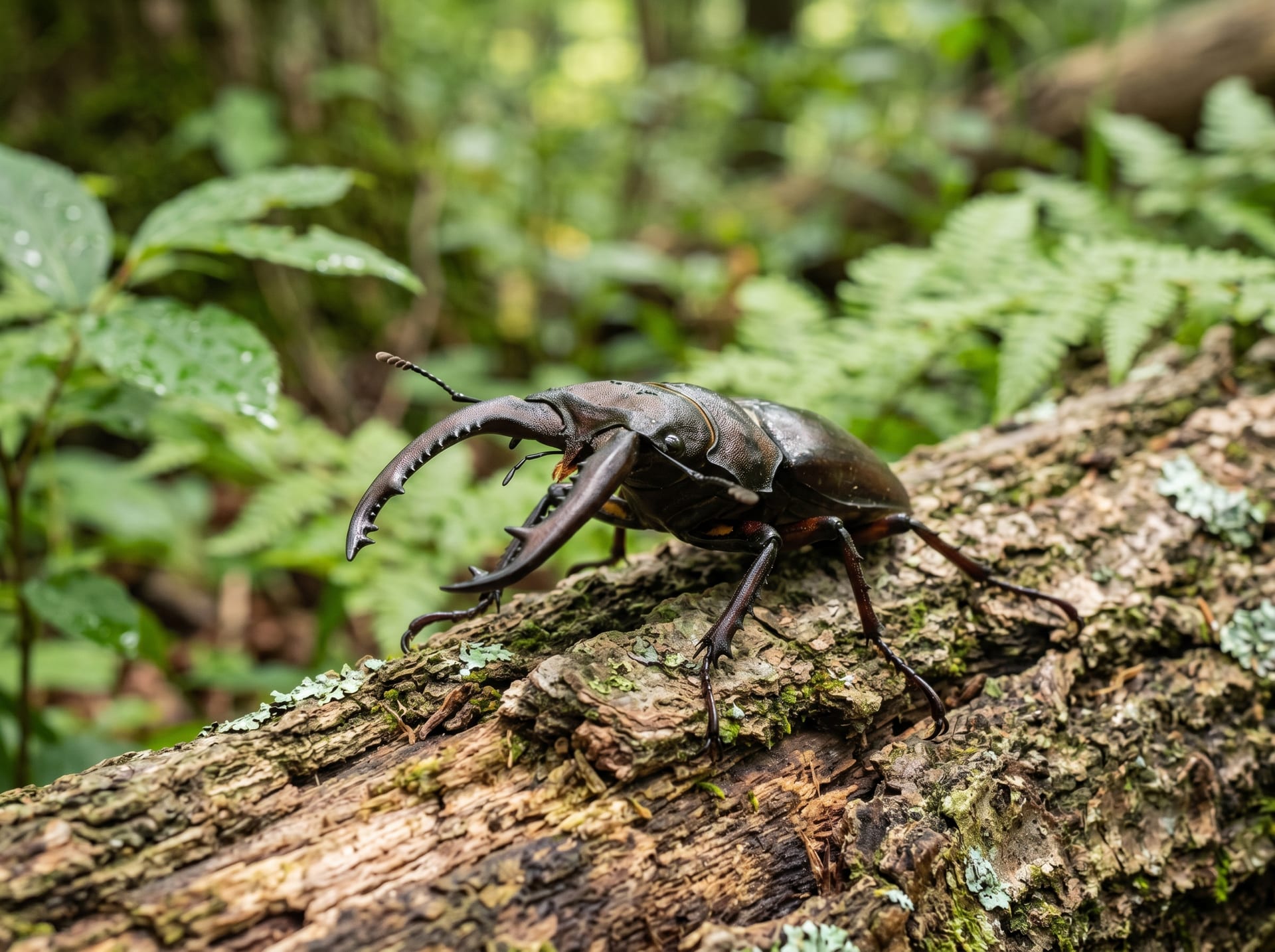
Source: Wikimedia Commons
Japanese Rhinoceros Beetle
BeginnerAllomyrina dichotoma
A Japanese summer icon. Popular from kids to adults. Larvae grow in leaf compost, pupating into adults in about a month. Perfect starter beetle.
Difficulty
Beginner
Temperature
20〜28℃
Lifespan
Adult 2-3 months / Larva ~10 months
Size
30-80mm (including horn)
Humidity
60〜80%
Diet
Jelly (adult) / Leaf compost & fermented mat (larva)
About
The Japanese rhinoceros beetle (Allomyrina dichotoma), known in Japan as kabutomushi, is one of the most iconic beetle species in East Asia. Found throughout Japan, China, the Korean Peninsula, Vietnam, Myanmar, Thailand, and Taiwan, it inhabits broad-leaved forests with temperate to subtropical climates. Males are distinguished by a prominent cephalic horn used in combat with rival males over territory and mating rights. Adults measure 30–80 mm in length and display a glossy dark-brown coloration. They are nocturnal, congregating at tree sap flows of oak and chestnut trees. Females lay 20–30 eggs in fermented substrate, and larvae develop over approximately one year. Their impressive horns, manageable care requirements, and cultural status as Japan's "king of insects" make them the most popular pet beetle in the country.
Source: Wikipedia (CC BY-SA 4.0)
Lifespan of the Japanese Rhinoceros Beetle
The Japanese Rhinoceros Beetle lives Adult 2-3 months / Larva ~10 months.
Size of the Japanese Rhinoceros Beetle
The Japanese Rhinoceros Beetle grows to 30-80mm (including horn).
Temperature & humidity for the Japanese Rhinoceros Beetle
The ideal temperature for the Japanese Rhinoceros Beetle is 20〜28℃.
In captivity, they require a mid-sized enclosure with at least 15 cm of fermented substrate, temperatures of 20–28°C, and humidity of 60–80%.
Basic Info
Origin
continental Asia, including Japan, China, the Korean Peninsula, and Southeast Asia
Breeding Records & Localities
Captive record (♂)
91.7 mm
Wild record (♂)
87.3 mm
Record source: BE-KUWA 2025 Edition (Japanese rhinoceros beetle captive 91.7mm Natsuzuka Shūichi 2017 / wild 87.3mm Mushi-tori 2012, both total length including horns)
Notable localities
HonshuShikokuKyushu
Regional subspecies
- Trypoxylus dichotomus septentrionalis — Mainland Japan
- Trypoxylus dichotomus takarai — Okinawa
Records are total length including horns (maximum body length). Japan's representative rhinoceros beetle. Captive-breeding records are updated annually through BE-KUWA (Mushi-sha) contests. Individual value fluctuates significantly based on locality, generation (CBF/WF/WD), and size.
Generation codes
- WD
- Wild-caught
- WF1
- Offspring of a wild-caught female
- F1〜
- Captive generations (same locality)
- CBF1
- Cross-locality captive-bred (reset)
References & Sources
Edited & verified by: BreederDirect editorial team
The taxonomic, regulatory, and husbandry data on this page are compiled and verified against the authoritative primary sources below.
Taxonomy & Authority
Accepted name: Allomyrina dichotoma (Linnaeus, 1771)
Synonyms: Allomyrina dichotoma, Scarabaeus dichotom Linnaeus, 1771
Authority databases: GBIF
Nomenclature follows global taxonomic authority databases.
Regulations & Conservation Status
Not CITES-listed
Plant Protection Act: When importing live specimens of Scarabaeoidea (including rhinoceros beetles, stag beetles, flower beetles, etc.), a species identification certificate issued by the exporting country government agency or equivalent must be attached in accordance with the Invasive Species Act (import ports are limited to Narita, Chubu, Kansai, Fukuoka, and Kagoshima airports). This species itself is not a designated invasive species, and import is possible upon submission of the certificate.
Sources: Ministry of the Environment, Invasive Species Act: "Guidance for Those Importing Live Insects in Scarabaeoidea" / CITES Appendix (checklist.cites.org)
Regulations may change. Always verify the latest information with the relevant authorities.
Japanese Rhinoceros Beetle Listings
Loading latest listingsFind listings for this species