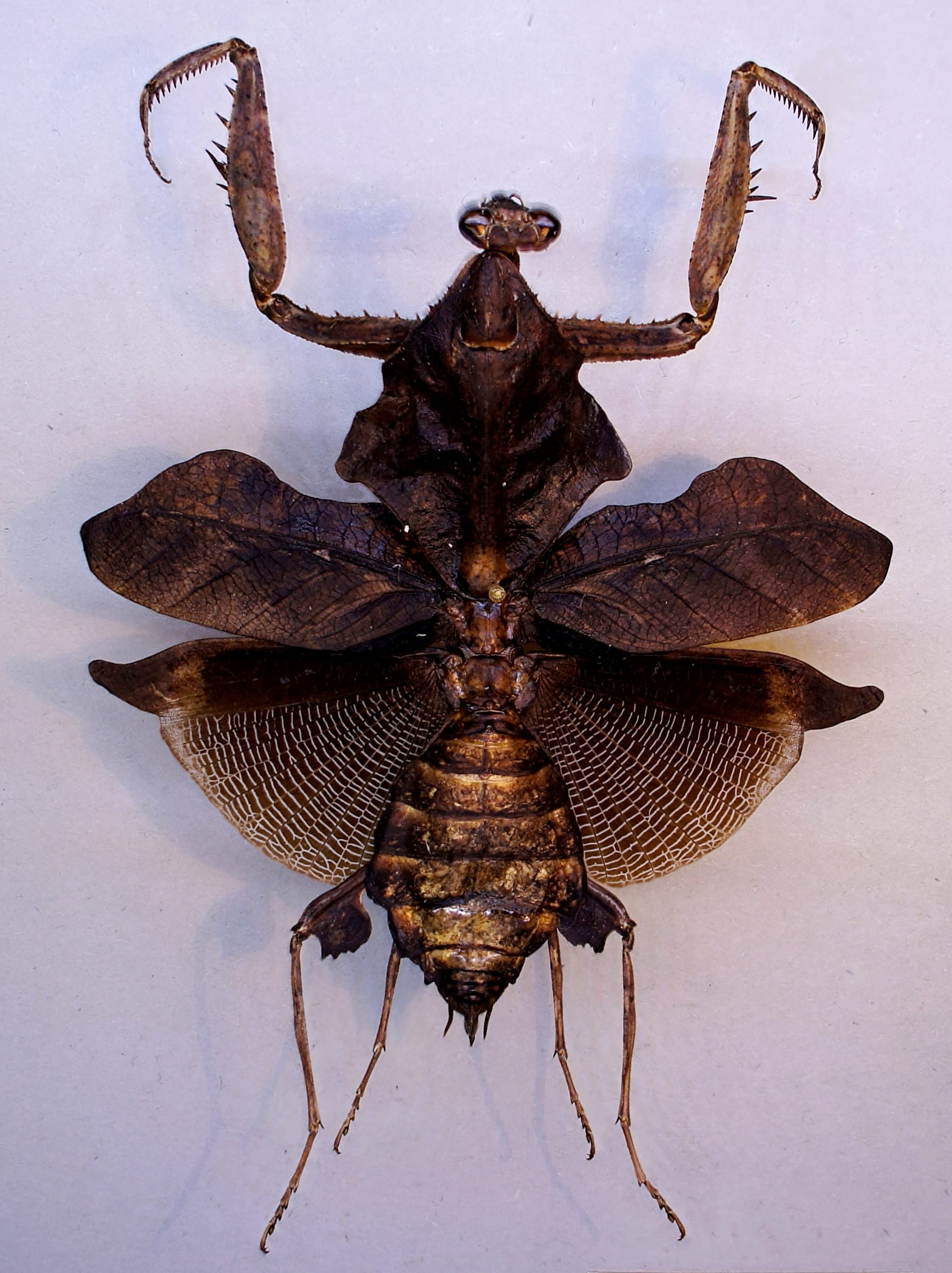
Source: Wikimedia Commons
Dead Leaf Mantis (lobata)
IntermediateDeroplatys lobata
A dead leaf mantis of the damp tropical forest floor in the Malay Peninsula, Borneo and elsewhere in Southeast Asia. A diamond-shaped prothorax and mottled grey-brown pattern mimic a fallen leaf.
Difficulty
Intermediate
Temperature
25℃
Lifespan
Adults 8-14 months
Size
Females 65-70mm, males about 45mm
Humidity
50〜80%
Diet
Prefers flying prey such as flies and moths (fruit flies for nymphs, then flies and locusts)
About
Deroplatys lobata is a dead leaf mantis found from Thailand through the Malay Peninsula to Sumatra, Java and Borneo, living near the ground among fallen leaves and bushes in damp tropical forest. Colour ranges from dark grey to light mottled grey, often with a faint pink flush on head and thorax. The prothorax spreads like a torn, crumpled leaf, and from the fourth instar females develop a wider shield than males; males are slender with a small diamond-shaped shield. Adult females measure 65-70mm and males about 45mm. First instar nymphs are large, up to 15mm, and take fruit flies from the start. It prefers flying prey such as flies and moths, later taking flies and locusts. Nymphs are reserved, adult females fierce and males timid all their lives. Adulthood follows six to nine moults. Care is intermediate and best attempted after some experience.
Source: Wikipedia (CC BY-SA 4.0)
Lifespan of the Dead Leaf Mantis (lobata)
The Dead Leaf Mantis (lobata) lives Adults 8-14 months.
Size of the Dead Leaf Mantis (lobata)
The Dead Leaf Mantis (lobata) grows to Females 65-70mm, males about 45mm.
Temperature & humidity for the Dead Leaf Mantis (lobata)
The ideal temperature for the Dead Leaf Mantis (lobata) is 25℃. Ideal humidity is 50〜80%.
Keep at about 25C and 50-80% humidity, a little damper than other species because the shield can hinder moulting.
Basic Info
Origin
Malay Peninsula, Thailand, Sumatra, Java, Borneo
Lifespan
Adults 8-14 months
Size
Females 65-70mm, males about 45mm
Temperature
25℃
Humidity
50〜80%
Diet
Prefers flying prey such as flies and moths (fruit flies for nymphs, then flies and locusts)
Care Guide
Temperature & Humidity
Keep around 25C, using a heat mat if the room is cold. Hold humidity at 50-80%, a little higher than for other species because the shield-shaped prothorax can hinder moulting. Mist the walls daily for humidity and drinking.
Breeding & Egg-laying
From the fourth instar sex by shield shape and abdominal segments (six in females, eight in males). Adult females have a large angular shield, males a small round one. Pair a well-fed female with the male and separate them if she turns aggressive.
Cohabitation
Adults eat their own kind, so house singly. Nymphs are fairly reserved, but adult females are fierce.
Lifespan & Rearing Period
Adulthood follows six to nine moults, and the genus is regarded as large and relatively long-lived.
Health & Notes
Failed moults are the main cause of death, so give a cage at least three times its length in height. It prefers flying prey: fruit flies for nymphs, then flies, moths and locusts. Dry leaves set off its camouflage.
Dead leaf mimicSoutheast AsiaIntermediateGround-dwellingDiamond thorax
Dead Leaf Mantis (lobata) FAQ
QHow difficult is it to keep Dead Leaf Mantis (lobata)?
A
Intermediate. This is an intermediate-level species. Some prior experience and knowledge of environmental management are recommended.
QWhat is the ideal temperature for Dead Leaf Mantis (lobata)?
A
The ideal temperature for Dead Leaf Mantis (lobata) is 25℃. Recommended humidity is 50〜80%. Avoid sudden temperature changes and maintain a stable environment.
QWhat is the lifespan of Dead Leaf Mantis (lobata)?
A
Last updated: September 17, 2026
Care Specifications
Semi-aggressiveSolitary
Sources: Bug Pets - Dead Leaf Mantis Deroplatys Sp. Care Guide / Deroplatys lobata - Wikipedia (EN)
References & Sources
Edited & verified by: BreederDirect editorial team
The taxonomic, regulatory, and husbandry data on this page are compiled and verified against the authoritative primary sources below.
Taxonomy & Authority
Accepted name: Deroplatys lobata Guérin-Méneville, 1838
Authority databases: GBIF
Nomenclature follows global taxonomic authority databases.
Regulations & Conservation Status
Not CITES-listed
Sources: CITES Appendix (checklist.cites.org)
Regulations may change. Always verify the latest information with the relevant authorities.
Related Species
Dead Leaf Mantis (lobata) Listings
Loading latest listingsFind listings for this species
Related Articles
Leaf-Cutter Ant Colony Care Guide | Fungal Garden Management, Feeding, Equipment & Legal Regulations
A comprehensive guide to keeping leaf-cutter ant colonies (Atta/Acromyrmex genus)—the "agricultural ants" that cultivate fungi on harvested leaves. Covers legal compliance with the Plant Protection Act, establishing colonies from starter queens, managing fungal garden (substrate) temperature and humidity (80–90% RH), selecting pesticide-free leaves and avoiding pesticide contamination, troubleshooting issues like green mold and fungal garden shrinkage, and gradually expanding equipment as colonies grow. This article consolidates all essential knowledge for leaf-cutter ant keeping.
Leaf Insect (Phyllium) Care Guide | How to Raise and Breed Mimicry Insects That Look Just Like Leaves
Leaf insects (Phyllium spp.) are representative examples of insects that perfectly mimic leaves. This guide explains the fundamental knowledge needed to successfully raise leaf insects, from precise temperature and humidity management to choosing host plants, supporting molting, and breeding methods through parthenogenesis.
Mantis Care Guide | Managing Domestic and Foreign Species, Feeding, and Tips for Successful Molting
A guide to caring for domestic mantises and foreign species (such as orchid mantises and thick-bodied mantises). Learn feeding methods, humidity control, and cage design tips for successful molting.
Mantis Care Guide | Raising Orchid Mantises and Giant Mantises
A beginner's guide to keeping mantises as pets. Learn about the care environment for exotic mantis species like the Orchid Mantis and the Japanese giant mantis, how to source and raise live food insects, molting management, and breeding tips.