Mantis Care Guide | Raising Orchid Mantises and Giant Mantises
A beginner's guide to keeping mantises as pets. Learn about the care environment for exotic mantis species like the Orchid Mantis and the Japanese giant mantis, how to source and raise live food insects, molting management, and breeding tips.
Key Takeaways
A beginner's guide to keeping mantises as pets. Learn about the care environment for exotic mantis species like the Orchid Mantis and the Japanese giant mantis, how to source and raise live food insects, molting management, and breeding tips.
Related Species

Mantis as Pets? The Surprisingly Deep Appeal of Mantis Keeping
The mantis is the poster child of carnivorous insects, and its distinctive triangular head and ambush hunting technique with its front legs captivate anyone who watches. In recent years, demand has surged for beautiful exotic species—particularly the Orchid Mantis (Hymenopus coronatus)—and more enthusiasts are obtaining individuals from specialist breeders to enjoy their care.
At the same time, native Japanese species like the giant mantis and Korean mantis can be captured in the wild during summer, providing a valuable opportunity to observe natural predatory behavior up close. Both offer a simple yet profound cycle of "feeding live insects and watching molts"—the true joy of mantis keeping. This article covers species-specific care environments, feeding methods, molting management, and breeding in detail.
The Orchid Mantis (Hymenopus coronatus): Characteristics and Care Environment
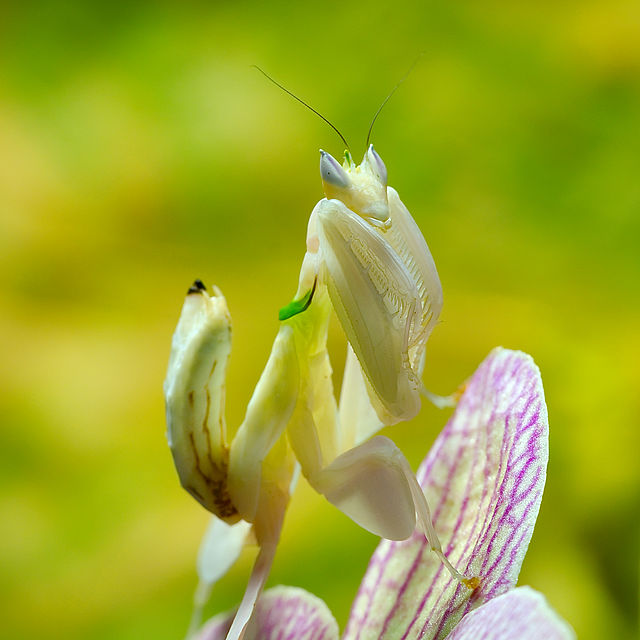
Native to the tropical rainforests of Malaysia and Indonesia, the Orchid Mantis is adorned with white and pink petal-like exoskeleton and is sometimes called "the world's most beautiful mantis." Adults measure 5–7 cm for females and 3–4 cm for males, making them quite small. Their unique ecology of mimicking flowers to ambush small insects is their greatest appeal, and witnessing their predatory strike in captivity is truly spectacular.
The enclosure must be tall. A minimum of 25 cm × 25 cm × 40 cm high is essential. Mantises hang from the ceiling to molt, so a height at least three times their body length is necessary to prevent molting failure. Paper towels or a bare bottom are easiest to maintain; arrange cork bark or artificial plants inside to create three-dimensional perching spots.
Temperature and humidity management reflect their tropical origins: maintain 25–28°C and 60–80% humidity. Temperatures below 23°C reduce appetite and lower metabolism. Mist the enclosure twice daily to maintain humidity, but avoid constant wetness, which promotes mold; balance with good ventilation. Japanese summers typically handle temperature fine, but watch for mold during humid rainy seasons.
Japanese Giant Mantis Care Environment
Growing to 10–12 cm as adults, the Japanese giant mantis is the largest mantis species in Japan, coming in green and brown morphs. When raising a wild-caught individual, remaining lifespan depends on the size at capture. Starting with smaller juveniles allows for longer enjoyment.
An insect container at least 30 cm wide works well. A screened lid-style insect cage is ideal, with wooden branches or popsicle sticks arranged vertically for movement space. Paper towels on the bottom are recommended for easy cleaning.
Room temperature (20–30°C) poses no problem. However, avoid direct sunlight and sealed rooms in summer, which can cause heat stress. Winter survival is essentially impossible; adults die after laying eggs in autumn. Overwinter the egg case (ootheca) outdoors and allow it to hatch naturally the following spring for continued breeding.
Feeding Methods and Live Food Sourcing
Mantises require live prey only. They rarely respond to dead insects or frozen crickets, and often refuse to eat even when starving if the food doesn't move.
Orchid Mantis feeding varies by growth stage:
| Growth Stage | Prey |
|---|---|
| Just hatched (first instar) | Yellow fruit flies (flightless strain) |
| Third to fourth instar | Isopods, banana worms |
| Fifth instar and beyond | Mealworms, small crickets |
| Adult females | Nutritious insects like zophobas or dubia roaches |
Feed juveniles every 2–3 days and adults every 3–4 days.
Japanese giant mantises prefer wild grasshoppers, crickets, moths, and robber flies. Commercial house crickets work fine too. Size prey to no more than 1–1.5 times the mantis's head width; oversized food can cause the mantis to thrash and injure itself.
Water is provided daily by misting water droplets on enclosure walls or leaf undersides for the mantis to drink voluntarily. Avoid water dishes, as mantises risk drowning. Direct water containers are unnecessary.
Molting Management: The Make-or-Break Milestone
Mantis molting is the critical juncture of captive care. Pre-molt signs include loss of appetite for several days and remaining motionless in the enclosure. Three things you must never do at this time:
- Touch the mantis
- Feed it
- Move the enclosure
Molting occurs while hanging from the ceiling or a branch, using gravity to pull the body downward. This requires vertical space at least three times the body length—an absolute prerequisite for successful molting. Without adequate foothold or if disturbed by other individuals or live crickets, molting fails (resulting in malformed limbs or death). Remove live feeders before molting begins.
After molting, leave the mantis untouched for 12–24 hours while the exoskeleton hardens, then resume feeding after 2–3 days.
Breeding and Male–Female Cohabitation
Orchid Mantis breeding is an advanced pursuit. Cohabiting mature males and females for mating carries the risk of the male being eaten during or after copulation. Prevent this by fully feeding the female beforehand and quickly separating the male once mating is confirmed.
Egg-laying occurs 1–3 weeks after mating, deposited in a spongy ootheca. At 25°C and ~70% humidity, the ootheca hatches in 4–6 weeks. Since dozens to over a hundred nymphs emerge at once, prepare small enclosures and live food (yellow fruit flies) in advance.
Wild-caught female Japanese giant mantises are often already mated and will lay eggs without a male. Overwinter the ootheca outdoors in a dry state and allow it to hatch naturally in April–May of the following year.
Conclusion: The Joy of Observation and Care
Mantis keeping is a sophisticated hobby demanding observation skills and meticulous management—sourcing live prey, tending through molts, timing feedings precisely. Exotic beauties like the Orchid Mantis typically come from breeders, but with experience, home breeding is entirely feasible.
Life with these "tiny fierce hunters" offers a one-of-a-kind experience of witnessing nature's instinct and vitality firsthand. Create a proper environment, savor each individual's personality and feeding changes, and enjoy your life with mantises to the fullest.