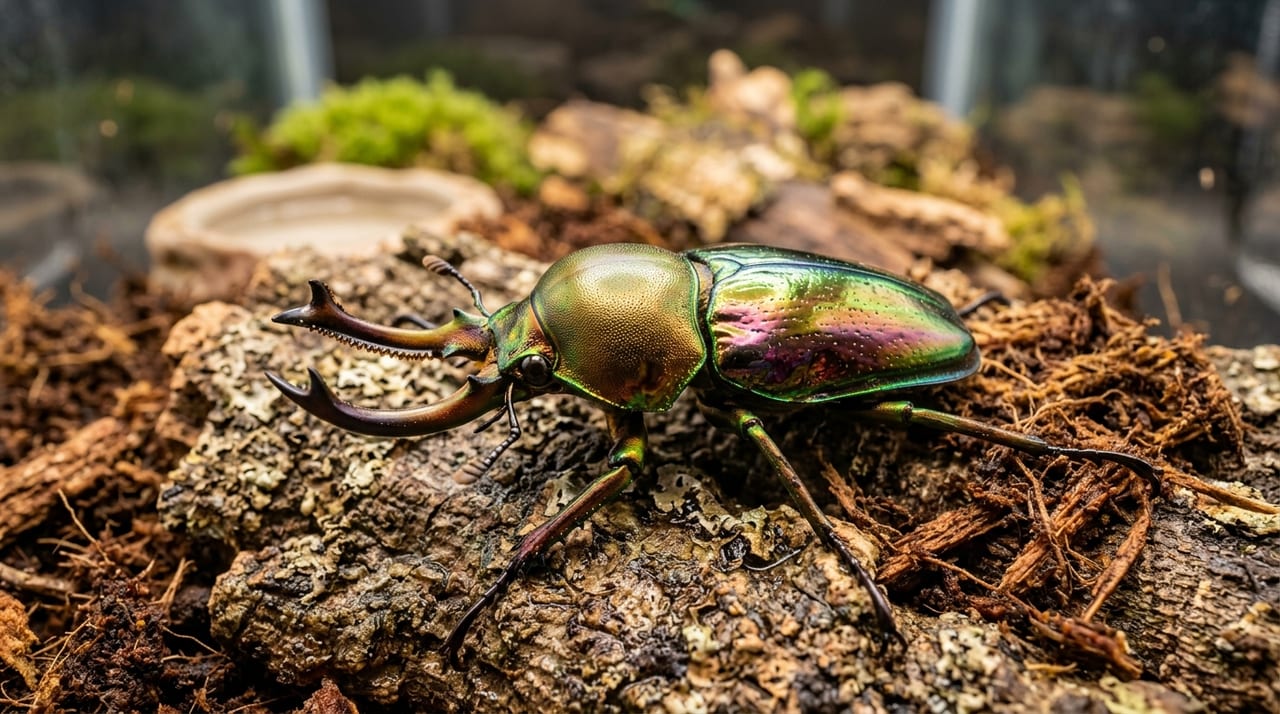
About Rainbow Stag Beetles
The Rainbow Stag Beetle (scientific name: Phalacrognathus muelleri) is a beetle native to Queensland, Australia, and as its name suggests, its most distinctive feature is its shell that shimmers in rainbow hues of green, gold, and purple depending on how light hits it. Adult males measure approximately 50-70mm in body length, females 35-50mm, making them medium-sized beetles with relatively short mandibles that are easy to handle, making them suitable for beginners. With a lifespan of 1-2 years as adults, they remain consistently popular as an introductory species for rearing and breeding.
However, behind this popularity lies an image that "breeding is difficult." In reality, breeding is relatively easy with proper management, but there are several key differences from Giant Stag Beetle care, so this article will explain the entire process.
Timeline for Rainbow Stag Beetle Breeding
Here is a summary of all breeding stages, durations, and temperature guidelines. Detailed explanations for each stage follow below.
| Stage | Duration | Temperature |
|---|
| Maturation (first feeding to pairing readiness) | 3-4 months post-emergence | 22-26°C |
| Pairing | 1 to several days | 22-26°C |
| Egg-laying substrate to larval removal | Approximately 4-6 weeks | 22-26°C |
| Larval period (females) | Approximately 6-8 months | 22-24°C |
| Larval period (males) | Approximately 8-12 months | 22-24°C |
| Pupation | Approximately 1-1.5 months | 22-24°C |
| Emergence to first feeding | Approximately 1 month | 22-26°C |
The optimal timing for pairing is after maturation (2+ months after first feeding), and breeding is possible at any time of year if 22-26°C can be maintained. From egg to next-generation adult typically takes approximately 8-14 months.
Adult Maturation and Pairing Preparation
For successful Rainbow Stag Beetle breeding, adults must first be properly matured. The guideline is 3-4 months post-emergence, and you should attempt pairing at least 2+ months after observing first feeding. Immature individuals shortly after emergence often produce infertile eggs when mated, so caution is necessary.
There are two pairing methods: "co-housing pairing" and "hand pairing (direct mating confirmation)." While Rainbow Stag Beetles are relatively docile, males may injure females, making hand pairing the safer option. Place the female on top of the male, and once you confirm the male extends his aedeagus and mating occurs, separate them. Mating duration is typically 5-30 minutes, and they naturally separate when finished. If forcibly pulled apart during mating, there is risk of aedeagus damage, so observe quietly until completion. If mating is not confirmed, try again the next day. For detailed pairing instructions, also refer to the Complete Stag Beetle Pairing Guide.
Setting Up the Egg-Laying Substrate
Rainbow Stag Beetles show a strong tendency to lay eggs in substrate rather than in wood, which is a major difference from Giant Stag Beetles. Prepare the following for the egg-laying setup:
- Container: Medium to large case (approximately 20L)
- Substrate: Fully fermented substrate mat (properly degassed)
- Egg-laying wood: Not strictly necessary, but adding one piece may increase egg count
- Temperature: 22-26°C (optimal range)
Pack the substrate firmly at the container bottom (10-15cm depth) and layer loosely on top. After placing the female, leave undisturbed for 2-3 weeks. If the surface substrate appears disturbed or eggs and larvae become visible through the container sides, breeding has been successful.
Plan for an egg-laying period of approximately 4-6 weeks. Remove the female and wait 2 weeks before excavating. Gently loosen the substrate to recover eggs and first-instar larvae.
Larval Rearing: Choosing Between Fungal Substrate Bottles and Mat Feeding
Rainbow Stag Beetle larvae can be raised in either fungal substrate bottles or fermented substrate mats, each with distinct advantages.
Fungal substrate bottle rearing makes it easier to raise larger individuals and tends to result in faster growth. Oyster mushroom substrate is reliable, and King Tuber mushroom substrate is also usable. However, Rainbow Stag Beetles are sensitive to degradation once the substrate is completely consumed, requiring timely replacements. Maintain temperature at 22-24°C.
Fermented substrate mat rearing is slower growing than fungal bottles but is more economical and simpler to manage. Use fully fermented substrate, and supplement or replace as it depletes. Mat rearing can still produce individuals exceeding 60mm.
Placing first-instar larvae initially in cups (approximately 200ml) before moving to 500-850ml bottles at the second instar increases survival rates.
Detailed Larval Period Guidelines: By Sex and Temperature
The Rainbow Stag Beetle larval period varies significantly by sex and rearing temperature. Use the following table to plan your timeline.
| Sex | Rearing Temperature | Larval Period |
|---|
| Female | 22-24°C | 6-8 months |
| Female | 25°C and above | 5-7 months (early maturation, smaller size) |
| Male | 22-24°C | 8-12 months |
| Male | 25°C and above | 7-10 months (early maturation, smaller size) |
| Male | 20°C and below | 12-18 months (low temperature, extended period) |
Higher temperatures shorten larval duration but tend to produce smaller adult beetles. For larger individuals, the strategy is to maintain a lower stable temperature of 22-24°C and raise them gradually over time. High temperatures (27°C and above) accelerate fungal degradation and increase the risk of "substrate intoxication" where larvae absorb harmful gases, so avoid them.
Larval Stage-Specific Management and Identification
Rainbow Stag Beetle larvae progress through stages: "first instar (1st) → 2nd instar → 3rd instar." Remember the characteristics of each stage and appropriate management.
First instar larvae: 1-2 weeks post-hatching. Body length is approximately 5-10mm, extremely small and fragile, requiring individual management in a small cup (200ml). Fermented substrate cups rather than fungal bottles result in higher survival rates.
Second instar larvae: 2-4 weeks post-hatching. Body length grows to approximately 15-25mm, and the head (head width) also enlarges. At this stage, transfer to 500ml fungal bottles or substrate bottles is feasible.
Third instar larvae (early and late period): The longest-duration stage. Body length reaches approximately 40-60mm in females and 60-80mm in males. Early third instar still feeds heavily and requires regular replacements, but late third instar (when the body takes on a yellowish tint) signals pre-pupation and replacement is strictly forbidden. Head width significantly affects final adult size, so ensuring adequate nutrition during early third instar is key.
For comprehensive larval management information, also refer to Insect Larva Rearing Summary and Complete Larval Rearing Guide.
Fungal Substrate and Mat Replacement Schedule
Regular replacements are crucial to supporting larval growth. Below is a timeline for replacement intervals.
| Timing | Container Guidelines | Replacement Signals |
|---|
| 1st to 2nd instar (2-3 weeks) | Small cup → 500ml bottle | Larva fills out, head width expands |
| 2nd to 3rd instar (approximately 2 months) | 500ml → 800-1400ml bottle | 2/3+ of fungal substrate consumed |
| Early 3rd to late 3rd instar (approximately 2-3 months) | 1400ml (same size may continue) | Heavy fecal material, fungal degradation |
| Late 3rd instar (pre-pupation) | No replacement | Stop when larva yellows |
How to identify replacement signals:
- White portion of the fungal bottle reduced by 2/3 or more (consumption sign)
- Fecal material accumulating heavily on bottle interior and bottom
- Larva taking on yellowish tint → absolutely do not replace (pre-pupation signal)
For detailed guidance on selecting fungal bottles, refer to Complete Insect Fungal Bottle Guide and Larval Substrate Replacement Procedure.
Pre-Pupation and Post-Emergence Management: The Golden Rule is Do Not Disturb
The period from pre-pupation to emergence is the most delicate stage in Rainbow Stag Beetle rearing.
Pre-pupation signals (period when replacement and moving are forbidden):
- Larval body color turns yellowish to orangish
- Movement slows, and curled posture becomes frequent
- The larva begins constructing an oval chamber (pupation cell) within the fungal bottle or substrate
- Once this stage begins, do not disturb at all until emergence
If the pupation chamber collapses: If the pupation chamber collapses or the pupa risks becoming wet from contact with moisture on the wall, transfer to an artificial pupation chamber (oasis or commercial molded products) becomes necessary. Support the pupa with a spoon rather than handling directly, and move it gently.
Post-emergence tips:
- The body is extremely soft immediately after emergence and must never be touched
- Wait 1-1.5 months until first feeding begins
- Complete color stabilization into rainbow hues takes an additional 2-4 weeks
Adult Management and Next Generation
Post-emergence individuals require 2-4 weeks for body color to stabilize. Initially, the green and gold luster may appear weak, but beautiful rainbow coloring steadies over time. Once first feeding begins, provide ample beetle jelly and wait for maturation before attempting the next pairing. For selecting adult food, refer to Insect Jelly Selection Guide.
Rainbow Stag Beetles are easily propagated across multiple generations, offering the enjoyment of building large-bodied bloodlines. In multi-generational rearing, systematically combining inbreeding (same parents) with outcrossing (different bloodlines) maintains vitality and body structure.
In first-time breeding, eggs often appear simply by "placing the female in the egg-laying substrate and waiting," making this a relatively easy species to breed when proper environment is provided. Using this article as a reference, try your hand at Rainbow Stag Beetle breeding. For pairing tips across stag beetles, see Complete Stag Beetle Pairing Guide, and for detailed temperature management, refer to Rainbow Stag Beetle Temperature Management Guide.