Pairing is the First Step in Stag Beetle Breeding
In stag beetle breeding, pairing (causing mating) is the first critical step. No matter how well-prepared your egg-laying setup is, unfertilized eggs will not hatch. Achieving reliable pairing is what makes the biggest difference in breeding success rates.
Domestic stag beetles (Japanese stag beetles, flat-horned stag beetles, saw-edged stag beetles, etc.) and foreign stag beetles (ParaWan major stag beetles, Giraffa stag beetles, etc.) differ in pairing difficulty and characteristics. The key to success without harming individuals is to adjust your approach based on whether the species has an aggressive or docile temperament. In particular, the popular Japanese stag beetle is docile and easy to handle, making it ideal for first-time breeding.
How to Distinguish and Confirm Successful Mating
Many breeders face the initial uncertainty: "Did mating succeed?" or "Is that wild-caught female already mated?" Accurately determining whether a female has mated is one of the most important factors for achieving high success rates in egg-laying setups.
Why Wild-Caught (WD) Females Can Be Considered Already Mated
Females caught while active in the wild (WD = Wild Display specimens) can be considered almost certainly already mated. In the wild, female stag beetles will have had mating opportunities during their active season. Additionally, female stag beetles have an organ called the spermatheca that stores sperm for extended periods, allowing a single mating to support multiple egg-laying cycles. For this reason, fertilized eggs can often be obtained even when wild-caught females are placed directly into egg-laying setups. However, for greater certainty, performing hand-pairing again before placement provides additional peace of mind.
How to Visually Confirm Mating Organ Lock During Hand-Pairing
The most reliable confirmation method is to directly observe the "locking of mating organs" during hand-pairing. When the male mounts the female, flexes his abdomen, and inserts and locks his mating organ into the female's genital opening (lock), mating has been successfully achieved. The lock typically lasts 5 to 30 minutes, during which both individuals should be left undisturbed. Once lock is confirmed, the female can be placed into an egg-laying setup as "confirmed mated."
Behavioral Signs of the Mated Female After Cohabitation
In cohabitation-pairing, direct observation is difficult, so assessment is based on the female's post-mating behavior.
- Feeds calmly and eats well: Mated females increase food consumption in preparation for egg-laying
- Abdomen becomes slightly distended: The abdomen may visibly swell
- Stops fleeing from the male: Mated females lose interest in the male and show calm behavior
Egg-Laying Behavior (Wood-Boring) as Final Confirmation
If the female actively begins boring into egg-laying wood or substrate after being placed in an egg-laying setup, this is a reliable sign that fertilization has likely occurred. If wood shavings are noticeably accumulating, egg-laying has likely begun.
The Difficulty of Confirming Mating and Pitfalls of Misunderstanding
It is difficult to determine whether a female has mated based on appearance alone. Abdominal distension varies between individuals and doesn't always indicate mating. Even after cohabitation, what seems like successful mating may not have resulted in actual lock. The most reliable method is visual confirmation during hand-pairing. For maximum certainty, re-confirming lock through hand-pairing even after cohabitation before placing into an egg-laying setup is recommended.
Quick Reference Table: Pairing Methods, Duration, and Temperature
Let's first review the overview in a table. Detailed procedures are explained in the sections that follow.
| Method | Cohabitation/Contact Duration | Recommended Temperature | Signs of Success |
|---|
| Hand-pairing | Single session (5–30 min lock observed) | 25–28°C | Direct observation of mating organ lock |
| Cohabitation-pairing | 3–7 days | 25–28°C | Female calmness, abdominal distension, egg-laying behavior |
Below 20°C, activity drops and success rates decline. Since they are nocturnal, attempting pairing from evening to midnight increases success rates.
Individual Condition Checklist Before Pairing
Before rushing into pairing, first confirm that individuals are "mature." Insufficiently mature individuals may not exhibit mating behavior or may fail to achieve fertilization even if mating occurs.
Post-Emergence Maturation Timeline
Stag beetles are reproductively immature immediately after emergence. Post-emergence maturation (the period during which internal organs fully develop) is required, with timelines varying by species.
- Japanese stag beetle: 3–6 months post-emergence
- Flat-horned stag beetle: 3–5 months post-emergence
- Saw-edged and alpine stag beetles: 6 months to over 1 year post-emergence (some remain dormant until the following summer)
- ParaWan major stag beetle: 4–6 months post-emergence
For purchased individuals, waiting at least 2 months from first feeding is a safe guideline.
Health Condition Checklist
- All six legs present and gripping firmly
- Actively feeding on jelly
- Responds quickly to stimulation
Individuals that have overwintered should be fed adequately to recover strength before pairing. Forcing mating immediately upon resuming activity risks female weakness during egg-laying.
Two Pairing Methods and When to Use Them
Hand-Pairing (Manual, Direct Observation)
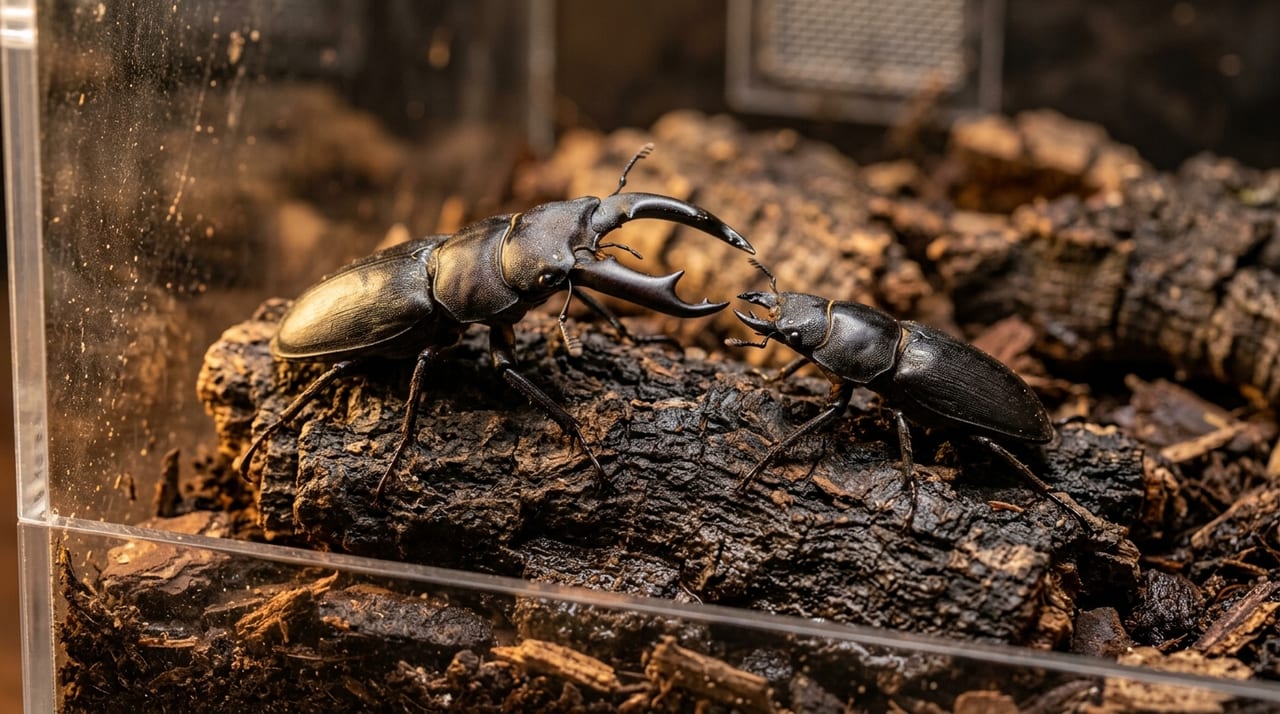
This method involves manually placing male and female together on a plastic case or shallow dish, with direct visual supervision until mating completes. It's especially effective for aggressive species like flat-horned stag beetles and ParaWan majors, where males risk attacking or crushing females.
Steps
- Place the female in the case and slowly approach the male from behind
- If the female remains still and assumes a receptive posture, pairing is ready to begin
- The male mounts the female, and confirm the locking of mating organs
- Keep the pair undisturbed while locked for 5–30 minutes until they naturally separate
- Once separated, immediately move the male to a separate case
If the male begins attacking the female, separate them immediately and retry after several days. Since mating can be visually confirmed, this method offers high reliability and is recommended for beginners.
Cohabitation-Pairing
This method involves placing male and female in the same case for 3–7 days and allowing natural mating. While slightly less reliable than hand-pairing, it works well for docile species or when managing many individuals. Japanese stag beetles are docile and achieve good success with cohabitation-pairing.
Important Notes
- Observe daily to ensure the female is not injured
- High cohabitation risk if the male is significantly larger than the female
- Make the case appropriately sized with egg-laying wood and leaf litter so the female can hide
- Always separate the male after the cohabitation period ends
Confirming Japanese Stag Beetle Pairing — Tips for a Docile Species
The Japanese stag beetle is notably docile among stag beetles. The risk of male aggression toward females is low, making cohabitation-pairing relatively safe. However, don't be complacent just because the species is docile.
Cohabitation-Pairing Tips
Include egg-laying wood and leaf litter in the cohabitation environment to provide hiding spots where the female can retreat. Cohabitation should last 3–5 days, with daily checks on the female's condition (injuries, appetite).
Specific Steps for Confirming Lock During Hand-Pairing
For Japanese stag beetles, place the male about 5 cm behind the female; he will detect her scent and approach naturally. Once the female assumes a receptive posture (remaining motionless), the male will slowly mount. When mating organ lock is confirmed, mating is successful and natural separation typically occurs within 5–15 minutes.
Timing Guidelines for Placement into Egg-Laying Setup
After confirming lock during hand-pairing, placement into an egg-laying setup within 1–2 days is ideal. For cohabitation-pairing, transfer to an egg-laying setup immediately after cohabitation ends. If you observe the female boring into egg-laying wood, this confirms successful mating and egg-laying has begun. For more details on stag beetle breeding, see Introduction to Insect Reproduction and Breeding.
Optimal Timing and Temperature Management for Pairing
Stag beetle mating activity is heavily influenced by temperature and season.
Optimal temperature range: 25–28°C provides the highest activity and mating likelihood. Below 20°C, movement becomes sluggish and pairing success drops. For winter breeding, maintain temperature control in a breeding room or greenhouse (22–26°C).
Time of day: Since stag beetles are nocturnal, attempting pairing from evening to midnight increases success rates. Individuals that are sluggish during the day become active at night.
Causes of Pairing Failure and Solutions
When pairing attempts fail to achieve mating, consider these possible causes:
Incomplete Post-Emergence Maturation
This is the most common cause. Recently emerged individuals or those just beginning to feed have immature reproductive function and low mating motivation. Solution: Wait at least 2–3 months from first feeding before retrying when the beetle actively feeds on jelly.
Insufficient Temperature
In temperatures below 20°C, stag beetle activity drops overall, making pairing unlikely. Solution: Adjust breeding temperature to 25–28°C before retrying.
Excessive Male Aggression
Particularly with flat-horned stag beetles and ParaWan majors, males may attack and injure females. Solution: Switch to hand-pairing with constant visual supervision. If aggression is severe, starting with "visual contact" through a divider to acclimate them to each other's scent increases success.
Female Rejection
Females may reject males if they already have sufficient stored sperm, or if they're ill or stressed. Solution: Retry after several days and improve the environment. Cohabitation in an already-set-up egg-laying setup with wood may make females more naturally receptive.
How Long Do Stag Beetles Mate? Mating Organ Structure and Important Notes
Stag beetle mating duration (from lock to separation) typically ranges from 5–30 minutes. However, individual variation is significant—some complete in minutes, others remain locked for over an hour. Including courtship time before lock, total pairing time from start to finish often ranges from 30 minutes to several hours.
| Stage | Time Range | Key Points |
|---|
| Courtship to lock | Minutes to ~30 min | Time for male to recognize and mount female; evening is more successful |
| Mating organ lock | 5–30 minutes | Can last over an hour in some individuals; keep undisturbed |
| Lock release and separation | Wait until natural separation | Never forcibly separate |
The times in the table are practical guidelines based on breeding experience. Length beyond expectations doesn't necessarily indicate abnormality.
Absolutely Avoid During Mating
Never forcibly separate a locked pair. During lock, mating organs are tightly secured; forcible separation risks damage to the organs, rendering both beetles unusable for breeding or causing death. No matter how long the lock persists, the rule is to wait quietly for natural separation.
How Stag Beetle Mating Organs Work
The male stag beetle's mating organ is normally retracted at the end of the abdomen and not visible externally. During mating, it extends and inserts into and locks at the female's genital opening at the end of her abdomen. This is what "lock" refers to throughout this article.
Interestingly, mating organ shape varies by species. They function like a lock and key, making cross-species locking difficult even between closely related species. These shape differences are important tools for experts identifying similar-looking beetle species.
When Does the Female Start Egg-Laying After Mating?
After mating, the female doesn't immediately begin egg-laying. Typically, the female placed in an egg-laying setup first feeds actively on jelly to build nutrition, then begins laying eggs within days to two weeks. When the female actively bores into egg-laying wood or substrate, egg-laying has begun. For timing of egg extraction, refer to the section "Moving to Egg-Laying Setup and Species-Specific Notes" below.
After mating, the male may remain over the female for an extended period. This is called "mate-guarding," a behavior protecting the female from rival males and a sign that mating is complete. It's frequently observed in saw-edged stag beetles and similar species with high male competition, sometimes making mating seem to last longer. This is not abnormal and doesn't require immediate separation, but once mate-guarding naturally ends, move the male to a separate case so the female can focus on egg-laying.
Post-Mating Behavior and How to Confirm Pairing Success
Here are three main methods to confirm whether mating has completed:
- Visual confirmation of mating organ lock: Most reliable. Observing lock during hand-pairing indicates high likelihood of fertilization
- Post-cohabitation abdomen and behavior observation: Mated females show slight abdominal distension and calmly burrow into substrate or wood
- Egg-laying confirmation in setup: Ultimate confirmation comes from the number of eggs and larvae when the setup is excavated
After mating, males may attempt to remount or females may attack males. Once their role is complete, separate males promptly to allow females to focus on egg-laying. To avoid the disappointment of thinking pairing succeeded only to find unfertilized eggs, strongly confirm mating by visual observation during hand-pairing before moving to an egg-laying setup.
Transitioning to Egg-Laying Setup and Species-Specific Considerations
After pairing completes, move females to egg-laying setups as quickly as possible. Continued cohabitation prevents females from concentrating on egg-laying and increases stress and injury risk.
Species-Specific Setup Basics
- Japanese stag beetle: Strengthen kunugi or sawtooth oak wood with custard-apple or inoculated substrate. Add approximately 5 cm of substrate to case bottom.
- Flat-horned stag beetle: Tightly pack fine-particle fermented substrate deeply (10–15 cm) into case. Embedding wood increases effectiveness.
- Saw-edged and alpine stag beetles: Fully fermented substrate alone is sufficient. They lay many eggs even without wood.
- ParaWan major: Tightly pack coarser fermented substrate deeply and place multiple pieces of egg-laying wood.
After placing females in egg-laying setups, excavate after 1–2 months; success is confirmed if eggs and larvae appear. If no larvae are found, consider re-pairing. For more on Japanese stag beetle adult care and long-term husbandry, see Stag Beetle Lifespan and Adult Care Basics.
Successful pairing is the foundation of all breeding success. Understanding the basics—individual maturity, health condition, and method selection—significantly impacts egg-laying results. If unsure which species to start with, refer to Popular Stag and Rhinoceros Beetle Rankings and begin with hardy, easy-to-breed species.