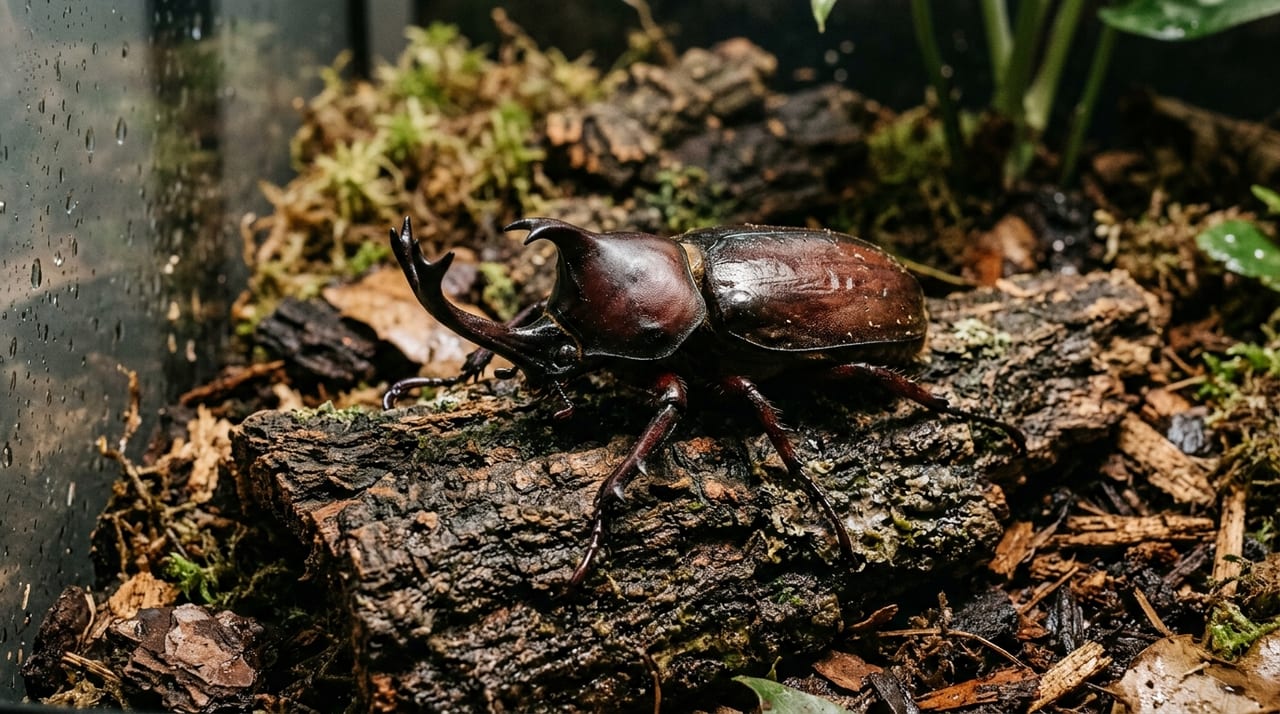
Fungal substrate bottles are one of the most effective methods for rearing longhorn beetle larvae. As fungal mycelium breaks down the sawdust, nutritional value increases, promoting larval growth. Choosing the appropriate fungal substrate bottle and exchanging it at the right time is key to producing large specimens.
How Fungal Substrate Bottles Work and Differences Between Fungal Species
A fungal substrate bottle is a rearing container in which fungal mycelium is cultivated in hardwood sawdust. The mycelium breaks down lignin and cellulose in the sawdust, converting it into a state that is easier for larvae to digest. There are mainly three types of fungal species used.
- King Oyster mycelium is the most common and has good larval feeding, suitable for many species including native giant stag beetles.
- Polypore mycelium is essential for specific species such as Tarandus and Regius, and is used for species that cannot be reared on King Oyster mycelium.
- Oyster mushroom mycelium has properties similar to King Oyster mycelium but is somewhat more cold-tolerant.
Fungal substrate bottles using King Oyster mycelium are recommended for beginners as they are easy to handle. Different manufacturers use different hardwood sawdust species, particle sizes, and additives, which affect larval growth.
Choosing Capacity and Size
Fungal substrate bottles are used differently depending on their capacity.
| Larval Stage | Capacity | Bottle Type |
|---|
| 1st to 2nd instar larvae | 500–800ml | Small bottle |
| 3rd instar male larvae | 1400–1500ml | Medium bottle |
| Large species or when targeting large specimens | 2000–3000ml | Large bottle |
Females often require only two 800ml bottles from 1st instar through emergence. For male giant stag beetles, the typical relay method uses 800ml (1st to 2nd instar), then 1400ml (early 3rd instar), and finally 1400ml or 2000ml (late 3rd instar to pupation)—a three-bottle relay. Wide-mouth bottle types make larval insertion and observation easier and reduce stress during replacement. Purchasing blocks (replacement fungal substrate blocks) and filling bottles yourself can reduce costs, but there is a risk of contamination by unwanted microorganisms, so work must be done in a clean environment.
How to Determine the Right Time for Replacement
Correctly determining when to replace the fungal substrate bottle is an important point that directly affects producing large specimens. Signs that replacement is needed are as follows.
- As a guideline for replacement, when feeding marks (the brown portions eaten by the larvae) visible from the outside of the bottle reach 70–80% of the total, it is time for replacement.
- Replacement is also necessary if the mycelium becomes degraded and discolored brown, or if moisture accumulates at the bottom.
However, the consumption rate varies depending on species and temperature. If mushrooms grow profusely, it is a sign that the mycelium's nutritional value is being depleted. Conversely, if there are signs the larva is beginning to form a pupation chamber, do not replace the bottle. Destroying the pupation chamber can cause emergence defects. If the pupation chamber cannot be confirmed from outside the bottle, check whether feeding marks have stopped progressing and gently lift the bottle to confirm there are no cavities. When replacing, carefully remove the larva from the old bottle without injury, and measuring and recording body weight is helpful for monitoring growth.
Temperature Management and Storage of Fungal Substrate Bottles
To maximize the performance of fungal substrate bottles, temperature management is important. For giant stag beetles, the ideal rearing temperature for larvae is 20–23°C. At high temperatures (25°C or above), mycelium degradation accelerates and larvae tend to pupate early, resulting in smaller specimens. Conversely, at low temperatures (18°C or below), growth slows, but over time larvae can still develop into large specimens. Common temperature management methods include wine coolers, refrigerated incubators, and air-conditioned rooms. Purchased fungal substrate bottles should ideally be stored in a cool, dark place (18–20°C); prolonged storage in a warm location will cause degradation before use. Before introducing larvae, placing the fungal substrate bottle in the rearing temperature environment for 1–2 days to acclimate it reduces stress from temperature differences.
Consult with BreederDirect Breeders About Choosing Fungal Substrate Bottles
There are very many manufacturers and brands of fungal substrate bottles, and evaluations vary depending on the species being reared and the breeder's preferences. At BreederDirect, you can learn from breeders with a proven track record in longhorn beetle breeding about fungal substrate bottle brands that have produced results through actual use. Since the final size can vary depending on which fungal substrate bottle is used, even with the same bloodline, a breeder's experience is very helpful as reference. Some breeders also sell fungal substrate bottles as a set when selling larvae, so it is recommended to consult together.
Common Mistakes in Fungal Substrate Bottle Management
Here are common mistakes that beginners tend to make when managing fungal substrate bottles.
- "Mistiming the replacement" is one. When 70–80% of the entire bottle is covered with feeding marks (the brown portions), it is a sign to replace, but missing this and leaving the larva in degraded substrate will significantly inhibit its growth.
- "Degradation from temperature fluctuations" is another. Because mycelium is living, it is sensitive to rapid temperature changes; particularly in summer heat (28°C or above), mushrooms can fruit and the mycelium can degrade into a muddy state.
Additionally, stacking fungal substrate bottles for storage reduces air circulation and can cause anaerobic fermentation, so it is important to space them apart on shelves.