Nitrate Management in Coral Tanks | Methods to Prevent Accumulation and Techniques to Lower Levels
Explanation of nitrate management methods that negatively affect corals. Introduction to the causes of nitrate increase and techniques to effectively lower it using protein skimmers, algae reactors, and water changes.
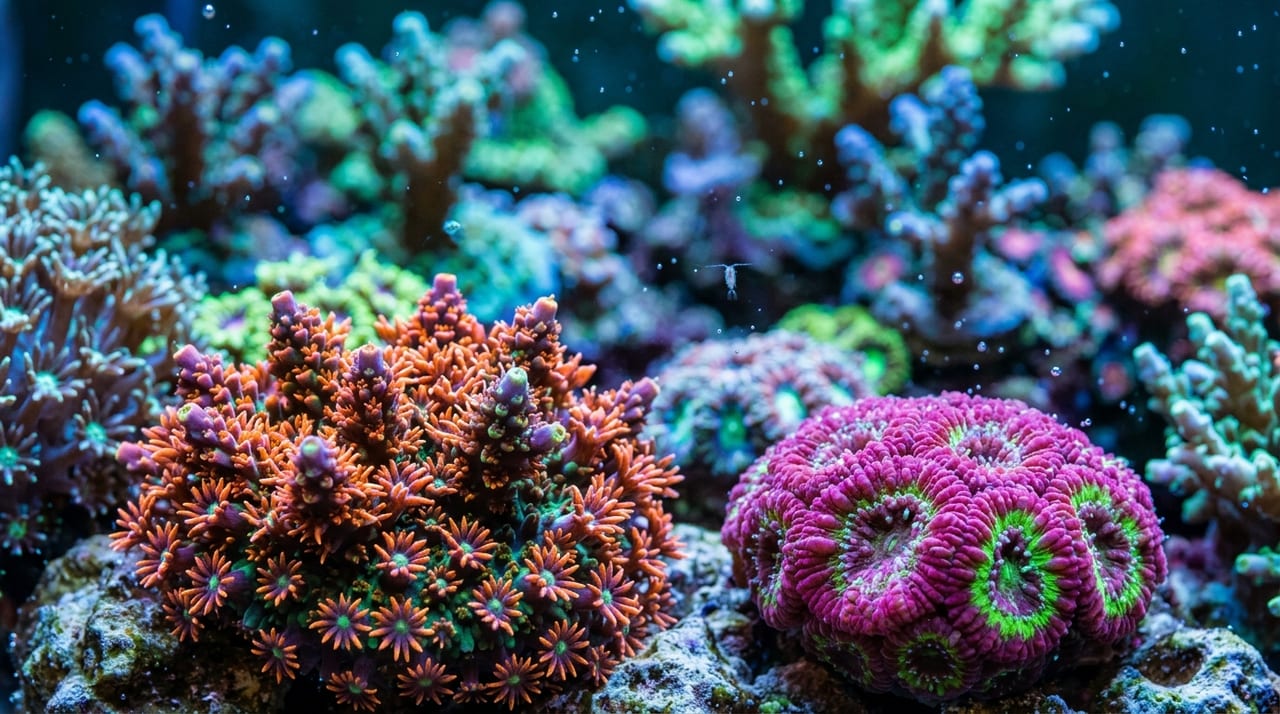
Key Takeaways
Explanation of nitrate management methods that negatively affect corals. Introduction to the causes of nitrate increase and techniques to effectively lower it using protein skimmers, algae reactors, and water changes.
In coral husbandry, the management of nitrate (NO₃⁻) is a critical task that holds the key to long-term maintenance. Nitrate accumulates in the tank as the final product of bacterial decomposition, and if left unchecked, it causes coral discoloration, stunted growth, and ultimately death. This article provides a detailed explanation ranging from the causes and mechanisms of nitrate increase to practical management techniques.
Impact of Nitrate on Corals
In fish-only tanks, nitrate levels of tens to 100 ppm or so rarely become immediately fatal. However, for corals, the story is different.
- LPS and soft corals: The target is 20 ppm or less. Exceeding this causes the symbiotic zooxanthellae to proliferate abnormally, resulting in browning where the entire coral turns brown. Colorful toadstools and other corals that were vibrant when purchased quickly lose their beauty.
- SPS (Acropora species): Ideally below 5–10 ppm. Acropora has particularly low tolerance for nitrate, and in high-nitrate environments, bleaching progresses from the tips and can lead to death in a short time. In high-end SPS tanks, it is not uncommon for aquarists to maintain levels below 2 ppm.
Nitrate itself is less toxic than ammonia or nitrite, but it inhibits the constant opening of polyps, leading to color loss, increased risk of bacterial infection, and synergistic eutrophication with phosphate. The cumulative long-term damage compounds. If your corals are not improving despite regular water changes, the first step is to measure your nitrate levels.
Main Causes of Nitrate Accumulation
- Feeding and bioload: The largest source of nitrate is "the food introduced" and "waste from organisms." The more fish you have and the more food you provide, the faster nitrate accumulates. Keep the number of fish in a coral tank minimal and selective, limiting feeding to once or twice daily with only the amount they will consume.
- The nitrogen cycle mechanism: In the tank, the nitrogen cycle progresses as ammonia (NH₃) → nitrite (NO₂⁻) → nitrate (NO₃⁻). The final product, nitrate, is reduced and denitrified to nitrogen gas (N₂) by anaerobic bacteria, but in typical reef tanks, oxygen is too abundant and anaerobic zones are scarce, so denitrification cannot keep up.
- Detritus accumulation: Organic matter (detritus) accumulated in the deep sand and crevices of rocks continues to produce nitrate as it decomposes anaerobically. Even in visibly clean tanks, siphoning the substrate can reveal blackened sand. This "invisible dirt" is a very common cause of chronic nitrate elevation.
Practical Techniques to Lower Nitrate and Prevent Accumulation
1. Utilizing a Protein Skimmer
A protein skimmer is the most important device for removing organic matter from the tank before it is converted to nitrate. It separates organic matter onto fine bubbles and removes it as skimate (waste water).
The key to selection is to "choose a model with processing capacity 1.5 to 2 times your tank volume." It is better to oversize the skimmer than to struggle with a small one. Dispose of the skimate cup once or twice a week, and clean the interior monthly. Tuning the skimmer (bubble moisture) is also important; bubbles with slight moisture capture organic matter better than completely dry bubbles.
2. Regular Water Changes
The simplest and most reliable method of nitrate removal. Exchange 10–20% of the total water volume with fresh synthetic seawater once weekly to physically dilute and remove nitrate.
The important consideration is the quality of the seawater used for water changes. Use high-quality synthetic seawater stock that has balanced calcium, magnesium, and KH, and match the specific gravity (1.025–1.026), temperature, and pH to your tank before adding. Abrupt water quality changes are stressful for corals. When nitrate is high, temporarily increasing the frequency to twice weekly for concentrated reduction is also effective.
3. Algae Reactor (Macro Algae Reactor)
A method of cultivating Chaetomorpha (fluffy green macro algae) in a dedicated reactor or separate sump section. As the algae grow, they consume nitrate and phosphate as nutrients, preventing eutrophication of the water column.
Maintenance is simple: trim and discard a portion of the algae once or twice a week. Along with the discarded algae, the absorbed nutrients are exported from the system. Aside from electricity costs (dedicated LED lighting is required), running costs are nearly zero, and once established, it is very effective. If nitrate exceeds 20 ppm, this is one of the items to consider first.
4. Carbon Source Dosing (Vodka Method / Carbon Source Dosing)
A method of adding a small amount of vodka (unsweetened), sugar water, vinegar, or commercial carbon source additives to enhance bacterial activity and promote nitrate consumption. When bacteria proliferate using the carbon source as an energy source, they take up nitrate, which is ultimately harvested by the protein skimmer.
However, incorrect dosing carries risks of cloudiness, oxygen depletion, and hydrogen sulfide production. If trying this for the first time, use a commercial carbon source additive and take a cautious approach, starting at half the recommended amount and increasing gradually. Simultaneously enhancing aeration to raise dissolved oxygen in the tank increases safety.
5. Reconsidering Live Rock and Substrate
The interior of natural live rock contains microscopic spaces where anaerobic bacteria reside, promoting natural denitrification. Place an appropriate amount of live rock for your tank volume (guideline: 0.05–0.1 kg per liter of capacity).
Regarding substrate, excessively deep sandbed (5 cm or more) is prone to detritus decay in anaerobic zones and becomes a source of nitrate and hydrogen sulfide production instead. If inexperienced with natural systems, maintaining shallower sand (2–3 cm or less) or even bare bottom (no substrate) is often easier to manage.
6. Denitrifier (Denitrification Device)
A specialized reactor that uses anaerobic bacteria to convert nitrate into nitrogen gas. In established reef tanks it delivers powerful results, but incorrect use risks hydrogen sulfide production. For beginners, the methods mentioned above take priority, and it is safer to tackle this after gaining experience.
Accurate Nitrate Measurement and the Habit of Record-Keeping
Test kits using reagents (Salifert, Red Sea, etc.) strike a good balance in accuracy and cost. Electronic testers are convenient, but accuracy varies significantly depending on the model; parallel use with reagent kits is recommended to verify accuracy.
The important thing is regular record-keeping. Recording measurement values once a week in a notebook or spreadsheet allows you to detect gradual upward trends early. If you notice "it was 5 ppm last week but 15 ppm this week," you can take action before significant damage occurs. Measuring before feeding and before water changes is easy to compare.
Summary
Nitrate management is fundamental to long-term coral husbandry. By combining early organic matter removal with a protein skimmer, dilution through regular water changes, and biological consumption via an algae reactor—these three together maintain nitrate at appropriate levels in most tanks. Don't forget the "effort of prevention" through controlling bioload and feeding amounts. Making measurement a habit and addressing problems while they are small is the surest path to enjoying a beautiful reef tank for years to come.