Mastering Biological Filtration in Reef Tanks — Complete Guide to Bacteria & Nitrogen Cycling
Deep dive into biological filtration for reef tanks: nitrifying and denitrifying bacteria, live rock and sand functions, DSB, bacterial additives, and cycling management.
Key Takeaways
Deep dive into biological filtration for reef tanks: nitrifying and denitrifying bacteria, live rock and sand functions, DSB, bacterial additives, and cycling management.
Related Species
What is Biological Filtration—The Invisible Hero Supporting Coral Tanks
While hobbyists often focus on equipment like lighting and protein skimmers to maintain the beauty of a reef tank, biological filtration is actually what fundamentally stabilizes water quality. Biological filtration refers to the process by which microorganisms living in the water—primarily bacteria—convert harmful nitrogen compounds into harmless substances through their metabolic activity.
Corals are even more sensitive to water chemistry than fish, and even trace amounts of ammonia or nitrite can damage their tissues. Understanding the mechanics of biological filtration and intentionally cultivating bacterial colonies within the tank is the foundation for maintaining coral health long-term.
The Basics of the Nitrogen Cycle: Ammonia → Nitrite → Nitrate
In the tank, organic matter from fish waste, uneaten food, and coral mucus generates ammonia (NH₃/NH₄⁺) during decomposition. The process by which this ammonia is ultimately rendered harmless is called the "nitrogen cycle" or "nitrification cycle."
Stage 1: Nitrification
Ammonia-oxidizing bacteria (represented by species like Nitrosomonas) convert ammonia into nitrite (NO₂⁻). Nitrite is also highly toxic and harmful to corals and fish.
Subsequently, nitrite-oxidizing bacteria (represented by species like Nitrobacter and Nitrospira) convert nitrite into nitrate (NO₃⁻). While nitrate is less toxic than ammonia and nitrite, high concentrations can cause coral color loss and growth inhibition.
| Stage | Conversion | Responsible Bacteria | Environmental Conditions |
|---|---|---|---|
| Stage 1 | NH₃ → NO₂⁻ | Nitrosomonas species and others | Aerobic (requires oxygen) |
| Stage 2 | NO₂⁻ → NO₃⁻ | Nitrobacter and Nitrospira species | Aerobic (requires oxygen) |
Stage 2: Denitrification
The process of further breaking down nitrate and ultimately releasing it as nitrogen gas (N₂) out of the tank is called denitrification. This is performed by anaerobic bacteria (microorganisms living in low-oxygen environments).
Denitrification naturally occurs in places where oxygen doesn't easily reach, such as within live rock or in the deep layers of deep sand beds. Rather than a completely anaerobic environment, it proceeds most efficiently in low-oxygen (microaerophilic) conditions.
The Biological Filtration Function of Live Rock
Live rock is the core of biological filtration in reef tanks. It is porous limestone that has been colonized by bacteria and microorganisms over many years in natural ocean conditions, and it harbors enormous bacterial colonies not only on its surface but throughout the countless internal pores.
Surface (Aerobic Zone)
The surface of live rock is exposed to water flow and rich in oxygen. Nitrifying bacteria are established here, responsible for breaking down ammonia and nitrite.
Interior (Anaerobic Zone)
The pores within live rock are oxygen-poor, where denitrifying bacteria are active. Through this process of converting nitrate to nitrogen gas, live rock functions as a "natural biofilter" capable of achieving both nitrification and denitrification in a single structure.
Appropriate Live Rock Quantity
Generally, 1 to 1.5 kg of live rock per liter of tank volume is recommended (roughly 10–15 kg for a 60L tank). However, this is merely a guideline, and porous lightweight live rock (pumice-type) can have high surface area even in smaller quantities.
Introduction and Maintenance of Live Rock
- After purchase, perform curing (maintaining water flow and temperature in a separate container for 1–2 weeks to decompose and remove dead organisms)
- Placing uncured rock directly in the tank causes massive ammonia release from dead organisms, damaging existing inhabitants
- Regular maintenance of blowing away detritus (accumulated sediment) is also effective
The Role of Live Sand (Substrate)
Live sand refers to substrate colonized by bacteria and micro-organisms. Aragonite (aragonite-type sand) or coral sand are primarily used, serving both biological filtration and pH buffering functions.
Thin Bed (1–3 cm)
Many reef tanks use a thin sand bed of 1–3 cm depth. At this depth, primarily aerobic nitrification occurs, and detritus accumulation is easily visible and cleanable.
Deep Sand Bed (DSB)
Using a substrate depth of 10–15 cm or greater is called a Deep Sand Bed (DSB). Oxygen barely reaches the deep layers of sand, creating an environment where anaerobic bacteria dominate. In this setting, denitrification is highly active, and biological nitrate removal can be expected.
DSB Advantages
- Nitrate can be biologically reduced, potentially decreasing water change frequency
- pH buffering action (calcium and alkalinity supply through aragonite dissolution)
- Serves as habitat for micro-organisms (worms, copepods, amphipods, etc.), creating a natural food chain
DSB Disadvantages and Risks
- After several years, if the anaerobic zone becomes overly developed, there is a risk of hydrogen sulfide (H₂S) generation
- Disturbing the sand or performing extensive cleaning can release accumulated toxic gases all at once, potentially causing total tank collapse
- Requires significant floor space, limiting layout flexibility
If adopting DSB, introducing burrowing organisms (sea cucumbers, bristleworms, etc.) in appropriate quantities and implementing a "cleanup crew" that moderately stirs the surface layer is recommended.
Use of Bacterial Additives
Commercial bacterial additives are used to accelerate tank cycling and supplement biological filtration.
Main Product Categories
| Type | Representative Products | Purpose |
|---|---|---|
| Nitrifying Bacteria | Bio-Digest, Turbo Start, etc. | Accelerate cycling in new setups |
| Denitrifying Bacteria | ProBio S, Denitrate bacterial products, etc. | Nitrate reduction |
| Comprehensive Bacteria | Microbacter Seven, Pod Clean, etc. | Overall water stability and organic matter breakdown |
How to Use Bacterial Additives
- During new setup: Nitrifying bacteria additives can shorten nitrogen cycle establishment from typical 4–6 weeks to 2–3 weeks
- When the tank is already established: Unnecessary additions can backfire. Bacterial imbalance can temporarily cause water cloudiness
- After large water changes or emergencies: Effective for recovery when bacterial colonies have been reduced
Important Notes
Bacterial additives are not a cure-all. It's important to understand that fundamental water quality problems (overstocking, overfeeding, inadequate filtration capacity) cannot be solved by bacterial additives alone.
Carbon Source Addition and Promoting Denitrification
To actively remove nitrate, you can add a carbon source to the tank, which serves as an energy source for bacteria.
Representative Carbon Sources
- Vodka (ethanol): "Vodka dosing"—adding small amounts to increase denitrifying bacteria
- Vinegar (acetic acid): Similar effect to ethanol; somewhat harder to manage
- Commercial carbon sources: NoPoX (Red Sea), Bio-Pellets, and other specially formulated products
Carbon Source Addition Precautions
- Excessive amounts can cause rapid bacterial growth, consuming oxygen and creating hypoxia risk
- Sufficient protein skimmer performance is essential (the skimmer must remove proliferated bacteria)
- Start with small amounts and adjust while monitoring nitrate and phosphate levels
- In SPS tanks, reducing nitrate too close to zero can cause coral nutrient deficiency. Appropriate nitrate levels (around 1–5 ppm) are sometimes necessary for SPS color enhancement
Nitrogen Cycle Management During Reef Tank Startup
Establishing the nitrogen cycle when setting up a new reef tank is the first critical hurdle to successful coral keeping.
Startup Steps
- Equipment setup and saltwater introduction: Mix artificial seawater and adjust specific gravity to 1.024
- Live rock placement: Position cured live rock
- Ammonia source introduction: Add a few drops of commercial ammonia solution or one raw shrimp to the tank
- Wait and measure: Test ammonia and nitrite daily. As bacteria proliferate, values shift in order: ammonia → nitrite → nitrate
- Confirm cycle completion: When both ammonia and nitrite reach 0 ppm and nitrate is detected, cycling is complete
- Large water change: Perform approximately 50% water change to remove accumulated nitrate
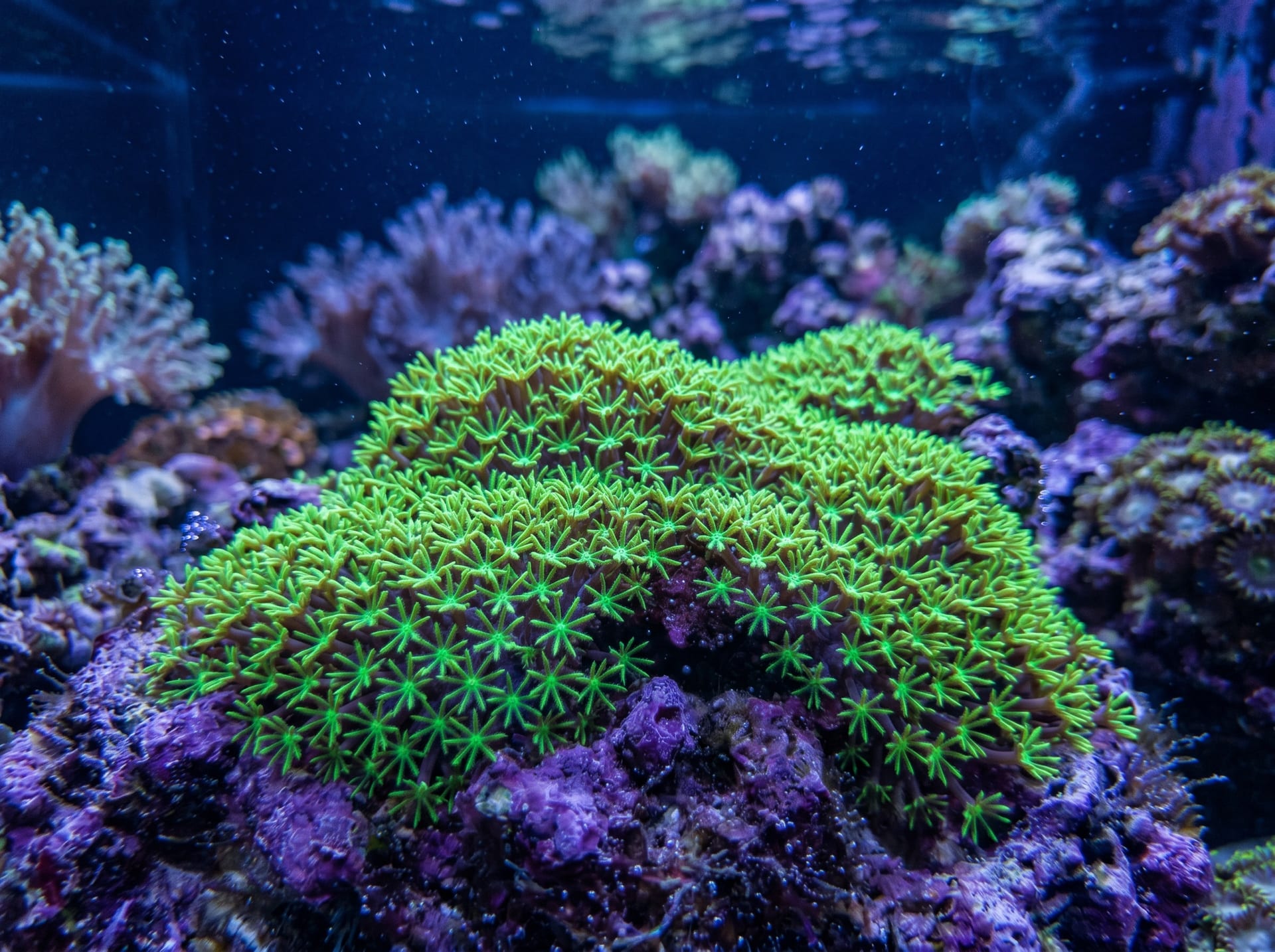
- Introduce test specimens: First introduce hardy soft corals (such as button coral or star polyps)
Typical Timeline During Startup
| Period | Condition |
|---|---|
| Weeks 1–2 | Ammonia peaks |
| Weeks 2–3 | Nitrite peaks; ammonia declines |
| Weeks 3–5 | Nitrite declines; nitrate rises |
| Weeks 5–6 | Both ammonia and nitrite at 0 ppm. Cycle complete |
When using bacterial additives, this timeline may be shortened by approximately half.
Biofilm and Bacterial Diversity
Bacteria in the tank are not merely nitrogen processors. Within live rock, glass surfaces, and piping, biofilms form—thin, membranous structures created by microbial communities—and thousands of species of bacteria, archaea, and protists coexist within them.
Biofilm Functions
- Organic matter decomposition and nutrient recycling
- "Competitive exclusion" suppressing pathogenic bacteria proliferation
- Maintaining the microbial environment affecting coral and fish immunity
To Maintain Diversity
- Do not continuously operate UV sterilization: UV kills bacteria and reduces biofilm diversity. Ideally use UV only during disease outbreaks
- Avoid excessive frequent water changes: Unnecessary water changes disrupt established bacterial colonies
- Be cautious with medications (copper, etc.): Copper ions kill bacteria and a wide range of microorganisms. Always perform copper treatment in a quarantine tank
Combination of Filtration Systems
In reef tanks, it is standard practice to combine multiple filtration methods with biological filtration as the foundation.
Biological Filtration (Base)
Live rock + live sand form the base. Additional media like ceramic rings or bioballs in a sump may be added, but excessive media becomes a detritus accumulation site—simplicity with minimal media is the rule in reef tanks.
Mechanical Filtration (Supplementary)
Filter socks and felt pads physically remove suspended organic matter. Frequent replacement and cleaning are necessary.
Chemical Filtration (Supplementary)
Activated carbon (removes organics and yellowing) and GFO (phosphate absorption) are used as needed.
Protein Skimmer (Essential)
Directly removes organic matter from the water—the cornerstone of reef tanks. It reduces the load on biological filtration and contributes to overall water stability.
Troubleshooting
Ammonia Detected
- Cause: Immature biological filtration, overstocking, excessive feeding, dead organisms in live rock
- Solution: Perform immediate water change, stop feeding, identify and remove the cause
Nitrite Won't Decrease
- Cause: Insufficient nitrite-oxidizing bacteria, inappropriate water temperature/pH
- Solution: Add bacterial additives, check and correct water temperature and pH
Chronic High Nitrate
- Cause: Insufficient denitrification capacity, overstocking, overfeeding
- Solution: Increase water change frequency, consider carbon source addition, install a refugium (macroalgae tank), review feeding amounts
Water Cloudiness
- Cause: Bacterial bloom (sudden bacterial population explosion)
- Solution: Usually clears naturally within a few days. Do not perform water changes; maintain skimmer operation
Summary
Biological filtration in reef tanks is the unsung hero—bacteria working 24/7 without rest maintain water quality for you. Understanding the nitrogen cycle, appropriately placing live rock and live sand, and maintaining favorable conditions for bacteria—these are the most reliable methods for long-term success in coral keeping.
While brilliant lighting and colorful corals catch the eye, their beauty is supported by the invisible work of bacteria. Practice tank management with biological filtration in mind and enjoy watching your corals thrive in stable water conditions.