Coral Diseases and Solutions | Symptoms and Prevention of RTN, STN, and BJD
Explains the causes, symptoms, and treatments for major coral diseases (RTN, STN, BJD, and bleaching). Introduces early detection signs, prevention strategies, and emergency procedures for when problems arise.
Key Takeaways
Explains the causes, symptoms, and treatments for major coral diseases (RTN, STN, BJD, and bleaching). Introduces early detection signs, prevention strategies, and emergency procedures for when problems arise.
Related Species
Coral Diseases Are a "Race Against Time" — Early Detection Determines Life or Death
When keeping corals, you may suddenly encounter scenes where tissue dissolves and peels away, or surfaces become covered with brown, jelly-like substances. These diseases progress extremely quickly, and it is not uncommon to lose an entire colony if proper treatment is delayed by just a few hours.
Rather than just fearing coral diseases, the best strategy to minimize damage is to understand in advance "what symptoms to watch for," "why they occur," and "how to respond." This article provides detailed explanations of three particularly problematic diseases in saltwater aquariums—RTN, STN, and BJD—as well as bleaching.
RTN (Rapid Tissue Necrosis) — The Most Dangerous Disease That Spreads in Hours
Symptoms and How to Identify It
RTN (Rapid Tissue Necrosis) is a disease in which tissue dies "rapidly," as its name suggests. A healthy coral can begin exposing its skeleton within hours, and in the fastest cases, the entire colony can bleach white in a single night.
The main symptoms are as follows.
- Tissue recedes along a clear boundary line, exposing white skeleton
- Mucus-like and gelatinous tissue sloughs off and floats in the water column
- Exposed skeleton appears white initially, but later algae colonize and turn it green or black
- It occurs especially frequently in SPS (Small Polyp Stony) corals such as Acropora and Montipora
Main Causes
RTN is rarely caused by a single factor; most cases result from a combination of multiple conditions.
- Sudden water quality deterioration: Rapid fluctuations in KH (carbonate hardness) or pH, sudden spikes in nitrate or phosphate
- Bacterial infection: Opportunistic bacteria such as Vibrio species infect stressed corals
- High water temperature: Sustained temperatures above 28°C increase tissue stress and easily trigger RTN
- Transport and relocation stress: Commonly develops shortly after purchase or after moving between tanks
Summer heat is a major trigger for RTN. Check Coral Summer Temperature Management for specific temperature control strategies.
Treatment — Act Immediately Without Hesitation
Response to RTN begins the moment it is discovered.
- Immediately cut below the affected area with bone cutters: Remove the necrotic portion by cutting below the progression line (on the healthy tissue side), physically eliminating the infected area.
- Dip in iodine solution: Submerge the cut fragment in diluted iodine (Lugol's) dip for 5-10 minutes to disinfect.
- Move to isolation tank: Remove the infected coral from the main tank to prevent secondary infection of other corals.
- Verify all water parameters: Check KH, pH, temperature, specific gravity, nitrate, and phosphate; correct any abnormalities immediately. Reference Introduction to Reef Tank Water Chemistry for KH management.
STN (Slow Tissue Necrosis) — A Chronic Disease That Progresses Gradually
Symptoms and How to Identify It
STN (Slow Tissue Necrosis) differs from RTN in that tissue recession progresses slowly over days to weeks. If you notice the coral gradually turning white from the base, suspect STN.
- The tissue recession line is clearly defined, with a sharp boundary between living tissue and white skeleton
- Progression is slow, but if left untreated, it will certainly spread to the entire colony
- In addition to Acropora, it also occurs in LPS (Large Polyp Stony) corals such as Scolymia and Trachyphyllia
Main Causes
- Chronic water quality imbalance: Prolonged KH deficiency, persistently high nitrate or phosphate levels
- Improper lighting: Placement in conditions with too much or too little light relative to the coral's needs
- Chemical attack from other corals: Even without direct sweeper tentacle contact, chemical compounds (such as terpenes) from neighboring corals can damage tissue
- Accumulation of fundamental environmental stress: Many cases result from multiple small stressors compounding over time
Treatment
STN allows more time for response than RTN, so you can address it methodically without panic.
- Cut away necrotic areas and create fragments: Cut along the healthy side of the progression line and manage as new fragments.
- Reassess placement: Re-evaluate whether water flow and lighting are appropriate, and relocate if necessary.
- Improve water quality fundamentally: Increase water change frequency or reassess KH supplementation dosage and schedule.
- Isolate and monitor: If progression continues after cutting, maintain distance from other corals and observe.
BJD (Brown Jelly Disease) — The Enemy of Flowing Anemone Corals
Symptoms and How to Identify It
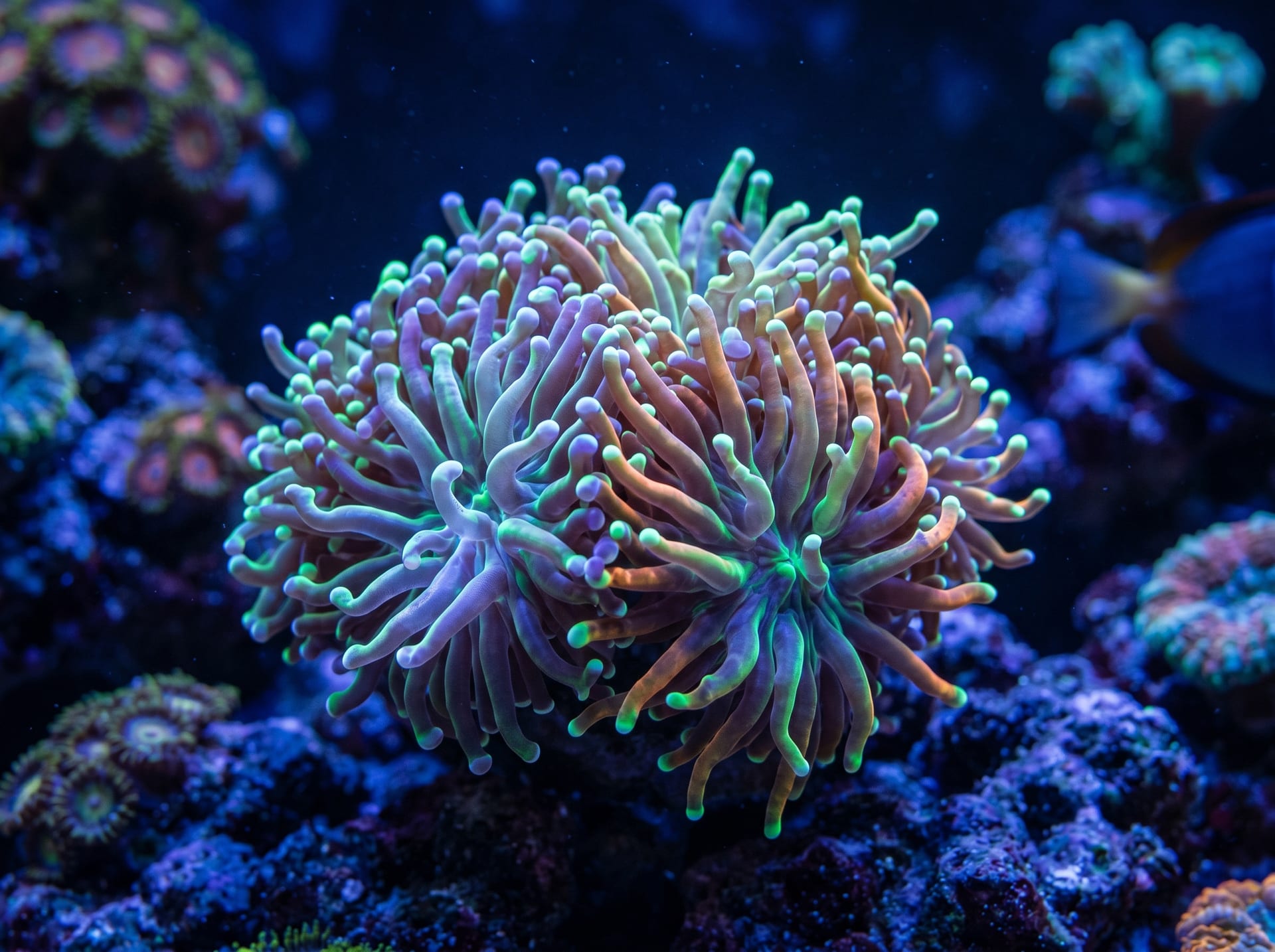
BJD (Brown Jelly Disease) is especially common in LPS corals of the genus Euphyllia, such as Anchor Corals (Euphyllia ancora) and Frogspawn Corals (Euphyllia glabrescens).
- Brown to yellowish-brown gelatinous substance appears around coral polyps
- Initially appears only on some polyps, but spreads to adjacent ones if left untreated
- In severe cases, the skeleton is eroded, making recovery difficult
- Water currents can spread the jelly throughout the tank, risking attachment to other corals
BJD is caused by protozoan infection and tends to infect damaged polyps or weakened corals more easily.
Treatment
- Carefully remove the jelly with a pipette: Remove it cautiously to avoid spreading it through the tank.
- Disinfect with iodine dip: Soak the affected area in Lugol's iodine dip to eliminate protozoa.
- Separate and fragment healthy polyps: In severe cases, cut out healthy skeletal portions and manage them as uninfected new fragments.
- Increase water flow to create an environment where jelly accumulation is difficult: Proper flow is also effective for BJD prevention. Reference Reef Tank Flow Design Guide for flow configuration.
Bleaching — Not a Disease, But a Critical SOS Signal
What Is Bleaching?
"Bleaching" is the loss of symbiotic zooxanthellae (Symbiodinium) from within the coral, causing the white skeleton to show through transparent tissue. While technically not a "disease" but rather an "environmental stress response," it leads to starvation or necrosis if left untreated.
The main causes are as follows.
- High water temperature: Sustained temperatures above 28°C for several days cause zooxanthellae loss (also watch for prolonged periods above 27°C)
- Sudden lighting changes: Abrupt transition to bright light (light stress)
- Abnormal water parameters: Significant fluctuations in KH, Mg, or Ca
- Introduction of medications or pesticides: Even trace amounts can be fatal to corals
Determining Recovery Potential
Even if bleached, recovery is possible if the skeleton is alive and polyps are extending. Maintain stable water parameters, appropriate lighting, and flow while patiently managing the coral for weeks to months. If the skeleton becomes completely covered with green or black algae, recovery is unlikely. If multiple corals begin collapsing simultaneously, check Reef Tank Crash Recovery Manual for emergency procedures and reset decisions.
BreederDirect's Safety and Peace of Mind System
When addressing coral diseases, "selecting healthy specimens" is the first step in prevention. This is because transport stress and initial infections frequently trigger RTN and BJD.
At BreederDirect, we work only with breeders who have raised and propagated corals for many years and personally confirm each coral's health before sale. Since most specimens are pre-fragmented with fully healed cut surfaces, they arrive in robust condition resistant to transport stress.
Additionally, if concerns arise after purchase—such as doubts about arrival condition or suspected illness—customers can contact breeders directly via messaging. Advice from knowledgeable breeders provides invaluable support for beginners.
Starting with healthy specimens and armed with the disease knowledge presented in this article, you can significantly reduce the risks of coral keeping. Enjoy building a beautiful reef tank with corals from trusted breeders at BreederDirect.