Source: Wikimedia Commons
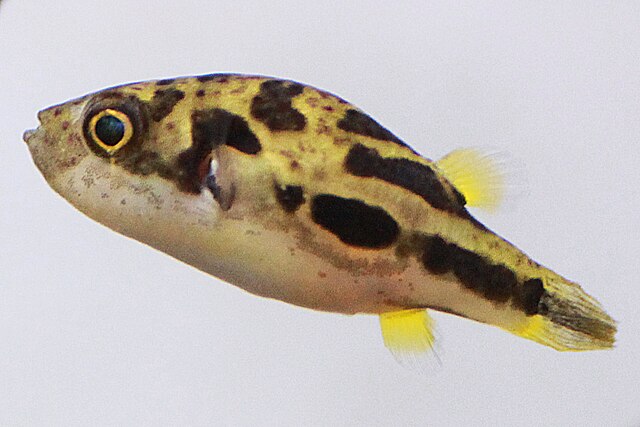
Pea Puffer
IntermediateCarinotetraodon travancoricus
Eats pest snails in tanks. Expressive face and bonds with owners.
Difficulty
Intermediate
Temperature
22〜28℃
Lifespan
3-5 years
Size
2-3cm
Diet
Frozen bloodworms, snails, frozen brine shrimp
About
The pea puffer (Carinotetraodon travancoricus), also known as the dwarf pufferfish or Malabar pufferfish, is a tiny freshwater puffer endemic to the rivers of Kerala and southern Karnataka in southwestern India, including the Pamba and Cauvery river systems. At a maximum length of 3.5 cm, it is among the world's smallest pufferfish. Its round, greenish-yellow body speckled with black spots and characteristically large, independently moving eyes give it an endearingly curious appearance. Pea puffers are highly intelligent and possess strong individual personalities, but also intense territorial aggression — they will nip fins of any tankmate and are best kept alone or in species-only setups. Diet is almost exclusively carnivorous: frozen bloodworms, brine shrimp, and small live snails are staples; most individuals refuse dry foods. Snails should be offered regularly to wear down the continuously growing beak-like teeth. Wild populations are declining due to habitat degradation; captive-bred specimens are increasingly available and preferable.
Source: Wikipedia (CC BY-SA 4.0)
Lifespan of the Pea Puffer
The Pea Puffer lives 3-5 years.
Size of the Pea Puffer
The Pea Puffer grows to 2-3cm.
Temperature & humidity for the Pea Puffer
The ideal water temperature for the Pea Puffer is 22〜28℃.
Optimal conditions are 24–28°C at pH 6.5–7.5.
Basic Info
Origin
Kerala and southern Karnataka in Southwest India
Care Specifications
- pH
- 7.5–8.3
- Hardness (GH)
- 5–25 dGH
- Water Temp.
- 22–28℃
- Min. Tank
- 12.6 L
Semi-aggressive
Sources: FishBase / Seriously Fish
Captive Breeding
Egg-laying
- Clutch size
- 1〜5
- Incubation temp.
- 28℃
- Incubation days
- 4〜5 days
Breeding season: Spawning can occur year-round with no distinct season; courtship behaviour is typically observed around sunset.
Breeding notes
Spawns in a batch pattern releasing 1–5 non-adhesive, spherical eggs (~1.5 mm diameter) per day. Preferred spawning media include java/willow moss, floating plants, and fine-leaved plants (Cabomba, Ambulia). Setting temperature toward the upper end of the species range (26–28 °C, within the 22–28 °C maintenance range) and conditioning with live foods such as bloodworms and small snails is reported to promote spawning. Fry absorb their yolk sac over an additional 2–3 days after hatching.
Breeding requires planning, proper husbandry, and responsibility. These figures are general guidelines.
Sources: Seriously Fish – Carinotetraodon travancoricus / PubMed 39344425 – Embryonic Development of C. travancoricus (Zygote, 2024)
References & Sources
Edited & verified by: BreederDirect editorial team
The taxonomic, regulatory, and husbandry data on this page are compiled and verified against the authoritative primary sources below.
Taxonomy & Authority
Regulations & Conservation Status
Not CITES-listedIUCN VU · Vulnerable
Avery pufferfish. IUCN Vulnerable (2010, A2de+3de+4de, endemic to Western Ghats). Not listed on CITES.
Sources: FishBase / Seriously Fish / CITES Appendices (Checklist)
Regulations may change. Always verify the latest information with the relevant authorities.
Pea Puffer Listings
Loading latest listingsFind listings for this species