Source: Wikimedia Commons
Common Marmoset
AdvancedCallithrix jacchus
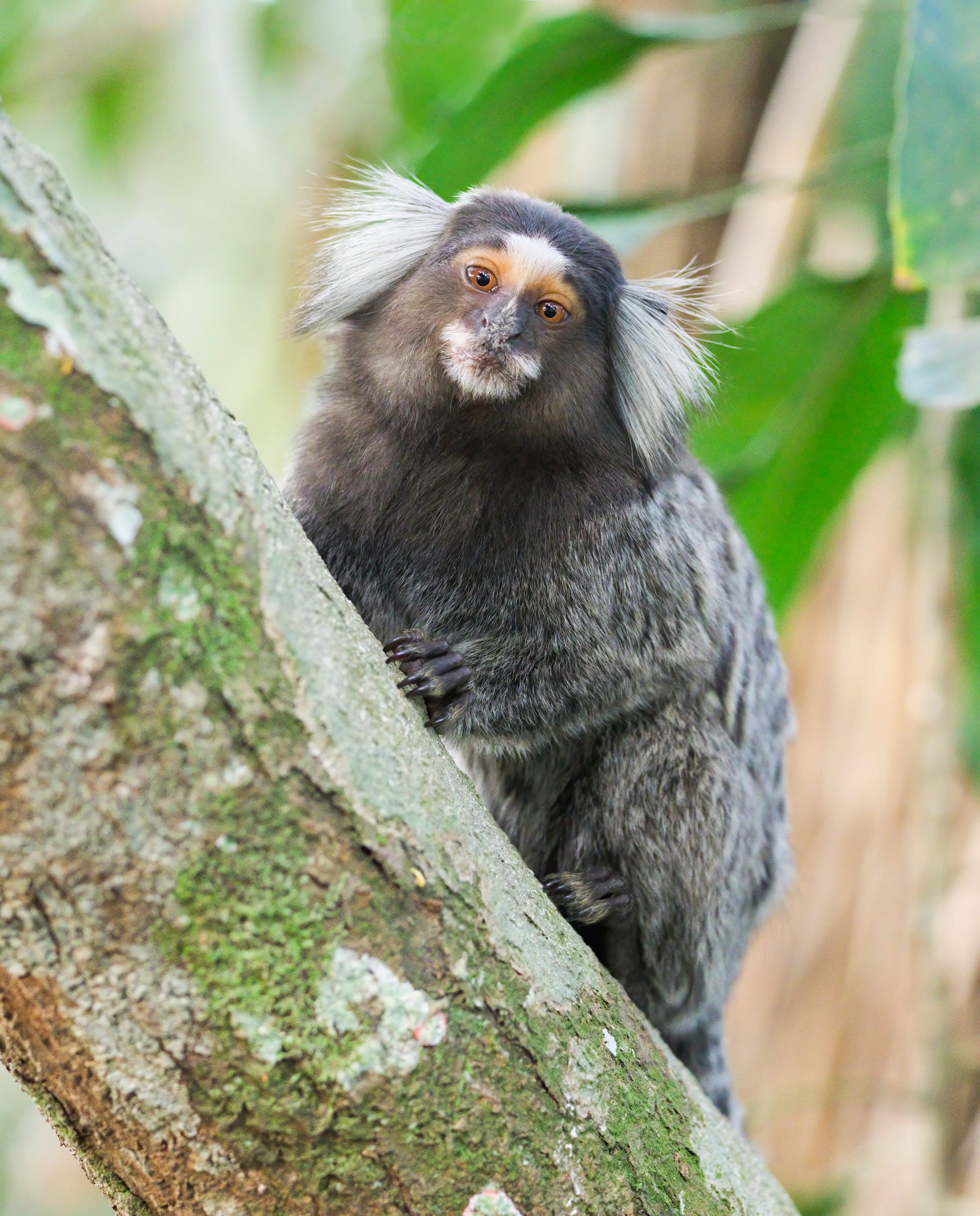
A small Brazilian monkey with white ear tufts and a banded tail. A highly social animal living in family groups, it needs companions, arboreal space and a gum-based diet, making it an advanced species.
Difficulty
Advanced
Temperature
18〜26℃
Lifespan
10-12 years (captive average; maximum 22.8 years)
Size
Head-body about 18.5-19cm / 236-256g
Humidity
40〜60%
Diet
Marmoset pellets, gum arabic, insects, fruit, boiled egg
About
The common marmoset is a small callitrichid monkey native to northeastern Brazil (the states of Piaui, Paraiba, Ceara, Rio Grande do Norte, Pernambuco, Alagoas and Bahia) and introduced to Rio de Janeiro and Buenos Aires. It has white ear tufts, a long banded tail and a pelage mixing brown, grey and yellow; all digits except the big toe bear claw-like nails for clinging vertically to trunks. The diet centres on plant exudates such as gum, sap and latex obtained by gouging bark, making up 20-70% of feeding behaviour, with insects at 24-30% plus fruit, seeds, flowers and occasionally bird eggs and nestlings. It lives in family groups of typically nine animals with one or two breeding females, a breeding male, their offspring and adult relatives; gestation is about five months and non-identical twins can be born twice a year. The IUCN lists it as Least Concern, and all primates not on Appendix I are on CITES Appendix II. In Japan the Ministry of Health's animal import notification system excludes monkeys and refers them to the MAFF Animal Quarantine Service, which treats monkeys as rabies-quarantine animals, so animals on the domestic market are captive-bred in Japan. Though popular as pets, they become difficult to manage as they mature and abandonment has been reported.
Source: Wikipedia (CC BY-SA 4.0)
Lifespan of the Common Marmoset
The Common Marmoset lives 10-12 years (captive average; maximum 22.8 years).
Average captive lifespan is 10-12 years with a record of 22.8 years.
Size of the Common Marmoset
The Common Marmoset grows to Head-body about 18.5-19cm / 236-256g.
Males average 188 mm in head-body length and 256 g, females 185 mm and 236 g.
Basic Info
Origin
Care Specifications
References & Sources
Edited & verified by: BreederDirect editorial team
The taxonomic, regulatory, and husbandry data on this page are compiled and verified against the authoritative primary sources below.
Primary sources
- Wikipedia
- CITES Appendices (PRIMATES spp. Appendix II)
- IUCN Red List Callithrix jacchus
- MHLW Animal Import Notification System (monkeys excluded; refer to AQS)
- MAFF Animal Quarantine Service (animals subject to quarantine)
- Wikipedia (JA) - Common marmoset (size, weight, range, diet, social structure)
- AnAge - Callithrix jacchus (maximum 22.8 years; captive average 10-12 years)
- GBIF
Taxonomy & Authority
Accepted name: Callithrix jacchus (Linnaeus, 1758)
Authority databases: GBIF
Nomenclature follows global taxonomic authority databases.
Regulations & Conservation Status
CITES Appendix IIIUCN LC · Least Concern
Domestic law: 狂犬病予防法の検疫対象動物(サル)。厚労省動物輸入届出制度は対象外で農水省動物検疫所の管轄。国内流通は国内繁殖個体。
All primates not on Appendix I are on CITES Appendix II (PRIMATES spp.). In Japan monkeys are excluded from the MHLW animal import notification system and handled by the MAFF Animal Quarantine Service as rabies-quarantine animals (dogs, cats, raccoons, foxes, skunks, monkeys).
Sources: CITES Appendices (PRIMATES spp. Appendix II) / IUCN Red List Callithrix jacchus / MHLW Animal Import Notification System (monkeys excluded; refer to AQS) / MAFF Animal Quarantine Service (animals subject to quarantine)
Regulations may change. Always verify the latest information with the relevant authorities.
Common Marmoset Listings
Loading latest listingsFind listings for this species