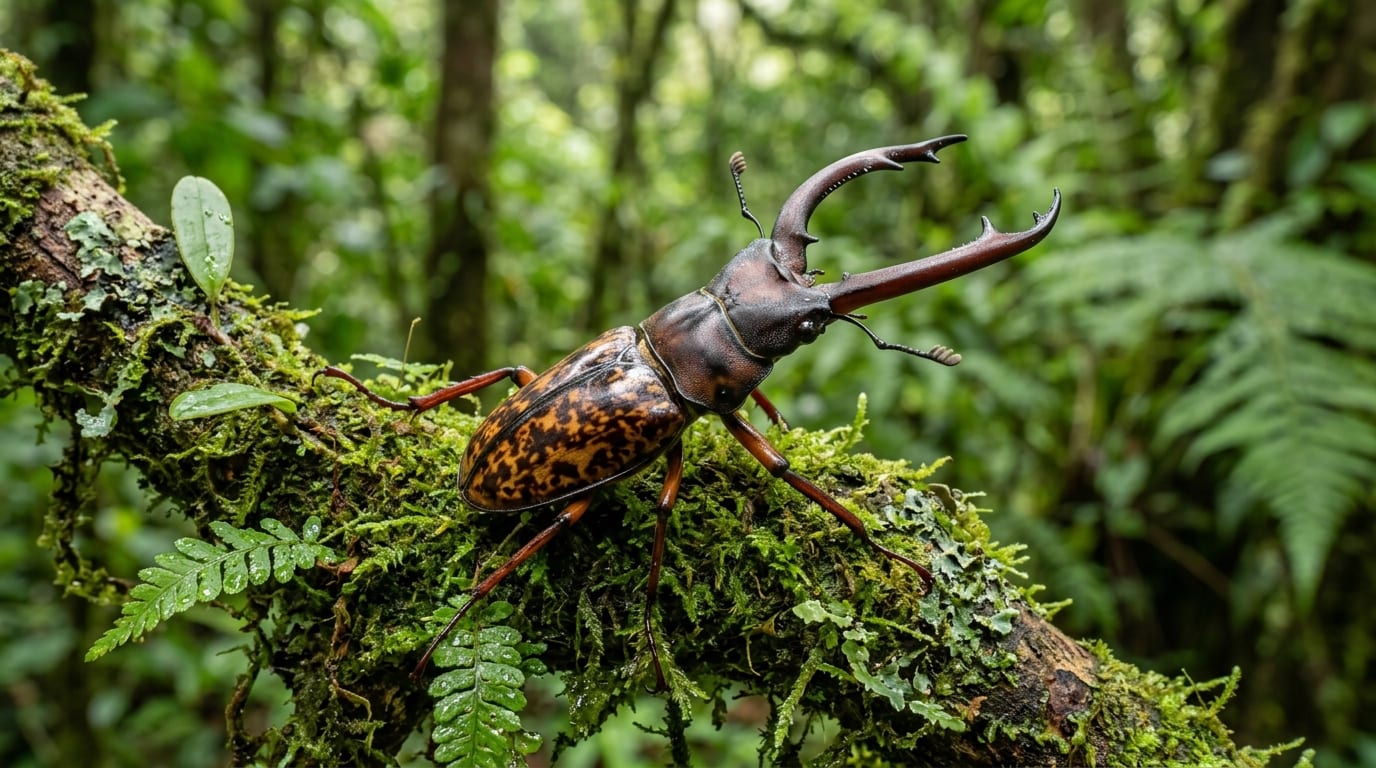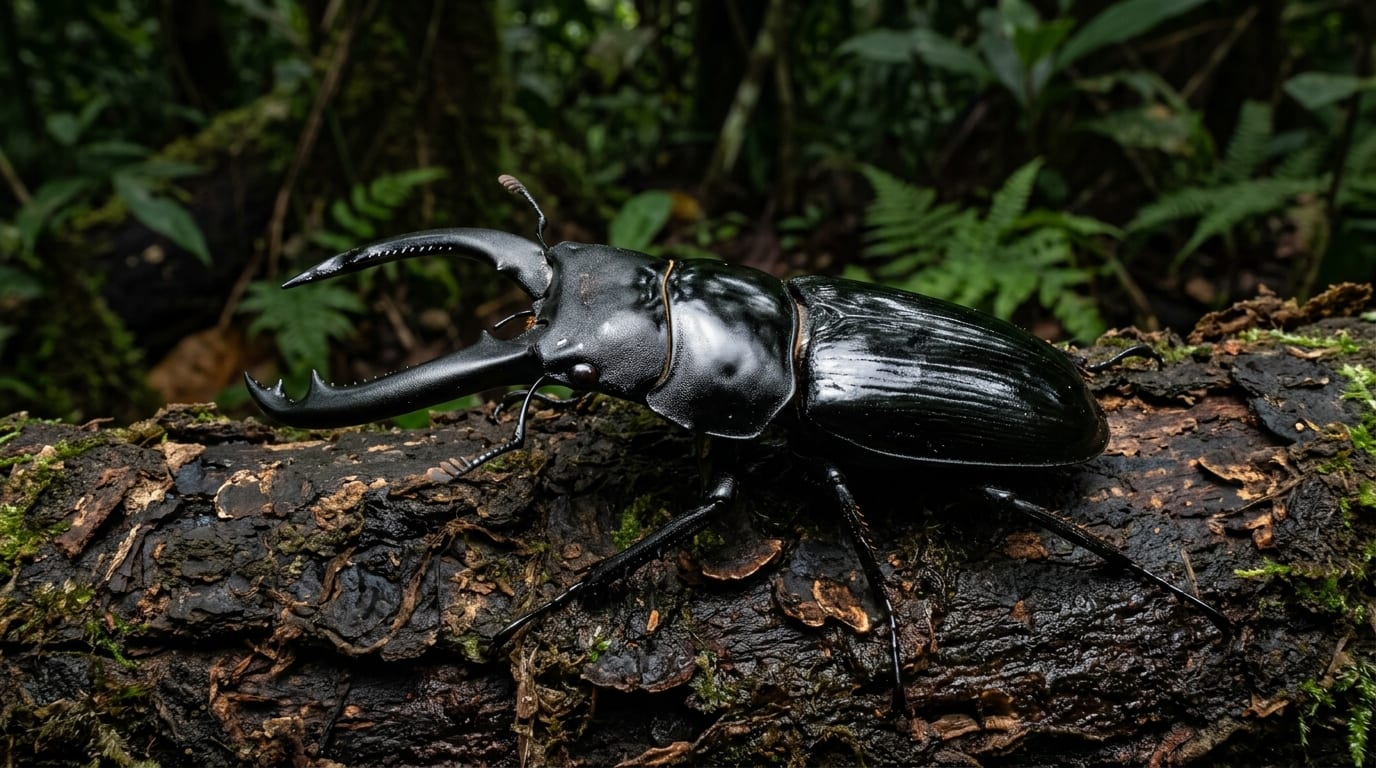
AI-generated image
Regius Giant Shining Stag Beetle
IntermediateMesotopus regius
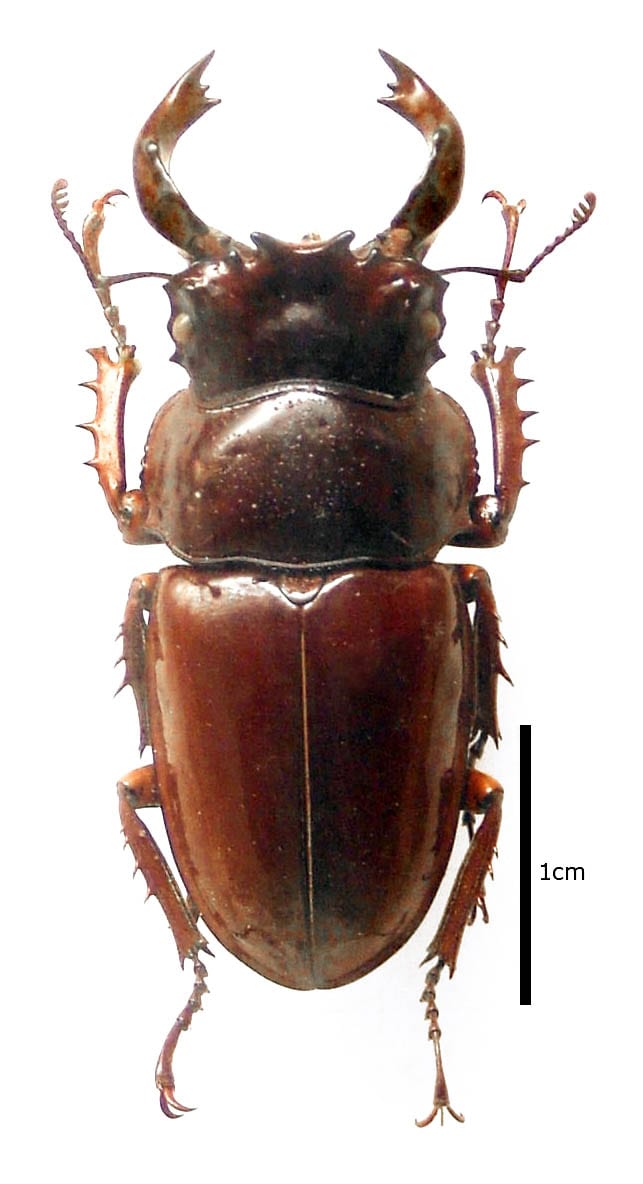
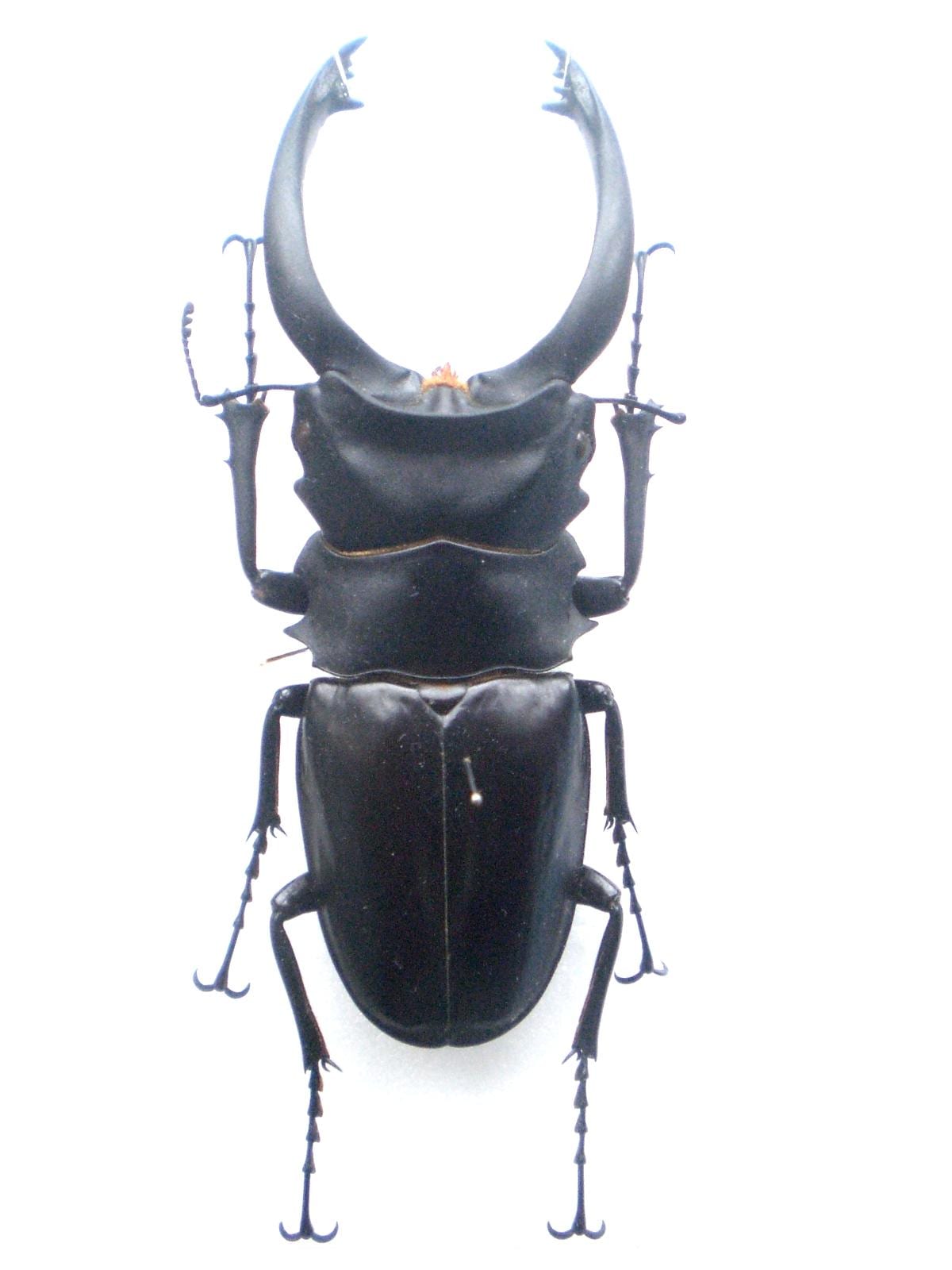
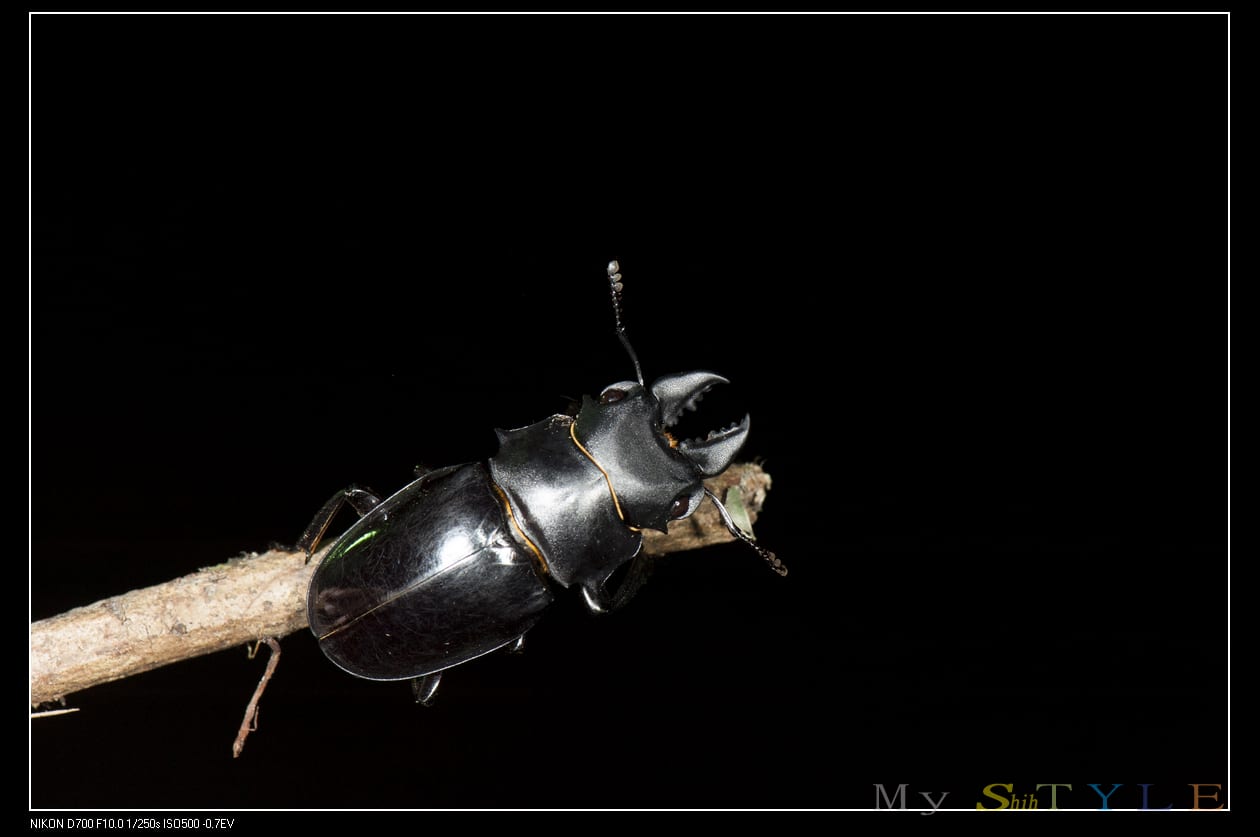
The other member of Mesotopus, a little smaller and slimmer than M. tarandus. Its mandibles curve more gently and appear to run further forward, giving it a cleaner outline.
Difficulty
Intermediate
Temperature
20〜28℃
Lifespan
A few months as an adult
Size
Captive record 96.4mm, wild record 93.0mm
Humidity
60〜80%
Diet
Adults take tree sap and beetle jelly; larvae are reared in Coriolus mycelium bottles
About
Mesotopus regius is the second species placed in Mesotopus, though it is commonly folded into M. tarandus as a synonym or subspecies, leaving the genus with one species. Set beside tarandus it is a little smaller and slimmer, its mandibles curve more gently and appear to run further forward, and the head is less rugged, giving a cleaner outline; the clypeal structure is also less developed. The genus lives in the rainforests of central Africa and carries a strong gloss often likened to lacquer. The name and that sheen sometimes lead people to take it for an Odontolabis of Southeast Asia, but it belongs to a different lineage. Husbandry follows the pattern worked out for Allotopus: the female lays into Coriolus or Ganoderma logs and into Coriolus medium, and the larvae are reared in Coriolus mycelium bottles. The captive record of 96.4 mm exceeds the wild record of 93.0 mm.
Source: Wikipedia (CC BY-SA 4.0)
Size of the Regius Giant Shining Stag Beetle
The Regius Giant Shining Stag Beetle grows to Captive record 96.4mm, wild record 93.0mm.
Basic Info
Origin
West and Central Africa, including Cameroon
Lifespan
A few months as an adult
Size
Captive record 96.4mm, wild record 93.0mm
Temperature
20〜28℃
Humidity
Care Specifications
Breeding Records & Localities
Captive record (♂)
96.4 mm
Wild record (♂)
93 mm
Record source: BE-KUWA 2025 edition, captive records for imported stag beetles (regius: captive 96.4 mm, Weirong Chen, registered 2019; wild 93.0 mm; expected maximum 102 mm)
Notable localities
CameroonWest AfricaCentral Africa
Generation codes
- WD
- Wild-caught
- WF1
- Offspring of a wild-caught female
- F1〜
- Captive generations (same locality)
- CBF1
- Cross-locality captive-bred (reset)
Sources: BE-KUWA Certified Breeding Records (Mushi-sha, FY2025 edition PDF, JA) / Mesotopus tarandus - Wikipedia (JA; range, size, morphology, biology, relationship to regius, rearing on Coriolus mycelium)
References & Sources
Edited & verified by: BreederDirect editorial team
The taxonomic, regulatory, and husbandry data on this page are compiled and verified against the authoritative primary sources below.
Taxonomy & Authority
Accepted name: Mesotopus regius Möllenkamp, 1896
Synonyms: Mesotopus tarandus regius
Authority databases: GBIF
Nomenclature follows global taxonomic authority databases.
Regulations & Conservation Status
Not CITES-listed
Plant Protection Act: When importing live specimens of Scarabaeoidea (including rhinoceros beetles, stag beetles, flower beetles, etc.), a species identification certificate issued by the exporting country government agency or equivalent must be attached in accordance with the Invasive Species Act (import ports are limited to Narita, Chubu, Kansai, Fukuoka, and Kagoshima airports). This species itself is not a designated invasive species, and import is possible upon submission of the certificate.
Sources: Ministry of the Environment, Invasive Species Act: "Guidance for Those Importing Live Insects in Scarabaeoidea" / CITES Appendix (checklist.cites.org)
Regulations may change. Always verify the latest information with the relevant authorities.
Regius Giant Shining Stag Beetle Listings
Loading latest listingsFind listings for this species