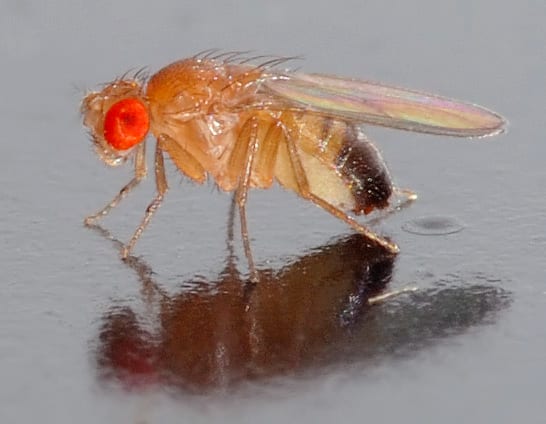
Source: Wikimedia Commons
Common fruit fly
BeginnerDrosophila melanogaster
A tiny 2-3mm fly with a yellowish body and red eyes. Flightless strains with underdeveloped wings are cultured in tubs as a micro live food for young mantis nymphs and small frogs.
Difficulty
Beginner
Temperature
20〜30℃
Lifespan
Adults about 2 months (laboratory conditions)
Size
2-3mm long
Humidity
60〜80%
Diet
Yeast (fermenting medium, ripe fruit)
About
Drosophila melanogaster Meigen, 1830 is a fly of the family Drosophilidae about 2-3mm long, with a yellowish body and red compound eyes. It is thought to originate in central Africa and has spread to warm regions worldwide; in Japan it is common around kitchens and stored food. In the wild it feeds on ripe fruit and sap and the yeasts growing on them. Its small size, short life cycle, high fecundity and simple diet made it a classic model organism, especially in genetics. Under laboratory conditions a generation takes about 10 days at 25C, adults live about two months and a female lays around 50 eggs a day. For feeding, flightless strains with a wing mutation are used, as is the larger Drosophila hydei. Adults are placed on a medium made from instant mashed potato and similar ingredients; kept at 20-30C, a new generation emerges roughly every two weeks at about 25C. In Japan ready-made cultures are sold at specialist shops for first-instar mantises and small frogs.
Source: Wikipedia (CC BY-SA 4.0)
Lifespan of the Common fruit fly
The Common fruit fly lives Adults about 2 months (laboratory conditions).
Size of the Common fruit fly
The Common fruit fly grows to 2-3mm long.
Temperature & humidity for the Common fruit fly
The ideal temperature for the Common fruit fly is 20〜30℃.
Basic Info
Origin
Originally central Africa; now warm regions worldwide
References & Sources
Edited & verified by: BreederDirect editorial team
The taxonomic, regulatory, and husbandry data on this page are compiled and verified against the authoritative primary sources below.
Taxonomy & Authority
Accepted name: Drosophila melanogaster Meigen, 1830
Synonyms: Drosophila aceti Heeger, 1851, Drosophila amelophaga Loew, 1862, Drosophila amelophila Loew, 1862, Drosophila ampelophaga Howard, 1900, Drosophila ampelophila Loew, 1862, Drosophila approximata Zetterstedt, 1847
Authority databases: GBIF · GBIF
Nomenclature follows global taxonomic authority databases.
Regulations & Conservation Status
Not CITES-listed
Not covered by CITES or the Invasive Alien Species Act. Although common in Japan, cultured flies and spent medium should be sealed and disposed of, never dumped outdoors.
Sources: Ministry of the Environment: List of invasive alien species (JA) / Species+ CITES query (no listing)
Regulations may change. Always verify the latest information with the relevant authorities.
Common fruit fly Listings
Loading latest listingsFind listings for this species