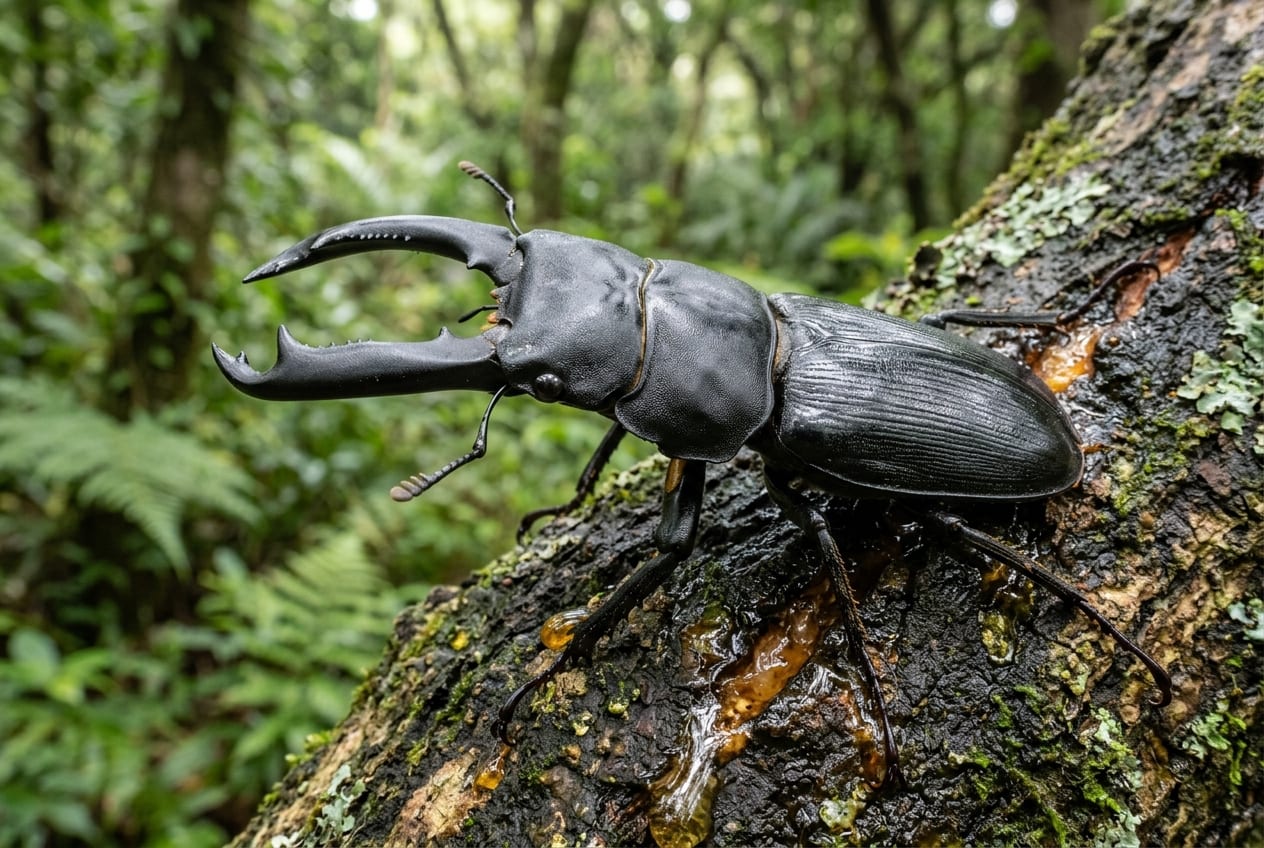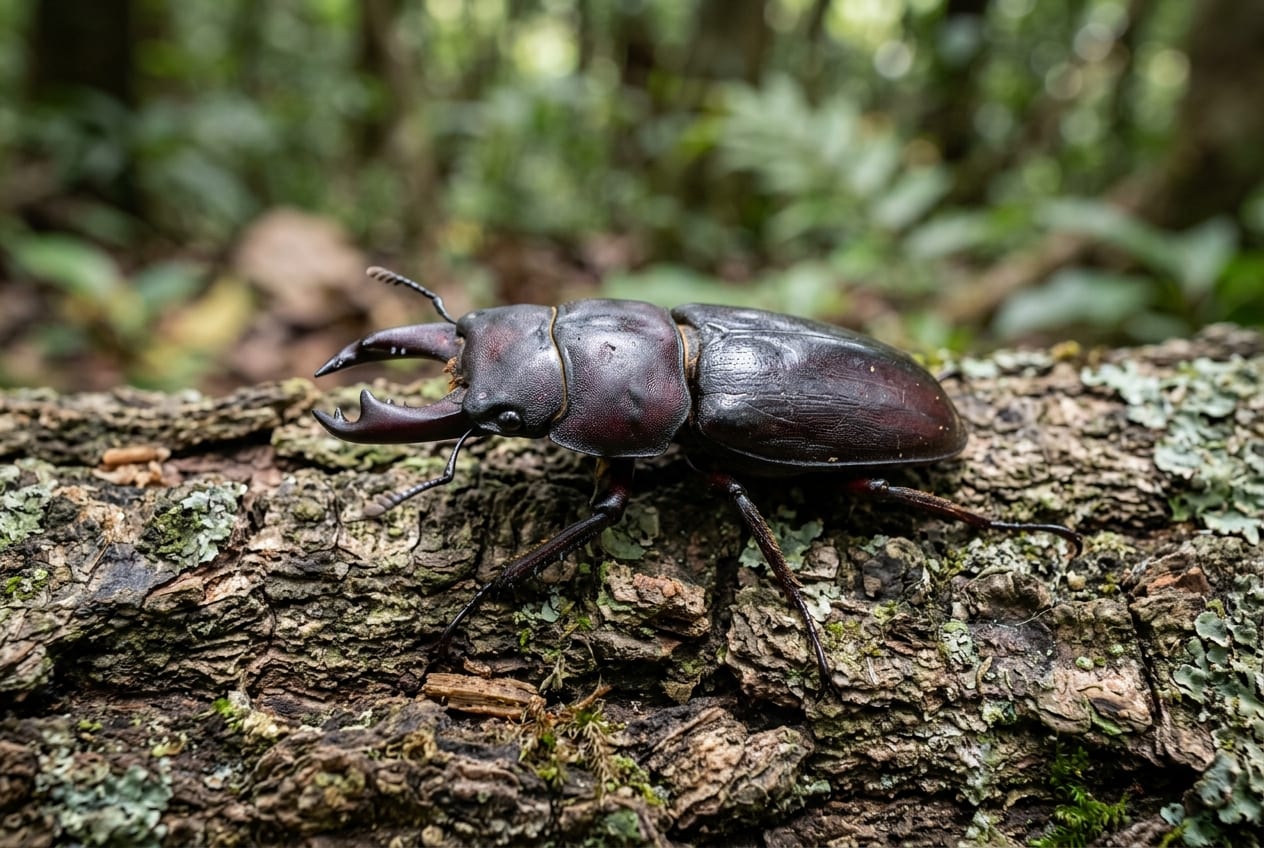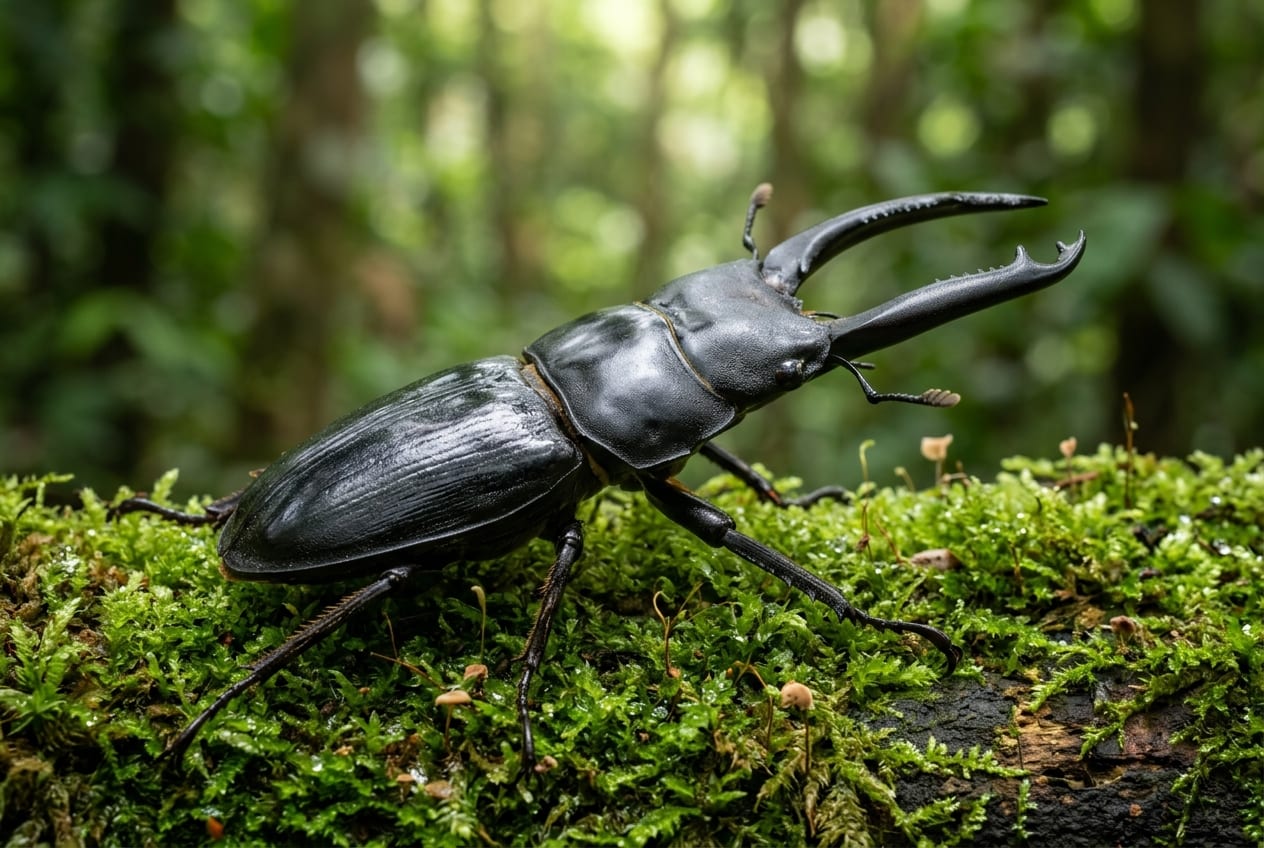
AI-generated image
Eurycephalus Flat Stag Beetle
IntermediateDorcus eurycephalus
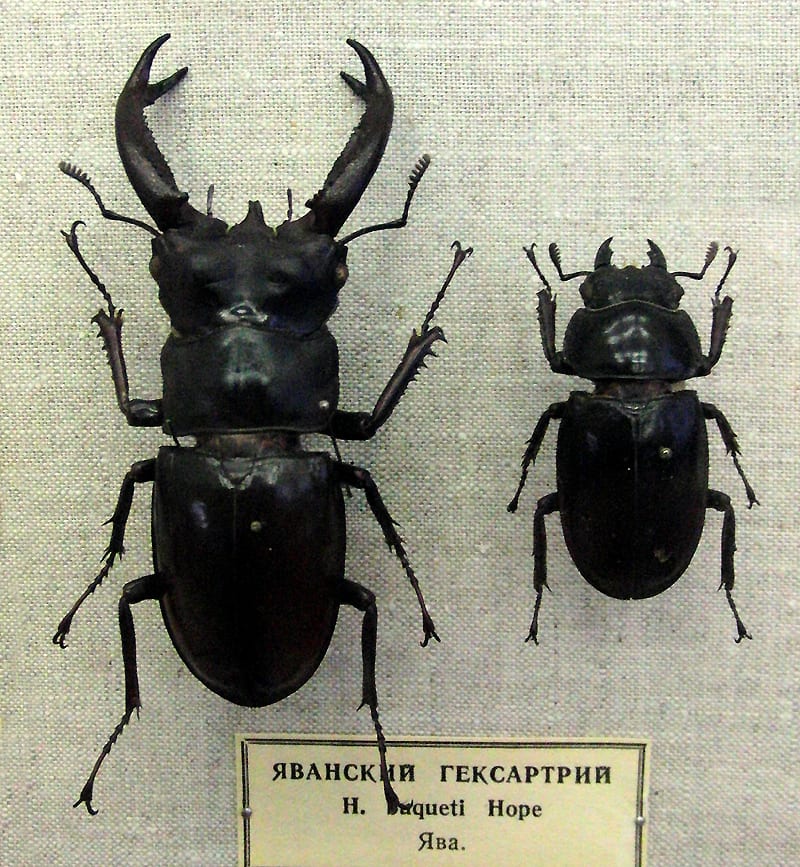
A stout, glossy flat stag endemic to Java, resembling Dorcus alcides. Wild long-mandibled males have slender arched mandibles, but captive stock tends to emerge short-mandibled and larvae grow slowly. Laying is easy but size is hard to achieve; a species for experienced keepers.
Difficulty
Intermediate
Temperature
18〜23℃
Lifespan
Adults 1-3 years
Size
Males up to 78.6mm (wild record), females 30-35mm in captive examples
Humidity
60〜80%
Diet
Beetle jelly (adults); kinshi bottles or fermented substrate (larvae)
About
The Eurycephalus flat stag beetle (Dorcus eurycephalus) is a mid-sized flat stag endemic to Java, Indonesia. With D. alcides of Sumatra and D. trachycus of Borneo it is one of the three stout flat stags, said to be even broader in proportion than alcides, with a rounded, highly polished body. Males are long- or short-mandibled; wild long-mandibled males have slender, gently arched mandibles with handsomely placed teeth. The wild record is 78.6mm and the BE-KUWA 2025 captive record 75.9mm (2013). Captive females run about 30-35mm. Laying follows ordinary flat-stag practice, and packed laying substrate or logs yield around 20 larvae. Larvae, however, grow slowly from first to third instar, one batch remaining second instar after nine months at 18C, and they wander readily on kinshi when the medium does not suit them. Captive stock tends to emerge short-mandibled, and producing long-mandibled males is difficult, so keepers call it a frustrating species. Keep at 18-23C, advancing early instars at around 23C.
Source: Wikipedia (CC BY-SA 4.0)
Lifespan of the Eurycephalus Flat Stag Beetle
The Eurycephalus Flat Stag Beetle lives Adults 1-3 years.
Size of the Eurycephalus Flat Stag Beetle
The Eurycephalus Flat Stag Beetle grows to Males up to 78.6mm (wild record), females 30-35mm in captive examples.
Temperature & humidity for the Eurycephalus Flat Stag Beetle
The ideal temperature for the Eurycephalus Flat Stag Beetle is 18〜23℃.
Basic Info
Origin
Java, Indonesia (West Java: Mt. Gede, Halimun etc.)
Care Specifications
Semi-aggressiveSolitaryBreeding: Moderate
Sources: Kuwagata Bibouroku: D. eurycephalus rearing log 2021 / p-bison: D. eurycephalus WF1 rearing log / Oshiromushi: D. eurycephalus WF1 rearing log / COLORS flat stag beetle catalogue
Breeding Records & Localities
Captive record (♂)
75.9 mm
Record source: BE-KUWA 2025 edition (Eurycephalus: captive 75.9mm, Kohei Abe, 2013; wild record 78.6mm)
Notable localities
Mt. Gede, West JavaHalimun, West Java
No subspecies. The BE-KUWA female record is 38.6mm (2012).
Generation codes
- WD
- Wild-caught
- WF1
- Offspring of a wild-caught female
- F1〜
- Captive generations (same locality)
- CBF1
- Cross-locality captive-bred (reset)
Sources: BE-KUWA certified breeding records (Mushi-sha, 2025 edition) / COLORS flat stag beetle catalogue
References & Sources
Edited & verified by: BreederDirect editorial team
The taxonomic, regulatory, and husbandry data on this page are compiled and verified against the authoritative primary sources below.
Primary sources
- Wikipedia
- Ministry of the Environment (Japan): Importing live Scarabaeoidea beetles
- CITES Appendices (species not listed)
- Kuwagata Bibouroku: D. eurycephalus rearing log 2021
- p-bison: D. eurycephalus WF1 rearing log
- Oshiromushi: D. eurycephalus WF1 rearing log
- COLORS flat stag beetle catalogue
- BE-KUWA certified breeding records (Mushi-sha, 2025 edition)
- GBIF
Taxonomy & Authority
Accepted name: Dorcus eurycephalus Burmeister, 1847
Synonyms: Serrognathus eurycephalus
Authority databases: GBIF
Nomenclature follows global taxonomic authority databases.
Regulations & Conservation Status
Not CITES-listed
Plant Protection Act: Live Scarabaeoidea beetles (rhinoceros, stag and flower beetles) may be imported into Japan only with a species-name certificate issued by the exporting government under the Invasive Alien Species Act, and only through Narita, Chubu, Kansai, Fukuoka or Kagoshima airports. This species is not a designated invasive alien species and can be imported with the certificate.
Sources: Ministry of the Environment (Japan): Importing live Scarabaeoidea beetles / CITES Appendices (species not listed)
Regulations may change. Always verify the latest information with the relevant authorities.
Eurycephalus Flat Stag Beetle Listings
Loading latest listingsFind listings for this species