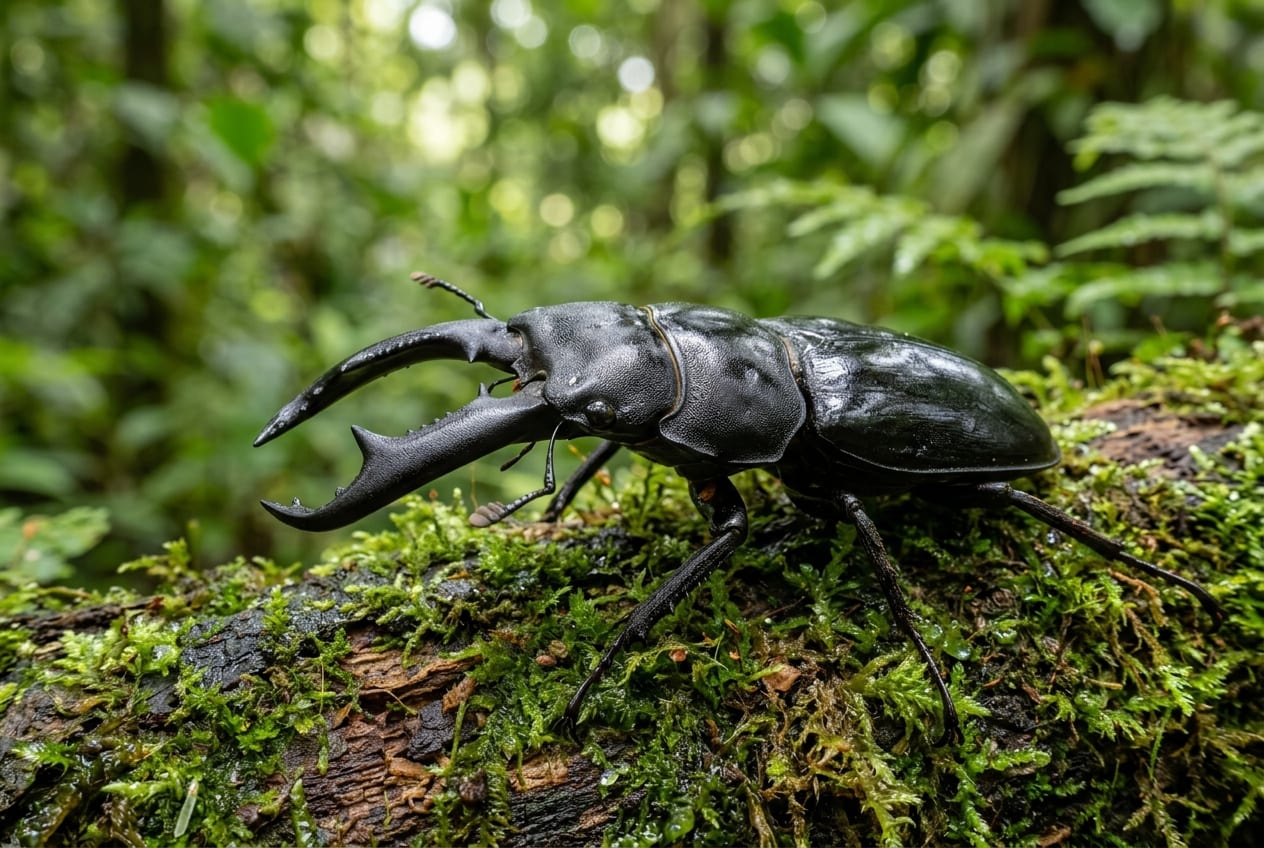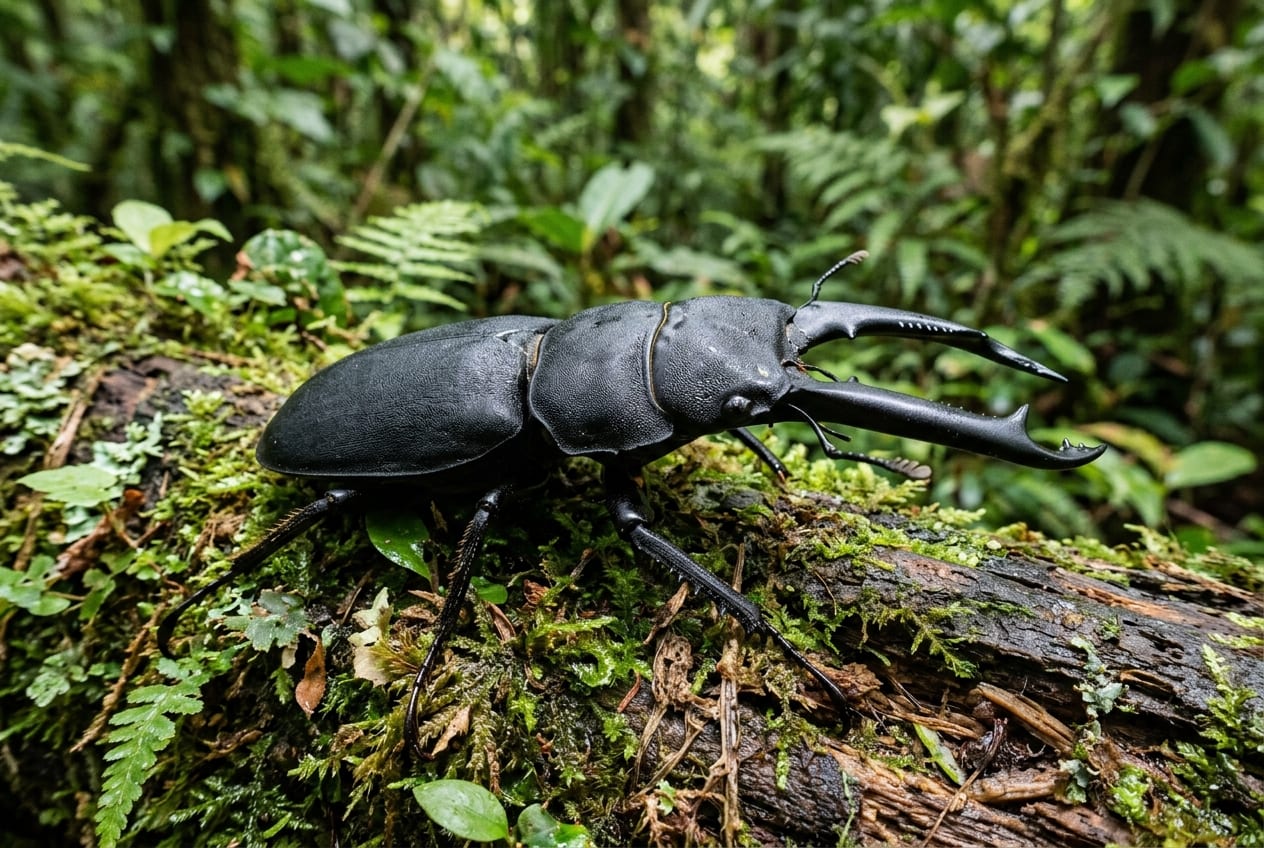
AI-generated image
Celebes Giant Flat Stag Beetle
IntermediateDorcus titanus typhon
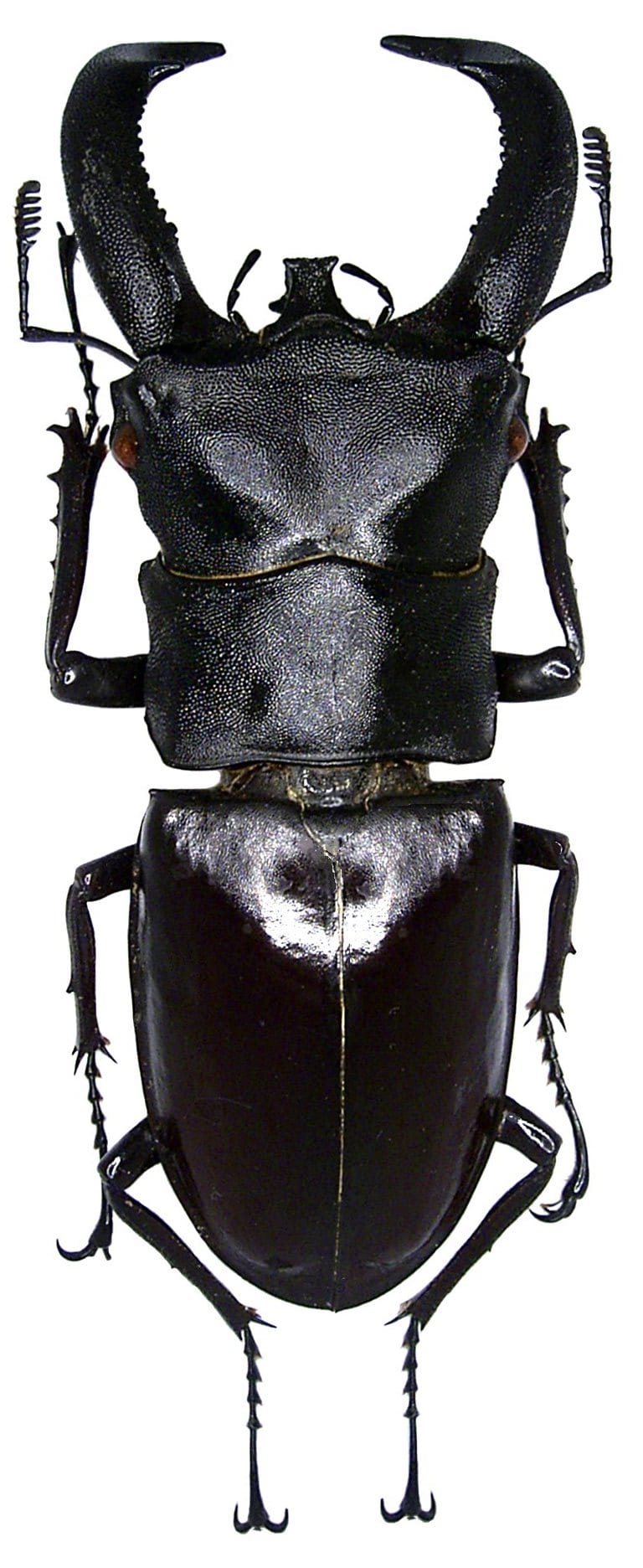
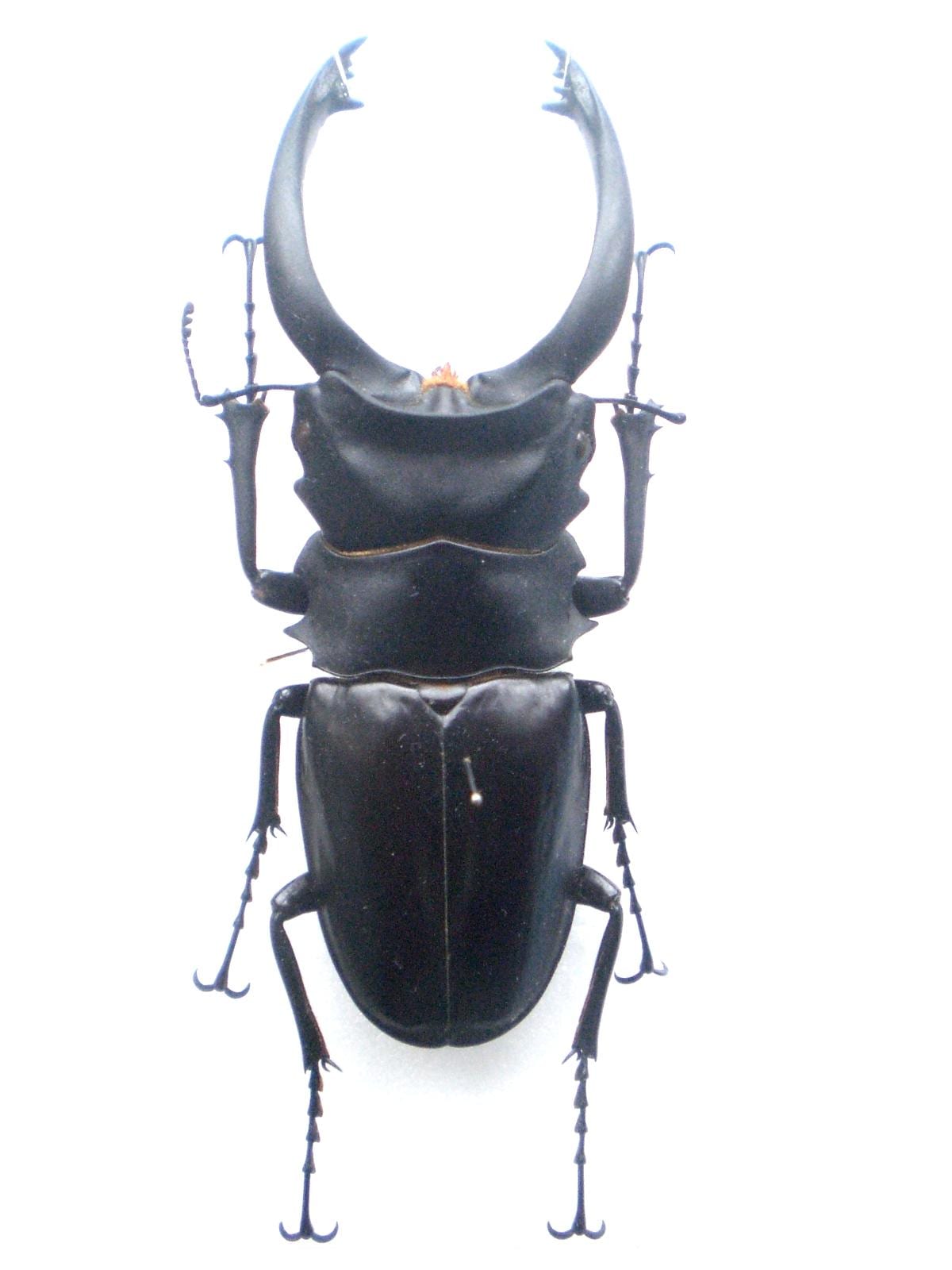
A subspecies of Dorcus titanus from Sulawesi and its neighbouring islands. Matt-surfaced with fairly long, slender mandibles, males exceed 106 mm, making it one of the largest and most aggressive flat stags.
Difficulty
Intermediate
Temperature
20〜26℃
Lifespan
Adults 1-3 years
Size
Males 60-106.4 mm / females 30-40 mm (captive record 107.3 mm)
Humidity
60〜80%
Diet
Tree sap, beetle jelly
About
The Celebes giant flat stag (Dorcus titanus typhon) is a subspecies of Dorcus titanus from northern and eastern Sulawesi, Buton and Kabaena in Indonesia; it is also called the Sulawesi flat stag. Males measure 60-106.4 mm and females 30-40 mm, placing it among the larger of the 25 subspecies. The surface is matt and the mandibles fairly long and slender. It closely resembles Philippine flat stags with a high inner tooth but can be separated by the shape of the clypeus. Historically, high-toothed individuals from Sulawesi, the Philippines and Sumatra were all placed under ssp. typhon, and the nominate subspecies also occurs in north-eastern Sulawesi. It is very aggressive with a powerful grip and males often kill females, so keep them singly and limit pairing to a short period.
Source: Wikipedia (CC BY-SA 4.0)
Lifespan of the Celebes Giant Flat Stag Beetle
The Celebes Giant Flat Stag Beetle lives Adults 1-3 years.
Size of the Celebes Giant Flat Stag Beetle
The Celebes Giant Flat Stag Beetle grows to Males 60-106.4 mm / females 30-40 mm (captive record 107.3 mm).
Temperature & humidity for the Celebes Giant Flat Stag Beetle
The ideal temperature for the Celebes Giant Flat Stag Beetle is 20〜26℃.
Basic Info
Origin
Indonesia (northern to eastern Sulawesi, Buton and Kabaena)
Lifespan
Adults 1-3 years
Care Specifications
AggressiveSolitary
Sources: Dorcus titanus - Wikipedia (JA; subspecies ranges, sizes and biology) / beetlebreeding.ch - The Breeding/Rearing of Dorcus titanus palawanicus by Kay (species-level guidance for D. titanus) / Mushinavi - Dorcus titanus (JA; egg-laying, larval rearing, list of foreign subspecies)
Breeding Records & Localities
Captive record (♂)
107.3 mm
Wild record (♂)
102 mm
Record source: BE-KUWA 2025 edition (Sulawesi flat stag, captive 107.3 mm, 藤井聖哲 2024 / wild 102.0 mm; projected maximum 113 mm)
Notable localities
Northern Sulawesi (Indonesia)Eastern Sulawesi (Indonesia)Buton (Indonesia)Kabaena (Indonesia)
Regional subspecies
- Dorcus titanus typhon — Northern to eastern Sulawesi, Buton and Kabaena; males 60-106.4 mm, females 30-40 mm, matt surface with fairly slender mandibles
- Dorcus titanus titanus — North-eastern Sulawesi, Peleng, Banggai and Taliabu; males 60-99.5 mm, females 30-52 mm; type locality Manado in northern Sulawesi
High-toothed individuals from Sulawesi, the Philippines and Sumatra were formerly all placed under ssp. typhon.
Generation codes
- WD
- Wild-caught
- WF1
- Offspring of a wild-caught female
- F1〜
References & Sources
Edited & verified by: BreederDirect editorial team
The taxonomic, regulatory, and husbandry data on this page are compiled and verified against the authoritative primary sources below.
Primary sources
- Wikipedia
- Ministry of the Environment, Invasive Species Act: "Guidance for Those Importing Live Insects in Scarabaeoidea"
- CITES Appendix (checklist.cites.org)
- beetlebreeding.ch - The Breeding/Rearing of Dorcus titanus palawanicus by Kay (species-level guidance for D. titanus)
- Mushinavi - Dorcus titanus (JA; egg-laying, larval rearing, list of foreign subspecies)
- BE-KUWA Certified Breeding Records (Mushi-sha, FY2025 edition PDF, JA)
- GBIF
Taxonomy & Authority
Accepted name: Dorcus titanus typhon (Boileau, 1905)
Synonyms: Serrognathus titanus typhon, Dorcus (Serrognathus) titanus typhon
Authority databases: GBIF
Nomenclature follows global taxonomic authority databases.
Regulations & Conservation Status
Not CITES-listed
Plant Protection Act: When importing live specimens of Scarabaeoidea (including rhinoceros beetles, stag beetles, flower beetles, etc.), a species identification certificate issued by the exporting country government agency or equivalent must be attached in accordance with the Invasive Species Act (import ports are limited to Narita, Chubu, Kansai, Fukuoka, and Kagoshima airports). This species itself is not a designated invasive species, and import is possible upon submission of the certificate.
Sources: Ministry of the Environment, Invasive Species Act: "Guidance for Those Importing Live Insects in Scarabaeoidea" / CITES Appendix (checklist.cites.org)
Regulations may change. Always verify the latest information with the relevant authorities.
Celebes Giant Flat Stag Beetle Listings
Loading latest listingsFind listings for this species