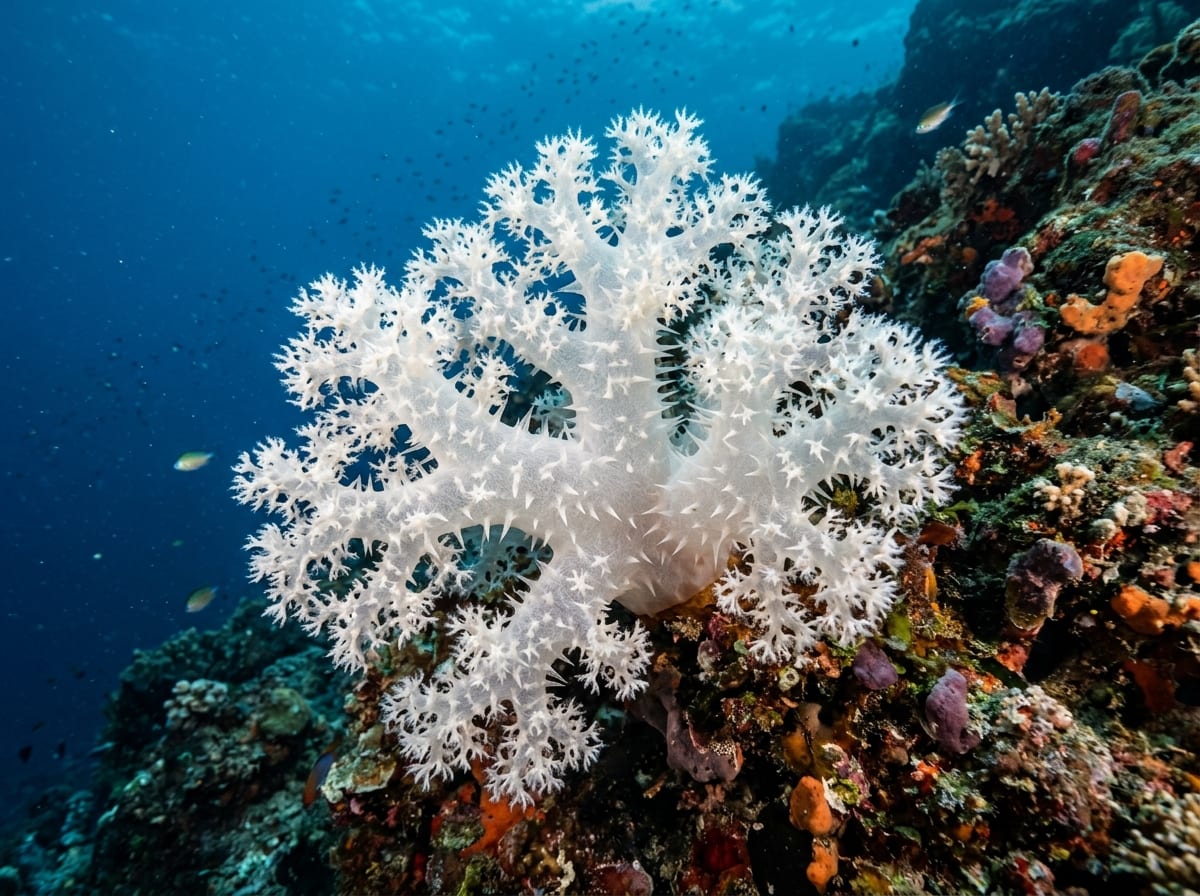
AI-generated image
Velvet Carnation Coral
AdvancedDendronephthya habereri
A Dendronephthya whose polyps are arranged in umbel-like clusters, forming rounded, cauliflower-like colonies. Sclerites protrude from the body wall, and most colonies are white. It has no zooxanthellae and must be fed.
Difficulty
Advanced
Temperature
24〜27℃
Lifespan
Little data available
Size
Colonies of about 40 cm recorded (Ito Diving Service)
Diet
Feeding only (plankton); no zooxanthellae
About
Dendronephthya habereri is a soft coral of the family Nephtheidae. Nearly 40 Dendronephthya species are known around Japan, and this one is characterised by polyps arranged like an umbel (Nipponica) and by sclerites protruding from the body wall, giving it a spiky look (Britannica Japan). Colonies look like cauliflower, with rounded polyp-bearing tips; most are white, and colonies of about 40 cm are recorded (Ito Diving Service). On the Izu Peninsula it is more common somewhat deeper, observed around 35 m. The related D. gigantea has red polyp-head sclerites with white supporting bundles. Reeflex describes it as an azooxanthellate food specialist that depends on plankton, recommending it only for advanced keepers with tanks of 500 L or more. Dendronephthya need an almost constant supply of fine food in aquaria and are notoriously difficult to keep (Wikipedia). In Japan, locally collected specimens appear in specialist shops from time to time.
Source: Wikipedia (CC BY-SA 4.0)
Size of the Velvet Carnation Coral
The Velvet Carnation Coral grows to Colonies of about 40 cm recorded (Ito Diving Service).
Basic Info
Origin
Japanese waters (Izu Peninsula and elsewhere); also recorded from Indonesia and the Red Sea
Lifespan
Little data available
Size
Colonies of about 40 cm recorded (Ito Diving Service)
Temperature
24〜27℃
Diet
Feeding only (plankton); no zooxanthellae
Care Guide
Lighting
It has no zooxanthellae and does not photosynthesise (Reeflex); subdued viewing light is enough.
Flow & Placement
In Izu it is commoner on somewhat deeper rock. Provide flow that sways the colony so food reaches the polyp clusters, and fix it to an overhang or rock.
Water Temperature & Quality
Reeflex gives 24-26°C, but in Japan it also lives in temperate waters such as Izu. Keep near the temperature of its origin and salinity at 33-35 ppt (SG 1.023-1.025).
Diet & Feeding
A plankton-dependent food specialist (Reeflex). Give liquid and fine particulate foods in small, frequent doses.
Health & Cautions
For advanced keepers only, with tanks of 500 L or more recommended (Reeflex). Heavy feeding fouls water, so provide strong filtration and water changes.
Soft coralDendronephthyaNon-photosyntheticJapanese waters
Velvet Carnation Coral FAQ
QHow difficult is it to keep Velvet Carnation Coral?
A
Advanced. This is an advanced-level species. It requires specialized equipment and advanced husbandry skills with precise environmental control.
QHow large does Velvet Carnation Coral get?
A
Velvet Carnation Coral typically reaches Colonies of about 40 cm recorded (Ito Diving Service) as an adult. Size may vary depending on care conditions and individual genetics.
QWhat should I feed Velvet Carnation Coral?
A
Velvet Carnation Coral feeds on: Feeding only (plankton); no zooxanthellae. Aim for a balanced diet with appropriate feeding frequency.
QWhat is the typical price for Velvet Carnation Coral?
A
The price of Velvet Carnation Coral varies significantly depending on variety, size, and individual quality. Check our market price page for the latest pricing information.
Last updated: September 23, 2026
Care Specifications
- Specific Gravity
- 1.023–1.025
- Salinity
- 33–35 ppt
- Min. Tank
- 500 L
Soft coralLight: Low (PAR 30-50)
Sources: Kotobank (Nipponica, Heibonsha World Encyclopedia): Dendronephthya / Reeflex (Dendronephthya habereri) / Ito Diving Service marine guide (Dendronephthya habereri) / Izuzuki marine life guide (Dendronephthya habereri) / Wikipedia (Dendronephthya)
References & Sources
Edited & verified by: BreederDirect editorial team
The taxonomic, regulatory, and husbandry data on this page are compiled and verified against the authoritative primary sources below.
Primary sources
- Wikipedia
- Species+ (CITES search)
- Ministry of the Environment: List of Designated Invasive Alien Species
- Okinawa Prefecture: Collection of reef-building corals is prohibited
- e-Gov: Natural Parks Act (Art. 22, marine park zones)
- Kotobank (Nipponica, Heibonsha World Encyclopedia): Dendronephthya
- Reeflex (Dendronephthya habereri)
- Ito Diving Service marine guide (Dendronephthya habereri)
- Izuzuki marine life guide (Dendronephthya habereri)
- WoRMS
- GBIF
Taxonomy & Authority
Regulations & Conservation Status
Not CITES-listed
Domestic law: Soft corals of this group are not included in the 'reef-building corals' whose collection Okinawa prohibits (stony corals, blue coral, sea fans and others). Collecting in the sea may still fall under fishing rights or prefectural fisheries rules, and taking designated species in marine park zones requires a permit (Natural Parks Act, Art. 22).
Not listed in the CITES Appendices (checked on Species+). Not designated as an Invasive Alien Species under Japanese law.
Sources: Species+ (CITES search) / Ministry of the Environment: List of Designated Invasive Alien Species / Okinawa Prefecture: Collection of reef-building corals is prohibited / e-Gov: Natural Parks Act (Art. 22, marine park zones)
Regulations may change. Always verify the latest information with the relevant authorities.
Related Species
Velvet Carnation Coral Listings
Loading latest listingsFind listings for this species
Related Articles
Coral Sweeper Tentacles and Aggression Guide | Placement Strategies to Prevent LPS and Soft Coral Territorial Wars
An explanation of physical territorial attacks by coral sweeper tentacles. Includes practical guidance on aggression rankings for LPS, Zoanthids, and soft corals, safe separation distance guidelines, layout design to prevent sweeper tentacle wars, and emergency treatment measures.
Coral Aging Colony Management Guide | Signs of Mature Colonies, Fragging Timing, and Maintenance Methods
Explaining signs of aging in coral colonies. This guide covers how to identify aging through growth stagnation, color fading, and base bleaching, the timing for fragging to promote rejuvenation, and practical strategies for managing the balance between colony size and tank space.
Complete Guide to pH and Carbonic Gas Management in Coral Aquariums | Causes of Daily Fluctuation and Practical Stabilization Methods
Comprehensive explanation of pH management in coral aquariums. Covers the mechanism of natural daily fluctuation, the impact of CO2 concentration on pH, practical methods for stabilizing pH through lighting, ventilation, and lime water addition, and detailed guidance on utilizing digital monitoring tools.
Complete Guide to Water Temperature Management in Coral Tanks | Optimal Temperature, Effects of Fluctuations, and Practical Stabilization Methods
A detailed guide to water temperature management in coral tanks. Covers optimal temperature ranges, how rapid temperature fluctuations damage corals, proper use of heaters and coolers, how to choose thermometers, and practical tips for stabilization including power outage precautions.