Complete Guide to pH and Carbonic Gas Management in Coral Aquariums | Causes of Daily Fluctuation and Practical Stabilization Methods
Comprehensive explanation of pH management in coral aquariums. Covers the mechanism of natural daily fluctuation, the impact of CO2 concentration on pH, practical methods for stabilizing pH through lighting, ventilation, and lime water addition, and detailed guidance on utilizing digital monitoring tools.
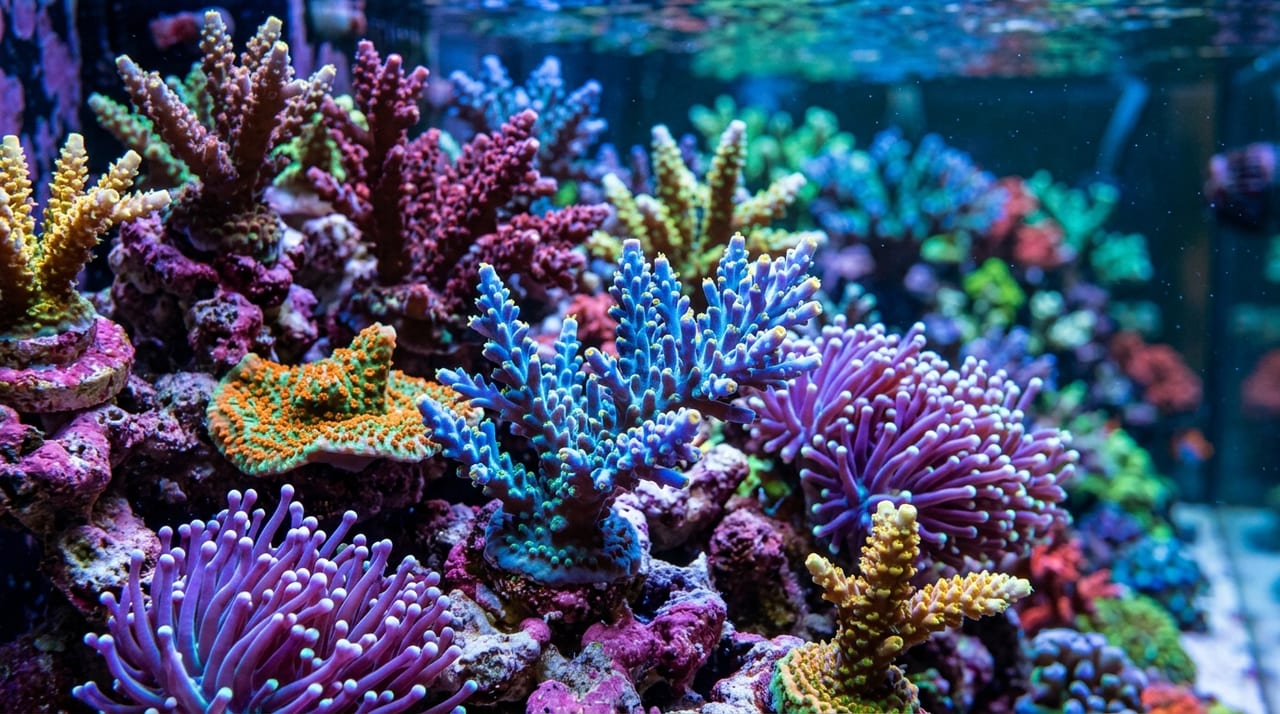
Key Takeaways
Comprehensive explanation of pH management in coral aquariums. Covers the mechanism of natural daily fluctuation, the impact of CO2 concentration on pH, practical methods for stabilizing pH through lighting, ventilation, and lime water addition, and detailed guidance on utilizing digital monitoring tools.
In coral husbandry, the most easily overlooked water quality parameter is pH "daily fluctuation". Even when alkalinity and calcium remain stable at their target values, if pH continues to decline at night, skeletal formation slows and long-term color and growth are negatively affected. This article systematically explains coral aquarium pH fundamentals, the mechanism behind daily fluctuation, its relationship with CO2, and stabilization methods that can be practiced at home.
Appropriate pH Range for Coral Aquariums and Skeletal Formation
The target pH for marine reef tanks is 8.1–8.4. Even in natural coral reefs, pH naturally rises to around 8.3–8.5 during the day and drops to around 8.0–8.2 at night, exhibiting natural daily fluctuation. Understanding this range, the critical point in captive aquariums is to maintain the minimum value at 8.0 or above.
When pH remains below 7.8, the ratio of carbonate ions decreases and aragonite saturation drops, making it harder for corals to add to their skeleton. When skeletal formation stops, not only does growth rate decline, but existing skeleton is also prone to subtle dissolution—a phenomenon called "skeletal erosion." Conversely, when pH exceeds 8.6, calcium carbonate becomes oversaturated and scale begins to deposit on pipes and pumps. Rather than chasing only the maximum pH value, stabilizing the minimum value is the key to long-term husbandry.
Mechanism Behind pH Daily Fluctuation
The primary cause of pH fluctuation in coral aquariums over a 24-hour period is the increase and decrease in CO2 (carbon dioxide) concentration in the water. When CO2 dissolves in water, it forms carbonic acid (H₂CO₃) and releases hydrogen ions, lowering pH. Conversely, when CO2 decreases, the carbonate equilibrium shifts toward the alkaline side and pH rises.
- During lighting (daytime): Corals, symbiotic algae, and coralline algae perform photosynthesis, consuming dissolved CO2 → pH rises
- After lights off (nighttime): Photosynthesis stops and respiration by corals, fish, and bacteria releases CO2 → pH drops
If the daily fluctuation range is around 0.3–0.5, it is within the natural range, but if it exceeds 0.8–1.0, poor ventilation or overcrowding of livestock is suspected. The larger the fluctuation range, the more easily pH stress accumulates in corals.
Indoor CO2 Concentration: An Easily Overlooked Factor
While outdoor CO2 concentration is approximately 400–420 ppm, in sealed indoor spaces it can reach 600–1,500 ppm. This tends to be especially high in rooms with many people or poorly ventilated bedrooms at night.
Protein skimmers and circulation fans agitate the water surface vigorously, equilibrating dissolved CO2 with indoor air CO2. When indoor CO2 concentration is high, the amount of CO2 dissolving into the tank increases, effectively lowering pH. Simply keeping ventilation openings constantly open or running ventilation fans periodically can improve pH by 0.1–0.2 in many cases. It is ideal to place a CO2 sensor in the room and manage it with a target of 600 ppm or below.
Five Practical Methods to Stabilize and Improve pH
pH stabilization involves widely varying costs and effort. Consider the following in order of priority.
1. Improving Indoor Ventilation
This is the lowest-cost measure with immediate results. Keep ventilation openings in the room where the aquarium is located constantly open to create an environment where CO2 does not accumulate. "Skimmer outside air intake," which extends the skimmer's fresh air inlet near a window, is also effective.
2. Lime Water (Calcium Hydroxide) ATO Addition
Lime water, made by dissolving calcium hydroxide, is a strong alkali with pH 12 or above. When used as replacement water in an automatic top-off (ATO) system, it simultaneously raises pH and alkalinity with each evaporation compensation. When set to drip slowly at night, it can effectively mitigate the pH drop after lights turn off.
3. Refugium Reverse Photoperiod Lighting
Set up a refugium (macroalgae section) in the sump and illuminate only the refugium during the period when the main tank lights are off. Macroalgae such as Chaetomorpha and Caulerpa absorb CO2 at night, easing the pH decline. Regularly thin algae before overgrowth to maintain stable absorption capacity.
4. CO2 Scrubber Installation
By inserting a CO2 scrubber (a device filled with absorbent material such as soda lime) into the air line to the skimmer or tank, high-concentration indoor CO2 is prevented from entering the water. It is particularly effective in environments where ventilation improvement is difficult, and continuous pH improvement of around 0.1–0.3 can be expected. The absorbent material requires periodic replacement, incurring running costs.
5. Enhanced Protein Skimmer Output
Skimmers promote gas exchange in the water through copious bubbles. Choosing a skimmer with adequate processing capacity increases CO2 off-gassing and contributes to raising the pH floor. Even simply adjusting an existing skimmer to near maximum output can produce noticeable improvement.
pH Monitoring and Calibration Practice
To understand the full picture of daily fluctuation, continuous logging rather than single-point measurement is essential.
| Measurement Method | Accuracy | Cost | Features |
|---|---|---|---|
| pH probe + reef controller | ±0.02–0.05 | High | 24-hour graphing; problem time periods easily identified |
| Digital pH meter (spot) | ±0.1 | Medium | Two daily readings capture daily fluctuation range |
| Liquid reagent test kit | ±0.1–0.2 | Low | Suitable for quick checks; continuous measurement not possible |
When using a probe, measurement values drift over time, so calibration 1–2 times per month is essential. Make 2-point calibration using standard solutions of pH 7.01 and pH 10.01 (or 4.01) a habit. Neglecting calibration introduces errors of 0.3–0.5, making it impossible to properly assess the effectiveness of interventions.
Building the habit of measuring at two points—just before lights turn on in the morning (lowest daytime value) and just before lights turn off (highest daytime value)—allows you to efficiently grasp the fluctuation range.
Calcium Reactor and pH Balance
In aquariums using a calcium reactor, low-pH effluent (around 6.4–6.8) from the reactor continuously flows into the sump. Because the reactor alone tends to chronically lower overall tank pH, a "hybrid approach" combining it with lime water ATO is widely adopted. Supplementing the alkaline side with lime water while supplying calcium and alkalinity through the reactor—this balance management yields particularly stable results in large reef tanks. Adjust the reactor flow rate gradually while monitoring the weekly minimum pH value.
Summary: pH Management Priorities and Essential Practice
The essence of pH management reduces to two points: maintaining the minimum nighttime value at 8.0 or above and keeping the daily fluctuation range within 0.5. It is realistic to consider the priority of initiatives as: ventilation improvement (low cost) → lime water ATO (medium cost) → refugium reverse photoperiod lighting (medium cost) → CO2 scrubber (high cost).
The starting point is to begin measuring morning and evening values with a pH probe or digital meter and understand your aquarium's daily fluctuation pattern. With data in hand, you can narrow down the problematic time periods and causes, then improve efficiently. pH stability is a foundational management parameter for all aspects of coral skeletal formation, coloration, and long-term health, and as with other parameters, best results come from the accumulation of continuous record-keeping and gradual fine-tuning.