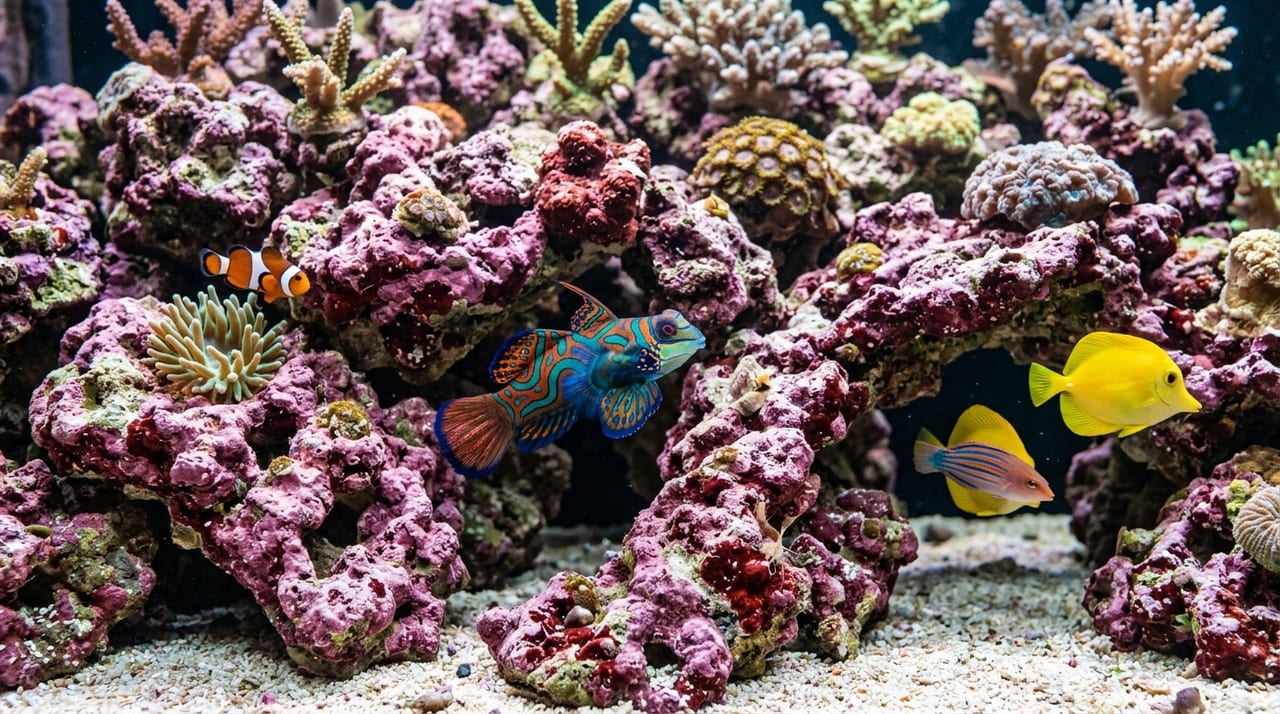
Marine tank automation: auto-dosing systems, water quality monitors, automatic water changes, and controller comparisons.
Key Takeaways
Marine tank automation: auto-dosing systems, water quality monitors, automatic water changes, and controller comparisons.
Maintaining a marine aquarium is said to require more effort than a freshwater setup, but recent advances in automation technology and IoT devices have made it possible to delegate many tasks to machines. Especially in coral keeping, where stable water parameters are critically important, automation becomes a powerful tool for maintaining a beautiful tank. This article provides a detailed guide to automation methods and equipment specifically for marine aquariums.
✍️
BreederDirect Editorial
The BreederDirect editorial team specializes in care information for animals, covering veterinary care and breeding to deliver beginner-friendly guides.
Find Marine Fish on BreederDirect
Buy directly from verified breeders
Browse Related Listings
Find Marine Fish listings related to this article on BreederDirect. Buy directly from verified breeders.
Related Tools
Related Articles
Browse by Category
🪸Coral
🐠Marine Fish
🐟Tropical Fish
🐡Goldfish
🐟Medaka
🦎Reptiles
Share
Auto-Dosing Basics
In coral keeping, maintaining calcium, KH (carbonate hardness), and magnesium is one of the most important daily management tasks. These elements are essential for coral skeletal growth, and dosing pumps allow precise, automatic daily replenishment.
How dosing pumps work: Peristaltic pumps precisely measure and deliver supplement solutions to the tank. Dosing small amounts multiple times per day prevents sudden water chemistry changes
Two-part dosing method: The basic method of dosing calcium and alkalinity solutions via separate pumps. The two solutions must be added at different times, as simultaneous addition causes precipitation
Three-part dosing method: Adds automatic magnesium dosing alongside calcium and alkalinity. Effective for SPS (Acropora, etc.) tanks with high magnesium consumption
Popular products: GHL Doser 2.1, Kamoer X1 Pro, Jebao DP-4, etc. Choose based on the number of channels (how many solutions can be dosed simultaneously) and precision
Determining dosing amounts: First, manually measure one week's consumption, then divide by 7 for the daily amount. Continue weekly water testing after implementation for fine-tuning
Dosing pump tubing requires regular cleaning and replacement. Crystallized supplement solution can clog tubes, so check tubing condition monthly.
Water Quality Monitoring Systems
For marine tanks, continuous monitoring of pH, specific gravity (salinity), ORP (oxidation-reduction potential), and temperature is ideal. This provides the foundation for early detection and rapid response to issues.
pH monitor: Ideal marine tank pH is 8.0–8.3. pH fluctuates due to CO2 buildup and supplement effects. Continuous measurement reveals trends, enabling early detection of problems
Specific gravity (salinity) monitor: Target value is 1.023–1.026. Can detect salinity increases from evaporation and can be linked to auto top-off systems
ORP monitor: Measures water oxidation-reduction potential, quantifying water "cleanliness." 300–450 mV is the healthy range. A sudden drop signals declining water quality
Temperature monitor: Wi-Fi-enabled temperature sensors allow real-time monitoring from anywhere. Setting alert notifications when the 24–26°C range is exceeded is critical
Integrated controllers: GHL ProfiLux, Neptune Apex, Hydros, and other integrated controllers manage multiple sensors centrally, with smartphone app access for data viewing and management
Probe-type sensors require regular calibration. Calibrate pH probes monthly and ORP probes every 2–3 months using calibration solutions. Neglecting calibration leads to inaccurate readings and incorrect management decisions.
Automatic Water Change Systems
Water changes are the most labor-intensive task in marine tank maintenance. Building an automatic water change system dramatically reduces this burden.
Basic mechanism: A drain pump removes old saltwater while new saltwater is simultaneously supplied. Daily small-volume changes via timer minimize water quality fluctuations
Automatic saltwater generation: An RO/DI purifier produces pure water, which is mixed with synthetic salt in a mixing station. Linking with a specific gravity sensor enables automatic production of properly concentrated saltwater
Drip-style water changes: Slowly supplying new saltwater drip-style while draining via overflow. Setting the daily change volume at 1–2% of total water volume creates virtually zero stress for livestock
Auto Top-Off (ATO) system: Detects water level drops from evaporation and automatically replenishes with pure (RO) water. Uses float switches or optical sensors for level detection. Nearly essential equipment for marine tanks
Safety mechanisms are critical: Always include safety devices in automatic water change systems. Redundant water level sensors, maximum pump run time limits, and overflow prevention float valves protect against equipment failure flooding
Building an automatic water change system requires some DIY skills, but off-the-shelf ATO systems (Tunze Osmolator, Smart ATO Micro, etc.) are easy to install and beginner-friendly.
Controller Comparison and Selection Guide
The core of marine tank automation is the aquarium controller. Compare features from different manufacturers and choose the best fit for your setup.
GHL ProfiLux: German-made precision controller. Extremely expandable, supporting numerous sensors and actuators. Highly programmable but requires some technical knowledge to configure
Neptune Apex: The most widely used controller in America. Intuitive web interface and smartphone app for easy operation. Active community with abundant information
Hydros: A relatively new manufacturer with a modular system that allows incremental feature additions. Excellent cost-performance ratio and beginner-friendly
Selection criteria: Consider tank size, coral species being kept, budget, and future expandability. Fish-only tanks need only temperature management and timer functions. SPS coral tanks require high-precision monitoring and dosing control
DIY options: Self-built controllers using Raspberry Pi or Arduino are also possible. With programming knowledge, you can build a system fully customized to your needs
The most important factor in choosing a controller is troubleshooting support. Since overseas products dominate, verify the availability of Japanese-language information and support beforehand.
Automated Lighting Control and Scheduling
Marine tank lighting affects not just fish behavior rhythms but also coral photosynthesis. Automated control recreates more natural light environments.
Sunrise/sunset programming: Use LED dimming to gradually brighten in the morning and dim in the evening. Sudden on/off causes stress to fish and corals
Moonlight mode: A faint blue light at night is useful for observing nocturnal creatures. It also allows enjoyment of coral fluorescence in darkness
Cloud simulation: Some advanced lights randomly vary intensity to simulate overcast skies. Mimicking natural light conditions is said to benefit coral health
Gradual light adjustment: When introducing new corals, start at low light levels and gradually increase over 2–4 weeks. This acclimation process can also be programmed
Seasonal variation: Replicating seasonal changes by setting longer lighting hours in summer and shorter in winter is also possible
Automation Implementation Roadmap
You don't need to implement everything at once. A phased approach lets you understand each piece of equipment and build the system safely.
Step 1 (Beginner): Install a lighting timer and ATO system. This alone significantly reduces daily effort and improves water quality stability
Step 3 (Advanced): Introduce an integrated controller and various sensors. Enables continuous water quality monitoring, alert notifications, and coordinated equipment control
Step 4 (Expert): Build automatic water change and saltwater generation systems. At this level, daily maintenance becomes mainly observation and feeding
Find the Perfect Marine Fish for Your Automated Setup on BriChoku
With stable water quality achieved through automation, you can take on more delicate marine fish and corals. On BriChoku, you can purchase healthy, beautiful marine fish directly from trusted breeders. Sharing details of your automated setup with breeders lets you get direct advice on the best species and additional tips for your environment. Find marine fish worthy of your optimized setup on BriChoku.