Equipment List for Saltwater Fish Keeping
Complete guide to equipment needed to start keeping saltwater fish. Explains tips for choosing equipment without mistakes for beginners, including aquariums, filters, lighting, and circulation pumps.
Key Takeaways
Complete guide to equipment needed to start keeping saltwater fish. Explains tips for choosing equipment without mistakes for beginners, including aquariums, filters, lighting, and circulation pumps.
Keeping saltwater fish may seem "difficult" or "expensive," but with proper knowledge and appropriate equipment, beginners can enjoy it sufficiently. The major difference from freshwater fish is the need to artificially maintain the special marine environment. This requires specialized equipment, but by understanding priorities and assembling accordingly, you can build a stable aquatic environment while keeping costs down.
In this article, we will explain in detail the equipment needed for saltwater fish keeping, dividing it into "essential" and "convenient to have." If you're thinking about starting saltwater fish keeping, please refer to this guide.
Essential Equipment ① | Aquariums and Filtration Systems
Choosing the Right Tank Size
Tank size is extremely important in saltwater fish keeping. The larger the volume of water, the more gradual the changes in water quality, lowering the difficulty of keeping fish. For beginners, a 60cm standard aquarium (approximately 60 liters) is the most balanced option and is recommended because it also keeps costs down.
Tanks 30cm or smaller tend to have unstable water quality and are considered for advanced keepers. Conversely, large tanks 90cm or larger offer high stability but come with higher maintenance costs. The standard approach is to start with a 60cm tank.
Choosing a Filtration System
There are three main types of filtration systems.
- Hang-on filters: Easy to install and inexpensive. Intended for small tanks, but often play only a supplementary role in saltwater keeping
- Canister filters: High filtration power and excellent quiet operation. Suitable for 60–90cm tanks
- Overflow systems: Offer the highest filtration capacity. The sump (filter tank) is separate from the main display tank, making maintenance easier. Costly, but the ideal choice for serious long-term keeping
Choose based on your budget and scale of keeping. If you're thinking of keeping corals along with fish, we recommend considering an overflow system from the start.
Essential Equipment ② | Protein Skimmers, Circulation Pumps, and Temperature Control
Protein Skimmers
The presence of the protein skimmer is the biggest difference between saltwater and freshwater keeping. It is an apparatus that physically removes dissolved proteins and organic matter from the water using the power of fine bubbles, and is essential for maintaining water quality.
Skimmer selection should be based on tank size and the number of fish. Refer to the specifications listed as "compatible water volume" and choose a size with some margin for peace of mind. Since they come in various forms—hang-on, sump-mounted, submersible—choose one that matches your tank setup.
Circulation Pumps
In the natural marine environment, there is always wave action and current. Circulation pumps are used to recreate this environment in the aquarium. Without water flow, oxygen supply becomes insufficient and waste tends to accumulate in certain areas, so installation is essential.
A product with a random flow mode is recommended. If water flows continuously in one direction, fish and corals become exhausted, so a model where flow direction and strength change irregularly is better suited to saltwater keeping.
Heaters and Coolers
The ideal water temperature for saltwater fish varies by species, but 24–26°C is the general guideline. Use a heater in winter and a cooler or chiller fan in summer for temperature control.
- Heaters: Built-in thermostat models are easier to manage. Choose wattage appropriate for tank size
- Aquarium coolers: Essential for managing high summer temperatures. Chiller fans are inexpensive but have the drawback of increased evaporation
- Thermometers: Digital models are easy to read and highly accurate
Essential Equipment ③ | Lighting
For Saltwater Fish Only
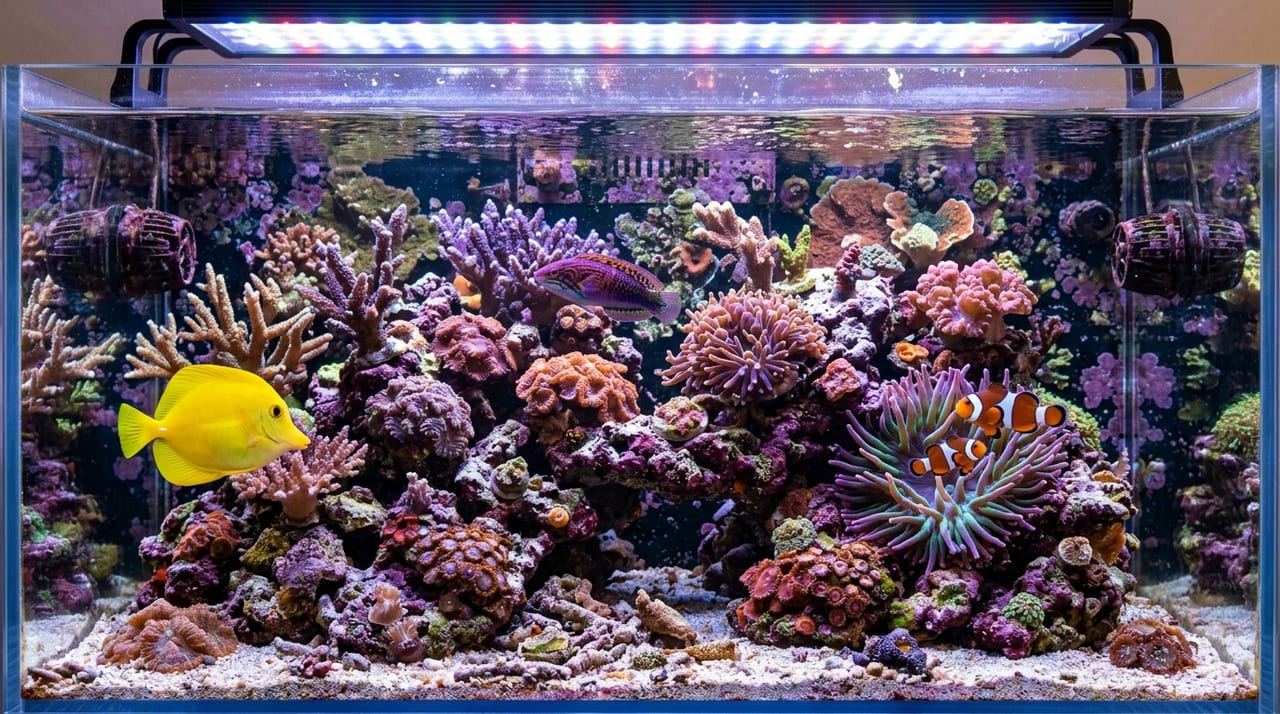
To enjoy the colors of ornamental fish, lighting combining white and blue LEDs is optimal. Saltwater fish display vibrant colors under blue light, so choosing a marine-specific LED will result in a beautiful appearance.
When Keeping Corals as Well
Corals harbor symbiotic zooxanthellae that perform photosynthesis and require strong light containing specific wavelengths. Full-spectrum marine-grade high-power LEDs become essential.
In recent years, more products allow fine-tuning of light intensity, color temperature, and photoperiod via smartphone apps, making it easier to create optimal lighting for different coral species and conditions. If your budget permits, we recommend selecting a high-performance light from the start in anticipation of future coral keeping.
Convenient Equipment to Have
Hydrometers (Refractometers)
This device measures the salinity of seawater. The appropriate specific gravity for saltwater fish and corals is 1.023–1.025. Deviations from this range can lead to illness or death.
The most accurate is a digital refractometer, which displays readings instantly with just a few drops of seawater. Inexpensive floating hydrometers can be used as a substitute, but they are less accurate and require regular calibration.
Water Quality Test Kits
Especially during the early stages of tank setup (before bacteria establish), ammonia and nitrite tend to spike rapidly, so regular testing is important. The items to monitor are as follows:
- Ammonia (NH₃) and nitrite (NO₂): Directly toxic to fish. Especially critical during startup
- Nitrate (NO₃): Manage through regular water changes
- pH: Ideal range is 8.1–8.3
- KH (carbonate hardness): Especially important when keeping corals
Artificial Seawater Mix and RO/DI Water Purifiers
Artificial seawater mix, which is dissolved in tap water to create seawater, is a consumable with significant quality variations. Choose reliable brands like Red Sea or Instant Ocean.
If you want even better water quality, consider installing an RO/DI water purifier to remove impurities from tap water. It removes chlorine, heavy metals, phosphates, and more, significantly improving the quality of your seawater.
Auto Top-off (ATO)
When seawater evaporates, the salt remains, causing salinity to increase. An ATO automatically replenishes fresh water to maintain constant specific gravity. It eliminates the daily manual top-off routine, greatly simplifying management.
Budget Guidelines and Getting Started
Here is a budget guide for equipment needed to start keeping saltwater fish in a 60cm tank.
| Setup | Estimated Cost |
|---|---|
| Hang-on/Canister filter setup (Entry level) | ¥50,000–¥80,000 |
| Canister filter + Skimmer (Standard) | ¥80,000–¥150,000 |
| Overflow tank (Advanced) | ¥150,000+ |
While the initial investment is not insignificant, saltwater fish keeping can be enjoyed for long periods once the environment stabilizes. The key to sustained success is gradually upgrading equipment without rushing.
BreederDirect's Reliable and Safe System
BreederDirect is a platform where you can purchase aquatic livestock directly from experienced breeders. A major feature is the ability to consult directly with breeders about questions such as "What equipment do I need?" and "How should I set up the aquatic environment?" before purchasing saltwater fish.
Even detailed questions that might be difficult to ask at a shop can receive accurate answers from breeders with hands-on experience in keeping and breeding fish. Those starting saltwater fish keeping for the first time can find peace of mind by connecting with trustworthy breeders through BreederDirect. Since you can freely ask breeders about acclimation methods and equipment setup, even beginners can establish their aquatic environment without confusion.
When unsure about equipment selection, we encourage you to consult with our breeders on BreederDirect.