Source: Wikimedia Commons
Senegal Bushbaby
AdvancedGalago senegalensis
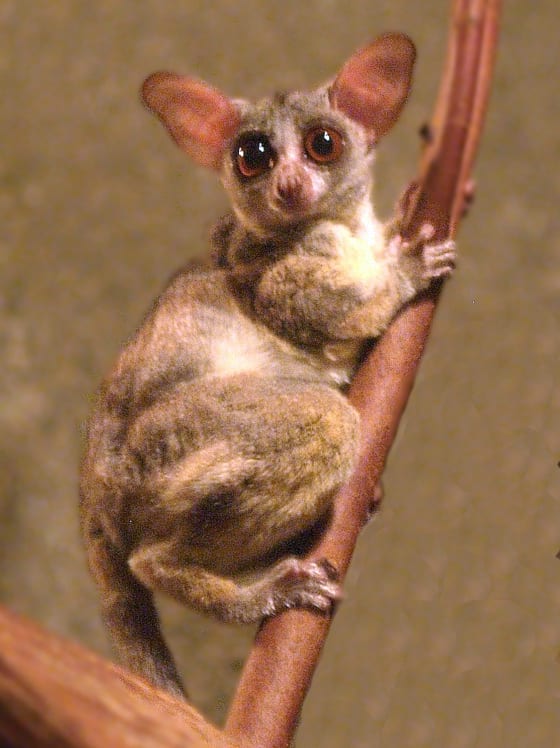
A small African prosimian with huge eyes and long hind legs that leaps 3-5 m through the night canopy and scent-marks with urine. A CITES II primate; only domestically bred animals circulate in Japan.
Difficulty
Advanced
Temperature
18〜26℃
Lifespan
About 10 years in captivity
Size
About 13cm body / 95-300g
Humidity
40〜60%
Diet
Insects, fruit, tree gum (acacia gum), small animals, prosimian diet
About
The Senegal bushbaby (Galago senegalensis) is a small nocturnal prosimian of sub-Saharan Africa and nearby islands such as Zanzibar, preferring dry woodland and savannah. It has thick woolly fur from silvery grey to dark brown, large eyes adapted to night vision, and an elongated tarsus with powerful hind-limb muscles that let it leap 3-5 m and hop like a kangaroo on the ground. Omnivorous, it favours grasshoppers and also eats small birds, eggs, fruit, seeds, flowers and tree gum, surviving on gum alone in drought. By day several sleep together in leaf nests or tree hollows; by night they forage alone. Females share territories with offspring while males hold ranges overlapping several females. They communicate by calls and by wetting hands and feet with urine to scent their routes. As a primate it is listed in CITES Appendix II, and because Japan has prohibited importing pet monkeys since 1 July 2005, only domestically bred animals are available. IUCN Least Concern.
Source: Wikipedia (CC BY-SA 4.0)
Lifespan of the Senegal Bushbaby
The Senegal Bushbaby lives About 10 years in captivity.
Wild lifespan is around 3-4 years, about 10 in captivity.
Size of the Senegal Bushbaby
The Senegal Bushbaby grows to About 13cm body / 95-300g.
Body length is about 13 cm, weight 95-300 g, with a long balancing tail.
Basic Info
Origin
Sub-Saharan Africa (dry woodland and savannah)
Lifespan
About 10 years in captivity
Care Specifications
References & Sources
Edited & verified by: BreederDirect editorial team
The taxonomic, regulatory, and husbandry data on this page are compiled and verified against the authoritative primary sources below.
Primary sources
- Wikipedia
- CITES Appendix II (PRIMATES spp.)
- IUCN Red List Galago senegalensis (LC)
- Animal Quarantine Service: Importing monkeys (pet monkeys cannot be imported since 1 July 2005)
- Infectious Diseases Control Act Enforcement Order, Art. 13 (import-prohibited animals incl. monkeys)
- Ministry of the Environment Specified Animal List
- Animal Diversity Web Galago senegalensis
- GBIF
Taxonomy & Authority
Accepted name: Galago senegalensis É. Geoffroy Saint-Hilaire, 1796
Authority databases: GBIF
Nomenclature follows global taxonomic authority databases.
Regulations & Conservation Status
CITES Appendix IIIUCN LC · Least Concern
Domestic law: Galagos, as primates, are understood to fall under the import-prohibited animal 'monkeys' of Article 13 of the Infectious Diseases Control Act enforcement order; pet imports have been barred since 1 July 2005 (Animal Quarantine Service), so only domestically bred animals circulate. Confirm with the Animal Quarantine Service for a final ruling.
All primates are listed in CITES Appendix II except species in Appendix I. Not a Japanese specified (dangerous) animal.
Sources: CITES Appendix II (PRIMATES spp.) / IUCN Red List Galago senegalensis (LC) / Animal Quarantine Service: Importing monkeys (pet monkeys cannot be imported since 1 July 2005) / Infectious Diseases Control Act Enforcement Order, Art. 13 (import-prohibited animals incl. monkeys) / Ministry of the Environment Specified Animal List
Regulations may change. Always verify the latest information with the relevant authorities.
Senegal Bushbaby Listings
Loading latest listingsFind listings for this species