Source: Wikimedia Commons
Kenyan Sand Boa
BeginnerEryx colubrinus
A small boa living buried in sand. Gentle and space-efficient beginner snake.
Difficulty
Beginner
Temperature
25〜32℃
Lifespan
15-20 years
Size
40-70cm
Humidity
40〜70%
Diet
Mice
About
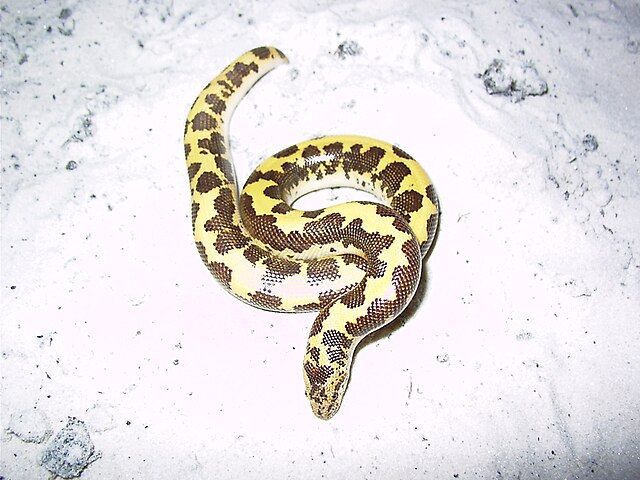
The Kenyan sand boa (Gongylophis colubrinus), also called the Egyptian sand boa, is a small, burrowing boa native to arid and semi-arid regions of East Africa, including Kenya, Tanzania, Egypt, Ethiopia, and Sudan. Adults typically reach 40–70 cm, with females considerably larger than males. The body is stout and cylindrical, and the blunt tail is used to anchor the snake while it bursts from the substrate to seize prey. Coloration is typically orange or yellow with brown saddle blotches. Kenyan sand boas are highly docile, rarely bite, and can be housed in compact enclosures with a deep sand substrate that allows burrowing. Their small size, gentle temperament, and ease of care make them one of the most recommended beginner snakes.
Lifespan of the Kenyan Sand Boa
The Kenyan Sand Boa lives 15-20 years.
Size of the Kenyan Sand Boa
The Kenyan Sand Boa grows to 40-70cm.
Temperature & humidity for the Kenyan Sand Boa
A hot spot of around 35°C and a cool side of 25°C are recommended.
Basic Info
Origin
East Africa (Kenya, Egypt, Ethiopia, Sudan and surrounding regions)
Lifespan
15-20 years
Size
40-70cm
Temperature
Morphs (Varieties)
Kenyan sand boas in the trade are primarily Albino, Anery, and Snow, which are recessive morphs. Line-bred individuals such as Stripe (codominant) and Nuclear (red-strong line) also circulate in the trade, but note that breeders vary in how they denote genetic inheritance modes.
RecessiveVisual only with two copies; one copy = het (carrier).
Albino (Amelanistic)AnerythristicSnowSplashHypomelanistic
Incomplete dominant1 copy visual; 2 copies (super form) more pronounced.
Stripe
Line-bredEstablished by selective line breeding.
Nuclear
Sources: Reptiles Magazine - Breeder's Choice (Kenyan Sand Boa) / A-Z Animals - Sand Boa Morphs (20+ Types)
A curated selection of notable morphs. Inheritance modes are a breeding-planning guide; actual appearance varies with combos.
References & Sources
Edited & verified by: BreederDirect editorial team
The taxonomic, regulatory, and husbandry data on this page are compiled and verified against the authoritative primary sources below.
Taxonomy & Authority
Accepted name: Eryx colubrinus (Linnaeus, 1758)
Synonyms: Anguis colubrina Linnaeus, 1758, Eryx loveridgei Stull, 1932, Eryx rufescens Ahl, 1933, Eryx thebaicus Reuss, 1834, Eryx thebaicus loveridgei Stull, 1932, Gongylophis colubrinus (Linnaeus, 1758)
Authority databases: GBIF · Reptile Database
Nomenclature follows global taxonomic authority databases.
Regulations & Conservation Status
CITES Appendix IIIUCN LC · Least Concern
Sources: CITES Checklist (Boidae spp. Appendix II; Gongylophis colubrinus) / IUCN Red List
Regulations may change. Always verify the latest information with the relevant authorities.
Kenyan Sand Boa Listings
Loading latest listingsFind listings for this species